



 Chat with AI
Exam 10: Externalities

Exam 1: Ten Lessons From Economics146 Questions
Exam 2: Thinking Like an Economist133 Questions
Exam 3: Interdependence and the Gains From Trade139 Questions
Exam 4: The Market Forces of Supply and Demand215 Questions
Exam 5: Elasticity and Its Application178 Questions
Exam 6: Supply, Demand and Government Policies145 Questions
Exam 7: Consumers, Producers and the Efficiency of Markets171 Questions
Exam 8: Application: the Costs of Taxation135 Questions
Exam 9: Application: International Trade151 Questions
Exam 10: Externalities199 Questions
Exam 11: Public Goods and Common Resources178 Questions
Exam 12: The Design of the Tax System154 Questions
Exam 13: The Costs of Production191 Questions
Exam 14: Firms in Competitive Markets198 Questions
Exam 15: Monopoly212 Questions
Exam 16: Monopolistic Competition212 Questions
Exam 17: Business Strategy and Oligopoly179 Questions
Exam 18: Competition Policy103 Questions
Exam 19: The Markets for the Factors of Production214 Questions
Exam 20: Earnings, Unions and Discrimination201 Questions
Exam 21: Income Inequity and Poverty111 Questions
Exam 22: The Theory of Consumer Choice158 Questions
Exam 23: Frontiers of Microeconomics111 Questions
Exam 24: Measuring a Nations Income51 Questions
Exam 25: Measuring the Cost of Living55 Questions
Exam 26: Production and Growth62 Questions
Exam 27: Saving, Investment and the Financial System62 Questions
Exam 28: The Natural Rate of Unemployment58 Questions
Exam 29: The Monetary System66 Questions
Exam 30: Inflation: Its Causes and Costs74 Questions
Exam 31: Open-Economy Macroeconomics: Basic Concepts68 Questions
Exam 32: A Macroeconomic Theory of the Open Economy61 Questions
Exam 33: Aggregate Demand and Aggregate Supply81 Questions
Exam 34: The Influence of Monetary and Fiscal Policy on Aggregate Demand73 Questions
Exam 35: The Short-Run Trade-Off Between Inflation and Unemployment57 Questions
Exam 36: Global Financial Crisis of 2008 and Beyond37 Questions
Exam 37: Five Debates Over Macroeconomic Policy38 Questions
Select questions type


Assume that your housemate is very messy.Suppose he gets a $200 benefit from being messy but imposes a $100 cost on you.The Coase theorem would suggest that an efficient solution would be for you to:
(Multiple Choice)
4.9/5  (86)
(86) Siobhan loves it when there are dried flowers in the kitchen, but Anna hates it.Anna puts a value of $12 on having a flower-free kitchen, while Siobhan puts a value of $14 on having the flowers.If Anna has the right to a flower-free kitchen, whose position will win out?
(Multiple Choice)
4.8/5 (90)
(90) Some environmentalists argue that we should protect the environment as much as possible, regardless of cost.Which of the following are likely to result from such a disregard for cost?
(i) lower levels of nutrition, health care and housing
(ii) a lower standard of living
(iii) slowing or reversing technological advancement
(Multiple Choice)
4.9/5 (74)
(74) Graph 10-1  -Refer to Graph 10-1.In the figure shown, an optimal government policy would be a tax on production to the value of:
 (Multiple Choice)
4.8/5 (87)
(87) While economists generally agree that markets are a good way to organise economic behaviour, there are some important exceptions.The exceptions include:
(Multiple Choice)
4.9/5 (74)
(74) In many cities, a congestion levy is applied to cars entering or parking in busy areas.Which of the following approaches does this represent?
(i) regulation to reduce the effects of negative externalities from exhaust fumes
(ii) a command-and-control approach to solving the externality problem
(iii) a Pigovian approach to solving the externality problem
(Multiple Choice)
4.7/5 (74)
(74) If the marginal consumer values timber less than the social cost of harvesting it , the timber market will be characterised by a negative production externality.
(True/False)
4.8/5 (66)
(66) At any given quantity, the willingness to pay in the market for automobile fuel is reflected in the:
(Multiple Choice)
4.7/5 (71)
(71) Which of the following are true of tradeable pollution permits?
(i) they will be sold by firms that can reduce pollution at low costs
(ii) the initial allocation of pollution permits does not matter
(iii) they are similar to using Pigovian taxes
(Multiple Choice)
4.8/5 (88)
(88) Aaron and Katie are building a house.They want to make sure they have a good relationship with the neighbours and do not want to impose any negative externalities on them.Which of the following are measures to avoid negative externalities on Aaron and Katie's neighbours?
(i) making sure their windows do not look into the neighbours' yard
(ii) carefully insulating their house so that sound doesn't carry when they play loud music
(iii) building an environmentally friendly house.
(Multiple Choice)
4.9/5 (76)
(76) Markets are often inefficient when negative production externalities are present because:
(Multiple Choice)
4.7/5 (86)
(86) Vaccinations are heavily subsidised in order to get the optimal number of people vaccinated.
(True/False)
4.8/5 (77)
(77) Despite the appealing logic of the Coase theorem, private actors often fail to resolve on their own the problems caused by externalities.
(True/False)
4.8/5 (65)
(65) When a market is in equilibrium and the marginal consumer values a commodity at less than the social cost of producing it, which of the following are true?
(i) at market equilibrium the demand curve lies below the social cost curve
(ii) reducing production to a level below the equilibrium level could possibly raise total economic wellbeing
(iii) the equilibrium price is higher than necessary to insure maximum economic wellbeing
(Multiple Choice)
4.7/5 (84)
(84) Jack loves surfing but prefers to go in winter instead of summer and always tries to find spots most surfers usually avoid.What could be one of the reasons for which Jack chooses to surf in this way?
(Multiple Choice)
4.7/5 (72)
(72) Graph 10-3 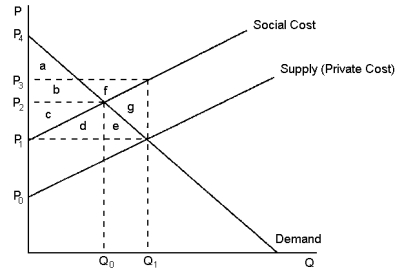 This graph reflects the market for kiwifruit, where pesticide used by kiwifruit orchardists also unintentionally kills honey bees.
-Refer to Graph 10-3.Assume that the kiwifruit orchardists must purchase a pesticide application permit (the cost for the permit is included in private cost) before spraying their fruit.What criteria should the government use in determining whether or not to issue a permit?
This graph reflects the market for kiwifruit, where pesticide used by kiwifruit orchardists also unintentionally kills honey bees.
-Refer to Graph 10-3.Assume that the kiwifruit orchardists must purchase a pesticide application permit (the cost for the permit is included in private cost) before spraying their fruit.What criteria should the government use in determining whether or not to issue a permit? (Multiple Choice)
4.9/5 (92)
(92) Externalities can be solved if parties are able to bargain without cost.
(True/False)
4.8/5 (92)
(92) 
Filters
- Essay(0)
- Multiple Choice(0)
- Short Answer(0)
- True False(0)
- Matching(0)