



 Chat with AI
Exam 10: Externalities

Exam 1: Ten Lessons From Economics146 Questions
Exam 2: Thinking Like an Economist133 Questions
Exam 3: Interdependence and the Gains From Trade139 Questions
Exam 4: The Market Forces of Supply and Demand215 Questions
Exam 5: Elasticity and Its Application178 Questions
Exam 6: Supply, Demand and Government Policies145 Questions
Exam 7: Consumers, Producers and the Efficiency of Markets171 Questions
Exam 8: Application: the Costs of Taxation135 Questions
Exam 9: Application: International Trade151 Questions
Exam 10: Externalities199 Questions
Exam 11: Public Goods and Common Resources178 Questions
Exam 12: The Design of the Tax System154 Questions
Exam 13: The Costs of Production191 Questions
Exam 14: Firms in Competitive Markets198 Questions
Exam 15: Monopoly212 Questions
Exam 16: Monopolistic Competition212 Questions
Exam 17: Business Strategy and Oligopoly179 Questions
Exam 18: Competition Policy103 Questions
Exam 19: The Markets for the Factors of Production214 Questions
Exam 20: Earnings, Unions and Discrimination201 Questions
Exam 21: Income Inequity and Poverty111 Questions
Exam 22: The Theory of Consumer Choice158 Questions
Exam 23: Frontiers of Microeconomics111 Questions
Exam 24: Measuring a Nations Income51 Questions
Exam 25: Measuring the Cost of Living55 Questions
Exam 26: Production and Growth62 Questions
Exam 27: Saving, Investment and the Financial System62 Questions
Exam 28: The Natural Rate of Unemployment58 Questions
Exam 29: The Monetary System66 Questions
Exam 30: Inflation: Its Causes and Costs74 Questions
Exam 31: Open-Economy Macroeconomics: Basic Concepts68 Questions
Exam 32: A Macroeconomic Theory of the Open Economy61 Questions
Exam 33: Aggregate Demand and Aggregate Supply81 Questions
Exam 34: The Influence of Monetary and Fiscal Policy on Aggregate Demand73 Questions
Exam 35: The Short-Run Trade-Off Between Inflation and Unemployment57 Questions
Exam 36: Global Financial Crisis of 2008 and Beyond37 Questions
Exam 37: Five Debates Over Macroeconomic Policy38 Questions
Select questions type


Using a supply-demand diagram, demonstrate how a positive consumption externality leads to market inefficiency.
(Essay)
5.0/5  (88)
(88) Assume that your housemate is very messy.Suppose he gets a $200 benefit from being messy but imposes a $300 cost on you.The Coase theorem would suggest that an efficient solution would be:
(Multiple Choice)
5.0/5 (81)
(81) Private markets fail to reach a socially optimal level when negative consumption externalities are present because:
(Multiple Choice)
4.8/5 (81)
(81) When weighing the costs and benefits of pollution, the costs always exceed the benefits because the benefit equals zero.
(True/False)
4.9/5 (81)
(81) In essence, the Pigovian tax places a price on the right to pollute.
(True/False)
4.8/5 (87)
(87) An externality is when the impact of one person's actions on the wellbeing of a bystander is captured in the price of a good.
(True/False)
4.9/5 (75)
(75) Internalising a positive production externality will cause the demand curve faced by an industry to:
(Multiple Choice)
4.9/5 (65)
(65) Government can accurately measure the social value of an externality.
(True/False)
4.8/5 (83)
(83) Government policies to encourage technology spillovers may go to industries with the most political clout rather than industries with the largest spillovers.
(True/False)
4.9/5 (85)
(85) Japanese fishermen use gill nets to catch tuna with great efficiency.Many environmentalists have objected to this practice since many marine animals such as dolphins and sharks are killed by the nets and discarded by the fishermen.Which of the following statements is most correct?
(Multiple Choice)
5.0/5 (63)
(63) The sound of birds singing from a new bird sanctuary in inner Melbourne could be considered an externality.
(True/False)
4.8/5 (83)
(83) Which of the following best defines the situation where the city council fines people who park too long in one spot?
(Multiple Choice)
4.8/5 (89)
(89) When Jake takes into account how his actions affect Jill, and changes these, an externality is solved.
(True/False)
4.8/5 (56)
(56) Graph 10-3 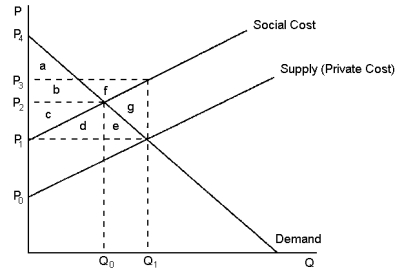 This graph reflects the market for kiwifruit, where pesticide used by kiwifruit orchardists also unintentionally kills honey bees.
-Refer to Graph 10-3.The difference between the social cost curve and the supply curve reflects the:
This graph reflects the market for kiwifruit, where pesticide used by kiwifruit orchardists also unintentionally kills honey bees.
-Refer to Graph 10-3.The difference between the social cost curve and the supply curve reflects the: (Multiple Choice)
4.9/5 (73)
(73) Policy responses that try to deal with market failure resulting from externalities are largely restricted to various forms of taxation.
(True/False)
4.8/5 (72)
(72) Suppose that a fish-food manufacturing company is located up the river from a fishing firm and often releases some of the food into the river.This means:
(Multiple Choice)
4.8/5 (79)
(79) The height of the demand curve for aluminum for any given quantity, shows the:
(Multiple Choice)
4.8/5 (78)
(78) Graph 10-2  This graph depicts the market for pork.Use this information to answer the following question(s).
-In Graph 10-2, what price and quantity combination efficiently allocates resources in such a way that the total value to consumers who buy and use pork minus the total costs to the producers who make and sell pork is maximised?
This graph depicts the market for pork.Use this information to answer the following question(s).
-In Graph 10-2, what price and quantity combination efficiently allocates resources in such a way that the total value to consumers who buy and use pork minus the total costs to the producers who make and sell pork is maximised? (Multiple Choice)
4.9/5 (79)
(79) 
Filters
- Essay(0)
- Multiple Choice(0)
- Short Answer(0)
- True False(0)
- Matching(0)