



 Chat with AI
Exam 10: Externalities

Exam 1: Ten Lessons From Economics146 Questions
Exam 2: Thinking Like an Economist133 Questions
Exam 3: Interdependence and the Gains From Trade139 Questions
Exam 4: The Market Forces of Supply and Demand215 Questions
Exam 5: Elasticity and Its Application178 Questions
Exam 6: Supply, Demand and Government Policies145 Questions
Exam 7: Consumers, Producers and the Efficiency of Markets171 Questions
Exam 8: Application: the Costs of Taxation135 Questions
Exam 9: Application: International Trade151 Questions
Exam 10: Externalities199 Questions
Exam 11: Public Goods and Common Resources178 Questions
Exam 12: The Design of the Tax System154 Questions
Exam 13: The Costs of Production191 Questions
Exam 14: Firms in Competitive Markets198 Questions
Exam 15: Monopoly212 Questions
Exam 16: Monopolistic Competition212 Questions
Exam 17: Business Strategy and Oligopoly179 Questions
Exam 18: Competition Policy103 Questions
Exam 19: The Markets for the Factors of Production214 Questions
Exam 20: Earnings, Unions and Discrimination201 Questions
Exam 21: Income Inequity and Poverty111 Questions
Exam 22: The Theory of Consumer Choice158 Questions
Exam 23: Frontiers of Microeconomics111 Questions
Exam 24: Measuring a Nations Income51 Questions
Exam 25: Measuring the Cost of Living55 Questions
Exam 26: Production and Growth62 Questions
Exam 27: Saving, Investment and the Financial System62 Questions
Exam 28: The Natural Rate of Unemployment58 Questions
Exam 29: The Monetary System66 Questions
Exam 30: Inflation: Its Causes and Costs74 Questions
Exam 31: Open-Economy Macroeconomics: Basic Concepts68 Questions
Exam 32: A Macroeconomic Theory of the Open Economy61 Questions
Exam 33: Aggregate Demand and Aggregate Supply81 Questions
Exam 34: The Influence of Monetary and Fiscal Policy on Aggregate Demand73 Questions
Exam 35: The Short-Run Trade-Off Between Inflation and Unemployment57 Questions
Exam 36: Global Financial Crisis of 2008 and Beyond37 Questions
Exam 37: Five Debates Over Macroeconomic Policy38 Questions
Select questions type


Government can internalise an externality by taxing the goods that have negative externalities and subsidising the goods that have positive externalities.
(True/False)
4.8/5  (83)
(83) What is the Coase theorem? What are the conditions needed for the Coase theorem to hold?
(Essay)
4.9/5 (76)
(76) Which of the following policies is government most inclined to use when faced with a positive externality?
(Multiple Choice)
4.7/5 (70)
(70) If the consumption of bananas is at a less than socially optimal level, we can say that:
(Multiple Choice)
4.9/5 (87)
(87) When a producer operates in a market characterised by negative production externalities, a tax that forces them to internalise the externality will:
(Multiple Choice)
4.9/5 (84)
(84) Graph 10-5 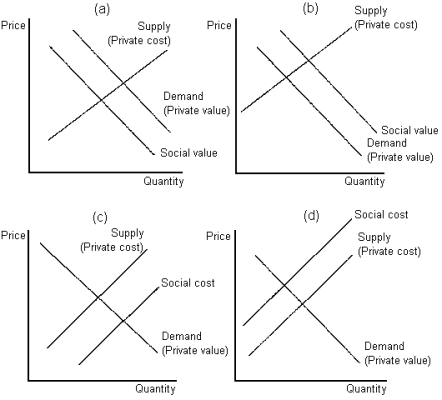 -Refer to Graph 10-5.In the figure shown, which set of graphs depict a situation most likely to benefit from a Pigovian tax?
 (Multiple Choice)
5.0/5 (72)
(72) Contracts cannot solve the inefficiency that arises from externalities.
(True/False)
4.8/5 (74)
(74) Graph 10-2  This graph depicts the market for pork.Use this information to answer the following question(s).
-In Graph 10-2, producer and consumer surplus at the point of market efficiency is represented by area(s):
This graph depicts the market for pork.Use this information to answer the following question(s).
-In Graph 10-2, producer and consumer surplus at the point of market efficiency is represented by area(s): (Multiple Choice)
4.8/5 (87)
(87) Firms that can reduce pollution easily will be willing to sell their emissions permits.
(True/False)
4.8/5 (74)
(74) To ensure the market reaches the social optimum in presence of a technology spillover, the government should subsidise producers by:
(Multiple Choice)
4.8/5 (74)
(74) When developing a new technology for operating guided missiles, inventors are likely to consider the other uses this technology might have in domestic use.
(True/False)
4.8/5 (80)
(80) In which of the following situations may tradeable pollution permits be preferred to Pigovian taxes?
(i) where they internalise the externality of pollution
(ii) where regulatory agencies do not know the demand curve for pollution
(iii) where the government is not interested in generating maximum revenue from polluting firms
(Multiple Choice)
5.0/5 (72)
(72) In a market characterised by externalities, the market equilibrium fails to maximise the total benefit to society as a whole.
(True/False)
4.8/5 (80)
(80) According to the Coase theorem, private parties are likely to solve the problem of externalities if:
(Multiple Choice)
4.9/5 (85)
(85) Social welfare can be enhanced by allowing firms to trade their carbon credits.
(True/False)
4.8/5 (74)
(74) Suppose fertiliser use on pastoral land causes water quality in surrounding areas to fall.If a tax on fertiliser was set at the optimal level:
(Multiple Choice)
4.9/5 (92)
(92) 
Filters
- Essay(0)
- Multiple Choice(0)
- Short Answer(0)
- True False(0)
- Matching(0)