



 Chat with AI
Exam 10: Externalities

Exam 1: Ten Lessons From Economics146 Questions
Exam 2: Thinking Like an Economist133 Questions
Exam 3: Interdependence and the Gains From Trade139 Questions
Exam 4: The Market Forces of Supply and Demand215 Questions
Exam 5: Elasticity and Its Application178 Questions
Exam 6: Supply, Demand and Government Policies145 Questions
Exam 7: Consumers, Producers and the Efficiency of Markets171 Questions
Exam 8: Application: the Costs of Taxation135 Questions
Exam 9: Application: International Trade151 Questions
Exam 10: Externalities199 Questions
Exam 11: Public Goods and Common Resources178 Questions
Exam 12: The Design of the Tax System154 Questions
Exam 13: The Costs of Production191 Questions
Exam 14: Firms in Competitive Markets198 Questions
Exam 15: Monopoly212 Questions
Exam 16: Monopolistic Competition212 Questions
Exam 17: Business Strategy and Oligopoly179 Questions
Exam 18: Competition Policy103 Questions
Exam 19: The Markets for the Factors of Production214 Questions
Exam 20: Earnings, Unions and Discrimination201 Questions
Exam 21: Income Inequity and Poverty111 Questions
Exam 22: The Theory of Consumer Choice158 Questions
Exam 23: Frontiers of Microeconomics111 Questions
Exam 24: Measuring a Nations Income51 Questions
Exam 25: Measuring the Cost of Living55 Questions
Exam 26: Production and Growth62 Questions
Exam 27: Saving, Investment and the Financial System62 Questions
Exam 28: The Natural Rate of Unemployment58 Questions
Exam 29: The Monetary System66 Questions
Exam 30: Inflation: Its Causes and Costs74 Questions
Exam 31: Open-Economy Macroeconomics: Basic Concepts68 Questions
Exam 32: A Macroeconomic Theory of the Open Economy61 Questions
Exam 33: Aggregate Demand and Aggregate Supply81 Questions
Exam 34: The Influence of Monetary and Fiscal Policy on Aggregate Demand73 Questions
Exam 35: The Short-Run Trade-Off Between Inflation and Unemployment57 Questions
Exam 36: Global Financial Crisis of 2008 and Beyond37 Questions
Exam 37: Five Debates Over Macroeconomic Policy38 Questions
Select questions type


Internalising a negative consumption externality will cause the market supply curve to shift to the left.
(True/False)
4.7/5  (85)
(85) Which of the following could be associated with positive consumption externalities?
(i) child immunisations (ensuring that the general population is vaccinated against communicable diseases)
(ii) alcohol consumption
(iii) maintaining the appearance of historic buildings
(Multiple Choice)
4.8/5 (69)
(69) Suppose people plant flowering trees near their homes to encourage rare native birds to feed.If people believe that an increase in native bird populations is valuable, people who plant these trees:
(Multiple Choice)
4.7/5 (68)
(68) Which of the following is one problem that keeps people from privately solving externalities?
(Multiple Choice)
4.9/5 (65)
(65) Graph 10-3 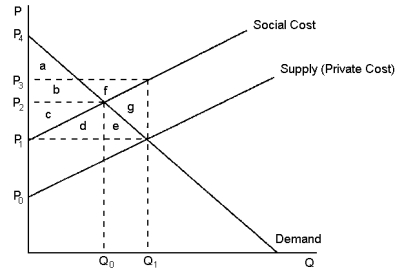 This graph reflects the market for kiwifruit, where pesticide used by kiwifruit orchardists also unintentionally kills honey bees.
-Refer to Graph 10-3.What price and quantity combination best represents the optimum price and number of kiwifruit trays that should be produced?
This graph reflects the market for kiwifruit, where pesticide used by kiwifruit orchardists also unintentionally kills honey bees.
-Refer to Graph 10-3.What price and quantity combination best represents the optimum price and number of kiwifruit trays that should be produced? (Multiple Choice)
4.9/5 (97)
(97) Graph 10-4 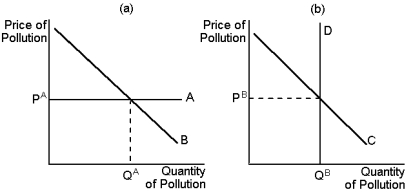 -Refer to Graph 10-4.The equivalence of a Pigovian tax and a pollution permit would require that:
 (Multiple Choice)
4.7/5 (76)
(76) When the government chooses an externality policy that aligns private incentives with social efficiency to solve an externality:
(Multiple Choice)
4.9/5 (79)
(79) Katie owns a rabbit which loves to roam in the neighbours' garden and eat the grass, as Katie only has a courtyard.However, when Katie's parents buy the property next door and she moves in with her family, Katie decides to keep her rabbit in a cage.What can explain the change in Katie's behaviour?
(Essay)
4.8/5 (83)
(83) Tim and Tom are having an argument because they can't agree on which television show to watch and they have only one television in their house, which they share.A possible solution to this problem is:
(Multiple Choice)
4.9/5 (84)
(84) The height of the supply curve at any given quantity of coal shows the:
(Multiple Choice)
4.8/5 (69)
(69) Which of the following statements about internalising a negative production externality is LEAST correct?
(Multiple Choice)
4.9/5 (81)
(81) A market for pollution permits can efficiently allocate the right to pollute through the forces of supply and demand.
(True/False)
4.8/5 (68)
(68) Airports can generate a negative externality with the noise the landing aircraft makes on neighbourhoods.Policies to reduce this noise problem include:
(Multiple Choice)
4.7/5 (75)
(75) The government attempts to resolve negative externalities caused by automobile exhaust by:
(i) taxing gasoline to reduce the amount that people drive
(ii) building safer highways
(iii) setting emission standards for automobiles
(Multiple Choice)
4.9/5 (78)
(78) Graph 10-1  -Refer to Graph 10-1.This graph reflects the presence of a:
 (Multiple Choice)
4.8/5 (76)
(76) The Coase theorem suggests that private solutions to the externality problem:
(Multiple Choice)
4.9/5 (80)
(80) Pigovian taxes enhance efficiency but the cost of administering such taxes frequently exceeds the revenue they raise for the government.
(True/False)
4.8/5 (77)
(77) 
Filters
- Essay(0)
- Multiple Choice(0)
- Short Answer(0)
- True False(0)
- Matching(0)