



 Chat with AI
Exam 14: Firms in Competitive Markets

Exam 1: Ten Lessons From Economics146 Questions
Exam 2: Thinking Like an Economist133 Questions
Exam 3: Interdependence and the Gains From Trade139 Questions
Exam 4: The Market Forces of Supply and Demand215 Questions
Exam 5: Elasticity and Its Application178 Questions
Exam 6: Supply, Demand and Government Policies145 Questions
Exam 7: Consumers, Producers and the Efficiency of Markets171 Questions
Exam 8: Application: the Costs of Taxation135 Questions
Exam 9: Application: International Trade151 Questions
Exam 10: Externalities199 Questions
Exam 11: Public Goods and Common Resources178 Questions
Exam 12: The Design of the Tax System154 Questions
Exam 13: The Costs of Production191 Questions
Exam 14: Firms in Competitive Markets198 Questions
Exam 15: Monopoly212 Questions
Exam 16: Monopolistic Competition212 Questions
Exam 17: Business Strategy and Oligopoly179 Questions
Exam 18: Competition Policy103 Questions
Exam 19: The Markets for the Factors of Production214 Questions
Exam 20: Earnings, Unions and Discrimination201 Questions
Exam 21: Income Inequity and Poverty111 Questions
Exam 22: The Theory of Consumer Choice158 Questions
Exam 23: Frontiers of Microeconomics111 Questions
Exam 24: Measuring a Nations Income51 Questions
Exam 25: Measuring the Cost of Living55 Questions
Exam 26: Production and Growth62 Questions
Exam 27: Saving, Investment and the Financial System62 Questions
Exam 28: The Natural Rate of Unemployment58 Questions
Exam 29: The Monetary System66 Questions
Exam 30: Inflation: Its Causes and Costs74 Questions
Exam 31: Open-Economy Macroeconomics: Basic Concepts68 Questions
Exam 32: A Macroeconomic Theory of the Open Economy61 Questions
Exam 33: Aggregate Demand and Aggregate Supply81 Questions
Exam 34: The Influence of Monetary and Fiscal Policy on Aggregate Demand73 Questions
Exam 35: The Short-Run Trade-Off Between Inflation and Unemployment57 Questions
Exam 36: Global Financial Crisis of 2008 and Beyond37 Questions
Exam 37: Five Debates Over Macroeconomic Policy38 Questions
Select questions type


Marginal adjustments to production end when firms in competitive markets experience a price equal to marginal revenue.
(True/False)
4.8/5  (59)
(59) Table 14-1
This table shows the revenue and costs of a parrot farmer.  -Refer to Table 14-1.If the farmer determines that marginal cost is $14, a harvest of parrots should:
 (Multiple Choice)
4.9/5 (74)
(74) A profit-maximising firm in a competitive market will always make marginal adjustments to production as long as:
(Multiple Choice)
4.9/5 (84)
(84) Table 14-1
This table shows the revenue and costs of a parrot farmer.
-Refer to Table 14-1.If the farmer chooses to maximise profit, the appropriate output level is where marginal cost is equal to:
-Refer to Table 14-1.If the farmer chooses to maximise profit, the appropriate output level is where marginal cost is equal to: (Multiple Choice)
4.8/5 (79)
(79) Because the goods offered for sale in a competitive market are largely the same:
(Multiple Choice)
4.8/5 (80)
(80) Which of the following are true of comparing marginal revenue to marginal cost?
(i) it reveals the contribution of the last unit of production to total profit
(ii) it is helpful in making profit-maximising production decisions
(iii) it always reveals whether a firm is making an economic profit
(iv) it tells a firm whether its fixed costs are too high
(Multiple Choice)
4.8/5 (88)
(88) If all firms in a market are identical, have upward sloping marginal cost curves, and input prices are perfectly elastic, then the competitive long-run market supply curve will be:
(Multiple Choice)
4.9/5 (85)
(85) Graph 14-6 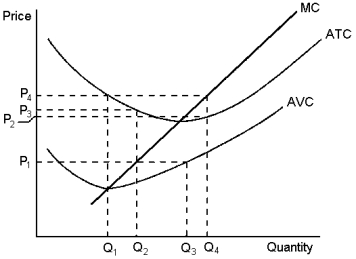 This graph depicts the cost structure of a firm in a competitive market.Use the graph to answer the following question(s).
-Refer to Graph 14-6.When market price is P₄, a profit-maximising firm's total cost can be represented by the area:
This graph depicts the cost structure of a firm in a competitive market.Use the graph to answer the following question(s).
-Refer to Graph 14-6.When market price is P₄, a profit-maximising firm's total cost can be represented by the area: (Multiple Choice)
4.9/5 (65)
(65) The production decisions of perfectly competitive firms follow the principle of economics that states that rational people:
(Multiple Choice)
4.9/5 (68)
(68) When new entrants to a competitive market have higher costs than existing firms:
(Multiple Choice)
4.8/5 (77)
(77) Regardless of the cost structure of firms in a competitive market, in the long run:
(Multiple Choice)
4.9/5 (90)
(90) In a competitive market, individual buyers and sellers have little ability to influence price.
(True/False)
4.9/5 (71)
(71) When a firm in a competitive market produces 10 units of output, it has marginal revenue of $8.What is the firm's total revenue when it produces nine units of output?
(Multiple Choice)
4.8/5 (72)
(72) In a competitive market, the price line also represents a firm's:
(Multiple Choice)
4.7/5 (85)
(85) A firm in a competitive market produces and sells 500 door knobs at a price of $10 each.It then chooses to increase its output to 1000 door knobs.After the increase in output, its average revenue will:
(Multiple Choice)
5.0/5 (81)
(81) In calculating accounting profit, accountants normally do not include:
(Multiple Choice)
4.9/5 (88)
(88) When firms already in a competitive market are profitable, an incentive exists for:
(Multiple Choice)
4.9/5 (83)
(83) Graph 14-7 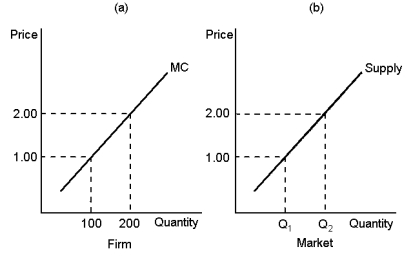 In this graph, panel (a) depicts the linear marginal cost of a firm in a competitive market, and panel (b) depicts the linear market supply curve for a market with a fixed number of identical firms.Use the graph to answer the following question(s).
-Refer to Graph 14-7.If there are 40 identical firms in this market, what level of output will be supplied to the market when the price is $2.00?
In this graph, panel (a) depicts the linear marginal cost of a firm in a competitive market, and panel (b) depicts the linear market supply curve for a market with a fixed number of identical firms.Use the graph to answer the following question(s).
-Refer to Graph 14-7.If there are 40 identical firms in this market, what level of output will be supplied to the market when the price is $2.00? (Multiple Choice)
4.7/5 (82)
(82) Graph 14-9 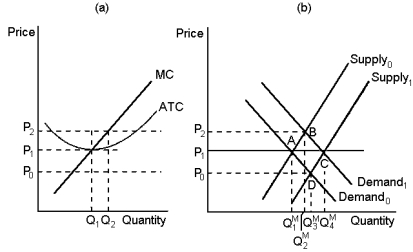 -Refer to Graph 14-9.If the market starts in equilibrium at point C in panel (b), a decrease in demand will ultimately lead to:
 (Multiple Choice)
4.9/5 (76)
(76) 
Filters
- Essay(0)
- Multiple Choice(0)
- Short Answer(0)
- True False(0)
- Matching(0)