



 Chat with AI
Exam 14: Firms in Competitive Markets

Exam 1: Ten Lessons From Economics146 Questions
Exam 2: Thinking Like an Economist133 Questions
Exam 3: Interdependence and the Gains From Trade139 Questions
Exam 4: The Market Forces of Supply and Demand215 Questions
Exam 5: Elasticity and Its Application178 Questions
Exam 6: Supply, Demand and Government Policies145 Questions
Exam 7: Consumers, Producers and the Efficiency of Markets171 Questions
Exam 8: Application: the Costs of Taxation135 Questions
Exam 9: Application: International Trade151 Questions
Exam 10: Externalities199 Questions
Exam 11: Public Goods and Common Resources178 Questions
Exam 12: The Design of the Tax System154 Questions
Exam 13: The Costs of Production191 Questions
Exam 14: Firms in Competitive Markets198 Questions
Exam 15: Monopoly212 Questions
Exam 16: Monopolistic Competition212 Questions
Exam 17: Business Strategy and Oligopoly179 Questions
Exam 18: Competition Policy103 Questions
Exam 19: The Markets for the Factors of Production214 Questions
Exam 20: Earnings, Unions and Discrimination201 Questions
Exam 21: Income Inequity and Poverty111 Questions
Exam 22: The Theory of Consumer Choice158 Questions
Exam 23: Frontiers of Microeconomics111 Questions
Exam 24: Measuring a Nations Income51 Questions
Exam 25: Measuring the Cost of Living55 Questions
Exam 26: Production and Growth62 Questions
Exam 27: Saving, Investment and the Financial System62 Questions
Exam 28: The Natural Rate of Unemployment58 Questions
Exam 29: The Monetary System66 Questions
Exam 30: Inflation: Its Causes and Costs74 Questions
Exam 31: Open-Economy Macroeconomics: Basic Concepts68 Questions
Exam 32: A Macroeconomic Theory of the Open Economy61 Questions
Exam 33: Aggregate Demand and Aggregate Supply81 Questions
Exam 34: The Influence of Monetary and Fiscal Policy on Aggregate Demand73 Questions
Exam 35: The Short-Run Trade-Off Between Inflation and Unemployment57 Questions
Exam 36: Global Financial Crisis of 2008 and Beyond37 Questions
Exam 37: Five Debates Over Macroeconomic Policy38 Questions
Select questions type


A profit-maximising firm's short-run shut down criterion is:
(Multiple Choice)
4.8/5  (72)
(72) Choose the correct statement.A competitive market is where:
(i) there are many buyers and sellers in a market
(ii) a single firm does not have a significant impact on the market price
(iii) the goods offered for sale are largely the same
(Multiple Choice)
4.9/5 (79)
(79) The entry and exit decisions of firms in a competitive market are signalled by:
(Multiple Choice)
4.9/5 (81)
(81) Explain what it means if a firm in a competitive market is labelled as a price-taker.
(Essay)
4.9/5 (91)
(91) Suppose a firm in a competitive market receives $1000 in total revenue and it has a marginal revenue of $20.What is the average revenue, and how many units were sold?
(Multiple Choice)
4.8/5 (78)
(78) Graph 14-4 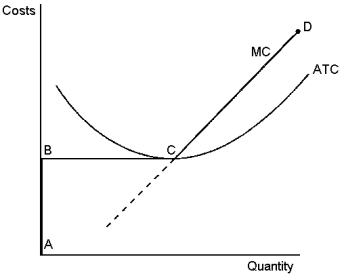 This graph depicts the cost structure of a profit-maximising firm in a competitive market.Use the graph to answer the following question(s).
-Refer to Graph 14-4.Which line segment best reflects the long-run supply curve for this firm?
This graph depicts the cost structure of a profit-maximising firm in a competitive market.Use the graph to answer the following question(s).
-Refer to Graph 14-4.Which line segment best reflects the long-run supply curve for this firm? (Multiple Choice)
4.9/5 (87)
(87) The short-run supply curve for a firm in a perfectly competitive market:
(Multiple Choice)
4.8/5 (87)
(87) If P < AVC, P < ATC, and marginal costs are increasing, then:
(Multiple Choice)
4.9/5 (82)
(82) When business managers of firms in a competitive market observe falling profits, they are likely to infer that the market is characterised by:
(Multiple Choice)
4.8/5 (77)
(77) Suppose a firm in a competitive market increase its output by 25 per cent, the price of its output is likely to:
(Multiple Choice)
4.9/5 (81)
(81) When a perfectly competitive firm makes a decision to shut down, it is most likely that:
(Multiple Choice)
4.8/5 (86)
(86) Discuss the process that induces firms to operate at efficient scale in the long run in a competitive market with free entry and exit.
(Essay)
4.9/5 (73)
(73) If identical firms that remain in a competitive market over the long run make zero economic profit, why do these firms choose to remain in the market?
(Essay)
4.9/5 (75)
(75) When profit-maximising firms in competitive markets are making losses:
(Multiple Choice)
4.9/5 (75)
(75) According to the information provided, if the increased production of farmed abalone caused a rise in the marginal transportation costs of moving abalone to market, the:
(Multiple Choice)
4.9/5 (71)
(71) Table 14-3
The market for Whizzly Jigs consists of many identical firms, each with the cost structure below.Suppose the current market price is $2. 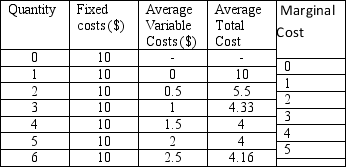
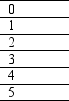 -Refer to table 14-3.With free entry and exit, what will be the long run price of Whizzly Jigs?
 (Multiple Choice)
4.7/5 (93)
(93) If a profit-maximising firm in a competitive market discovers that at its current level of production, price is less than marginal cost, it should:
(Multiple Choice)
4.9/5 (67)
(67) According to the information provided, at the end of the first year of operating her new business, Lee's accountant reported an accounting profit of $70 000.What was Lee's economic profit?
(Multiple Choice)
4.9/5 (93)
(93) As a general rule, when accountants calculate profit they account for explicit costs but miss:
(Multiple Choice)
4.9/5 (82)
(82) 
Filters
- Essay(0)
- Multiple Choice(0)
- Short Answer(0)
- True False(0)
- Matching(0)