



 Chat with AI
Exam 5: Environmental Influences and Control of Microbial Growth

Exam 1: Microbial Life: Origin and Discovery70 Questions
Exam 2: Observing the Microbial Cell69 Questions
Exam 3: Cell Structure and Function72 Questions
Exam 4: Bacterial Culture, Growth, and Development70 Questions
Exam 5: Environmental Influences and Control of Microbial Growth70 Questions
Exam 6: Viruses70 Questions
Exam 7: Genomes and Chromosomes70 Questions
Exam 8: Transcription, Translation, and Bioinformatics76 Questions
Exam 9: Gene Transfer, Mutations, and Genome Evolution72 Questions
Exam 10: Molecular Regulation73 Questions
Exam 11: Viral Molecular Biology70 Questions
Exam 12: Biotechniques and Synthetic Biology72 Questions
Exam 13: Energetics and Catabolism77 Questions
Exam 14: Electron Flow in Organotrophy, Lithotrophy, and Phototrophy73 Questions
Exam 15: Biosynthesis73 Questions
Exam 16: Food and Industrial Microbiology73 Questions
Exam 17: Origins and Evolution70 Questions
Exam 18: Bacterial Diversity71 Questions
Exam 19: Archaeal Diversity70 Questions
Exam 20: Eukaryotic Diversity69 Questions
Exam 21: Microbial Ecology70 Questions
Exam 22: Microbes in Global Elemental Cycles70 Questions
Exam 23: Human Microbiota and Innate Immunity70 Questions
Exam 24: The Adaptive Immune Response70 Questions
Exam 25: Microbial Pathogenesis70 Questions
Exam 26: Microbial Diseases69 Questions
Exam 27: Antimicrobial Therapy72 Questions
Exam 28: Clinical Microbiology and Epidemiology75 Questions
Select questions type


Alkaliphiles use ________ force in addition to proton motive force to maintain pH.
(Multiple Choice)
4.8/5  (69)
(69) A measure of the number of solute molecules in solution and is inversely related to water activity is known as
(Multiple Choice)
4.7/5 (87)
(87) Describe the studies with Salmonella that showed that in vitro conditions do not always model what happens in vivo (in this case in the phagocytic vacuole).
(Essay)
4.9/5 (83)
(83) Why is death a logarithmic function and not an instantaneous event upon treatment?
(Essay)
4.9/5 (76)
(76) Runoff from agricultural fields, lawns, and golf courses can cause an overgrowth of microbes due to
(Multiple Choice)
4.8/5 (70)
(70) At the bottom of the ocean, hydrostatic pressure averages a crushing 400 atm (atmospheres) and can go as high as ________ atm.
(Multiple Choice)
4.8/5 (73)
(73) The membrane needs to remain ________ so that it can expand as cells grow larger and so that proteins needed for solute transport can be inserted into the membrane.
(Multiple Choice)
4.8/5 (87)
(87) Why are thermophiles able to survive at temperatures that would quickly kill most mesophiles? Describe at least three adaptations.
(Essay)
5.0/5 (73)
(73) Briefly describe three techniques used to culture anaerobes in the laboratory.
(Essay)
4.8/5 (77)
(77) If a disinfectant is added to a culture containing 1 ´ 10⁶ CFU per milliliter and the D-value of the disinfectant is 2 minutes, how many viable cells are left after 4 minutes of exposure?
(Essay)
4.9/5 (82)
(82) No one ever expected to find microbes thriving in our stomachs. What organism was found there, what problem does it cause, and how does it survive there?
(Essay)
4.9/5 (76)
(76) Which of the following are commonly used to control microbial growth in foods?
(Multiple Choice)
4.8/5 (71)
(71) Which of the following grows in the indicated pH range shown in the figure below? 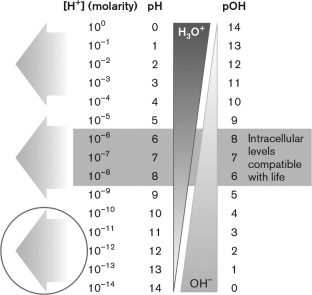
(Multiple Choice)
4.8/5 (80)
(80) Give an example of a naturally occurring organic acid stress situation in the food industry. How does the food industry mimic this, and why?
(Essay)
4.9/5 (83)
(83) An organism that grows at the top of a tube of medium containing thioglycolate is probably a(n)
(Multiple Choice)
4.9/5 (95)
(95) During the starvation response, only a limited number of organisms can
(Multiple Choice)
4.9/5 (78)
(78) The general result of the Arrhenius equation is that growth rate roughly doubles for every ________°C rise in temperature.
(Multiple Choice)
4.8/5 (88)
(88) 
Filters
- Essay(0)
- Multiple Choice(0)
- Short Answer(0)
- True False(0)
- Matching(0)