



 Chat with AI
Exam 20: Nuclear Chemistry

Exam 1: Chemistry: the Central Science133 Questions
Exam 2: Atoms, Molecules, and Ions124 Questions
Exam 3: Stoichiometry: Ratios of Combination137 Questions
Exam 4: Reactions in Aqueous Solutions146 Questions
Exam 5: Thermochemistry141 Questions
Exam 6: Quantum Theory and the Electronic Structure of Atoms135 Questions
Exam 7: Electron Configuration and the Periodic Table120 Questions
Exam 8: Chemical Bonding I: Basic Concepts102 Questions
Exam 9: Chemical Bonding II: Molecular Geometry and Bonding Theories139 Questions
Exam 10: Gases137 Questions
Exam 11: Intermolecular Forces and the Physical Properties of Liquids and Solids137 Questions
Exam 12: Modern Materials108 Questions
Exam 13: Physical Properties of Solutions151 Questions
Exam 14: Chemical Kinetics132 Questions
Exam 15: Chemical Equilibrium146 Questions
Exam 16: Acids and Bases137 Questions
Exam 17: Acid-Base Equilibria and Solubility Equilibria133 Questions
Exam 18: Entropy, Free Energy, and Equilibrium107 Questions
Exam 19: Electrochemistry122 Questions
Exam 20: Nuclear Chemistry127 Questions
Exam 21: Environmental Chemistry135 Questions
Exam 22: Coordination Chemistry132 Questions
Exam 23: Metallurgy and the Chemistry of Metals152 Questions
Exam 24: Nonmetallic Elements and Their Compounds117 Questions
Exam 25: Organic Chemistry121 Questions
Select questions type


The only stable isotope of aluminum is aluminum-27. What type of radioactive decay should be expected from  ?
? (Multiple Choice)
4.9/5  (81)
(81) Nuclei with an ________ number of protons and an ________ number of neutrons tend to be more stable than those with an ________ number of protons and/or an ________ number of neutrons.
(Multiple Choice)
4.8/5 (87)
(87) The ________ ________ ________ is a quantitative measure of the nuclear stability of a nucleus, which is the energy required to break up a nucleus into its component protons and neutrons.
(Short Answer)
4.9/5 (69)
(69) Alpha decay is not observed for isotopes of elements with atomic numbers less than 83.
(True/False)
4.7/5 (73)
(73) Determine how much energy is released when thorium-230 decays according to the following equation. 
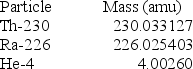 (1 kg = 6.022 × 1026 amu; NA = 6.022 × 10²³ mol-1;
C = 2.99792458 × 10⁸ m/s)
(1 kg = 6.022 × 1026 amu; NA = 6.022 × 10²³ mol-1;
C = 2.99792458 × 10⁸ m/s) (Multiple Choice)
4.9/5 (88)
(88) 
Filters
- Essay(0)
- Multiple Choice(0)
- Short Answer(0)
- True False(0)
- Matching(0)