



 Chat with AI
Exam 20: Nuclear Chemistry

Exam 1: Chemistry: the Central Science133 Questions
Exam 2: Atoms, Molecules, and Ions124 Questions
Exam 3: Stoichiometry: Ratios of Combination137 Questions
Exam 4: Reactions in Aqueous Solutions146 Questions
Exam 5: Thermochemistry141 Questions
Exam 6: Quantum Theory and the Electronic Structure of Atoms135 Questions
Exam 7: Electron Configuration and the Periodic Table120 Questions
Exam 8: Chemical Bonding I: Basic Concepts102 Questions
Exam 9: Chemical Bonding II: Molecular Geometry and Bonding Theories139 Questions
Exam 10: Gases137 Questions
Exam 11: Intermolecular Forces and the Physical Properties of Liquids and Solids137 Questions
Exam 12: Modern Materials108 Questions
Exam 13: Physical Properties of Solutions151 Questions
Exam 14: Chemical Kinetics132 Questions
Exam 15: Chemical Equilibrium146 Questions
Exam 16: Acids and Bases137 Questions
Exam 17: Acid-Base Equilibria and Solubility Equilibria133 Questions
Exam 18: Entropy, Free Energy, and Equilibrium107 Questions
Exam 19: Electrochemistry122 Questions
Exam 20: Nuclear Chemistry127 Questions
Exam 21: Environmental Chemistry135 Questions
Exam 22: Coordination Chemistry132 Questions
Exam 23: Metallurgy and the Chemistry of Metals152 Questions
Exam 24: Nonmetallic Elements and Their Compounds117 Questions
Exam 25: Organic Chemistry121 Questions
Select questions type


The dose unit of ionizing radiation is called the rad. The rad is defined in terms of
(Multiple Choice)
4.8/5  (81)
(81) Which of the following type(s) of radiation is/are detected by a Geiger counter?
(Multiple Choice)
4.7/5 (70)
(70) All isotopes of elements with atomic numbers higher than 83 (Bi) are radioactive.
(True/False)
4.8/5 (78)
(78) What is the nuclear binding energy per nucleon of uranium-234? 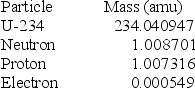 [1 kg = 6.022 × 1026 amu; NA = 6.022 × 10²³ mol-1; c = 2.99792458 × 10⁸ m/s]
 (Multiple Choice)
4.8/5 (87)
(87) What causes the radiation damage to matter when gamma rays damages it?
(Multiple Choice)
4.9/5 (87)
(87) What role does cadmium metal (Cd) play in a nuclear reactor?
(Multiple Choice)
4.9/5 (81)
(81) An 85-kg person exposed to barium-141 receives 2.5 × 10⁵ β particles, each with an energy of 5.2 × 10⁻¹³ J. How many rads does the person receive? (1 rad = 1 × 10⁻⁵ J/g)
(Multiple Choice)
4.8/5 (76)
(76) Calcium-39 undergoes positron decay. Each positron carries 5.49 MeV of energy. How much energy will be emitted when 0.00250 mol of calcium-39 decays? (1 MeV = 1.602 × 10⁻¹³ J)
(Multiple Choice)
4.9/5 (77)
(77) A nuclear reaction's reaction rate is affected by temperature, pressure, and catalysts.
(True/False)
4.8/5 (60)
(60) When a87 Br nucleus emits a beta particle, what is the nuclear species that results?
(Short Answer)
4.8/5 (86)
(86) In the equation below, what particle or type of radiation needs to be included to balance the equation? 208Po → ? + 208At
(Multiple Choice)
4.7/5 (78)
(78) In order to investigate the age of a mineral sample believed to be millions of years old, which would be the best choice of radioactive isotope to measure?
(Multiple Choice)
4.7/5 (92)
(92) What are magic numbers with reference to nuclear stability?
(Multiple Choice)
4.8/5 (84)
(84) Cesium-134 is a β emitter with a half-life of 2.0 years. How much of a 2.50-g sample of cesium-134 will remain after 10 years?
(Multiple Choice)
4.9/5 (86)
(86) What is the name for the difference between the mass of an atom and the sum of the masses of its constituent nucleons?
(Multiple Choice)
4.9/5 (68)
(68) A patient's thyroid gland is to be exposed to an average of 5.5 µCi for 16 days as an ingested sample of iodine-131 decays. If the energy of the β radiation is 9.7 × 10⁻¹⁴ J and the mass of the thyroid is 32.0 g, what is the dose received by the patient? (1 rad = 1 × 10⁻⁵ J/g; 1 Ci = 3.7 × 10¹⁰ disintegrations/s)
(Multiple Choice)
4.8/5 (79)
(79) 
Filters
- Essay(0)
- Multiple Choice(0)
- Short Answer(0)
- True False(0)
- Matching(0)