



 Chat with AI
Exam 20: Nuclear Chemistry

Exam 1: Chemistry: the Central Science133 Questions
Exam 2: Atoms, Molecules, and Ions124 Questions
Exam 3: Stoichiometry: Ratios of Combination137 Questions
Exam 4: Reactions in Aqueous Solutions146 Questions
Exam 5: Thermochemistry141 Questions
Exam 6: Quantum Theory and the Electronic Structure of Atoms135 Questions
Exam 7: Electron Configuration and the Periodic Table120 Questions
Exam 8: Chemical Bonding I: Basic Concepts102 Questions
Exam 9: Chemical Bonding II: Molecular Geometry and Bonding Theories139 Questions
Exam 10: Gases137 Questions
Exam 11: Intermolecular Forces and the Physical Properties of Liquids and Solids137 Questions
Exam 12: Modern Materials108 Questions
Exam 13: Physical Properties of Solutions151 Questions
Exam 14: Chemical Kinetics132 Questions
Exam 15: Chemical Equilibrium146 Questions
Exam 16: Acids and Bases137 Questions
Exam 17: Acid-Base Equilibria and Solubility Equilibria133 Questions
Exam 18: Entropy, Free Energy, and Equilibrium107 Questions
Exam 19: Electrochemistry122 Questions
Exam 20: Nuclear Chemistry127 Questions
Exam 21: Environmental Chemistry135 Questions
Exam 22: Coordination Chemistry132 Questions
Exam 23: Metallurgy and the Chemistry of Metals152 Questions
Exam 24: Nonmetallic Elements and Their Compounds117 Questions
Exam 25: Organic Chemistry121 Questions
Select questions type


The nuclear binding energy per nucleon is defined by which of the following?
(Multiple Choice)
4.8/5  (71)
(71) A 55-kg person exposed to thorium-234 receives 7.5 × 10⁴ β particles, each with an energy of 1.6 × 10⁻¹⁴ J. How many rads does the person receive?
(Multiple Choice)
4.8/5 (79)
(79) Which of the following materials is put into a nuclear reactor to slow the chain reaction?
(Multiple Choice)
4.8/5 (99)
(99) Identify the missing species in the following nuclear transmutation. 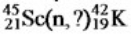
(Multiple Choice)
4.7/5 (73)
(73) What element is the stable end-product of the uranium radioactive decay series?
(Multiple Choice)
4.7/5 (75)
(75) What is the missing symbol in this plutonium fission reaction? 
(Multiple Choice)
4.8/5 (87)
(87)  ?
What is the total binding energy of 12C? [12C atomic mass = 12.000 amu; mass of proton = 1.007825 amu; mass of neutron = 1.008665 amu; 1 kg = 6.022 x 1026 amu; 1 J = 1 (kg•m2)/s2]?
(Multiple Choice)
4.9/5 (87)
(87) Petroleum is a fossil fuel containing many different carbon compounds. If the carbon atoms in petroleum have been in the ground for 100 million years, what fraction of the initial 14C atoms is still there? (t1/2 = 5730 yr)
(Multiple Choice)
4.9/5 (102)
(102) How many 14C atoms are in a charcoal sample that has a decay rate of 3500 disintegrations per min? (For 14C, t1/2 = 5730 yr.)
(Multiple Choice)
4.9/5 (77)
(77) What technique would you use to determine how old a cloth is that was found while digging in Egypt?
(Short Answer)
4.9/5 (75)
(75) 
A plot of the number of neutrons versus the number of protons in various isotopes produces a "belt of stability." Isotopes below the belt of stability (i.e., with a smaller neutron-to-proton ratio) decay by beta particle emission.
(True/False)
4.8/5 (89)
(89) A radioisotope decays, producing an alpha particle and Th-234. The original radioisotope must have been an atom of ________.
(Multiple Choice)
4.8/5 (81)
(81) Nuclear fusion is the combination of small nuclei into larger ones.
(True/False)
4.8/5 (84)
(84) Which of the following best represents the relationship between the energy released (ΔE) and the mass defect (Δm)?
(Multiple Choice)
4.8/5 (79)
(79) 
Filters
- Essay(0)
- Multiple Choice(0)
- Short Answer(0)
- True False(0)
- Matching(0)