



 Chat with AI
Exam 9: Chemical Bonding II: Molecular Geometry and Bonding Theories

Exam 1: Chemistry: the Central Science133 Questions
Exam 2: Atoms, Molecules, and Ions124 Questions
Exam 3: Stoichiometry: Ratios of Combination137 Questions
Exam 4: Reactions in Aqueous Solutions146 Questions
Exam 5: Thermochemistry141 Questions
Exam 6: Quantum Theory and the Electronic Structure of Atoms135 Questions
Exam 7: Electron Configuration and the Periodic Table120 Questions
Exam 8: Chemical Bonding I: Basic Concepts102 Questions
Exam 9: Chemical Bonding II: Molecular Geometry and Bonding Theories139 Questions
Exam 10: Gases137 Questions
Exam 11: Intermolecular Forces and the Physical Properties of Liquids and Solids137 Questions
Exam 12: Modern Materials108 Questions
Exam 13: Physical Properties of Solutions151 Questions
Exam 14: Chemical Kinetics132 Questions
Exam 15: Chemical Equilibrium146 Questions
Exam 16: Acids and Bases137 Questions
Exam 17: Acid-Base Equilibria and Solubility Equilibria133 Questions
Exam 18: Entropy, Free Energy, and Equilibrium107 Questions
Exam 19: Electrochemistry122 Questions
Exam 20: Nuclear Chemistry127 Questions
Exam 21: Environmental Chemistry135 Questions
Exam 22: Coordination Chemistry132 Questions
Exam 23: Metallurgy and the Chemistry of Metals152 Questions
Exam 24: Nonmetallic Elements and Their Compounds117 Questions
Exam 25: Organic Chemistry121 Questions
Select questions type


What is the total number of electron domains around the central atom for a molecule having a T-shaped molecular geometry, such as BrF3?

Free
(Multiple Choice)
5.0/5  (87)
(87) Correct Answer: Verified
A
How many bonds are there in one molecule of 1,5-hexadiyne (shown below)? 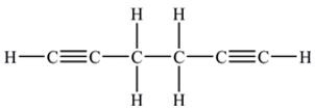
Free
(Multiple Choice)
4.8/5 (87)
(87) Correct Answer:Verified
VerifiedB
Which one of the following molecules is nonpolar?
Free
(Multiple Choice)
5.0/5 (74)
(74) Correct Answer:Verified
VerifiedA
Thiocarbonyl disulfide (CSF2), based on the coordinate axes provided below, in which direction does the net molecular dipole moment point for the molecule? 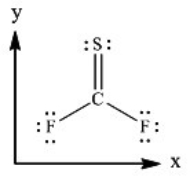
(Multiple Choice)
4.9/5 (83)
(83) According to the VSEPR model, is the molecule PF5 polar or nonpolar?
(Short Answer)
4.8/5 (88)
(88) According to molecular orbital (MO) theory, the twelve valence electrons in the O2 molecule are distributed as follows:
(Multiple Choice)
4.9/5 (77)
(77) Predict the molecular geometry and polarity of the SO2 molecule.
(Multiple Choice)
4.8/5 (72)
(72) How do you describe the molecular geometry of a molecule that has more than one central atom?
(Multiple Choice)
4.8/5 (74)
(74) What is the molecular geometry of N2O as predicted by the VSEPR model? 
(Multiple Choice)
4.8/5 (84)
(84) In the valence bond treatment, a π bond is formed when two p orbitals overlap side to side.
(True/False)
4.9/5 (87)
(87) The nitrosonium ion, NO+, forms a number of interesting complexes with nickel, cobalt, and iron. According to molecular orbital theory, which statement about NO+ is correct?
(Multiple Choice)
4.8/5 (69)
(69) What is the molecular geometry of XeO2F2 as predicted by the VSEPR model? 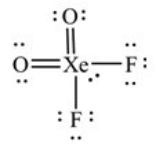
(Multiple Choice)
4.7/5 (82)
(82) To make an sp3 hybrid orbital, one s atomic orbital is mixed with three p atomic orbitals.
(True/False)
4.9/5 (81)
(81) What is the molecular geometry of NO2- as predicted by the VSEPR model?
(Multiple Choice)
4.8/5 (82)
(82) The Lewis structure of formaldehyde, CH2O, is shown. Use VSEPR model to predict the molecular geometry and the H-C-H bond angle. Outline your reasoning. 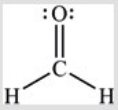
(Essay)
4.8/5 (71)
(71) Which is the most reasonable prediction for the H-O-H bond angle in H2O?
(Multiple Choice)
4.7/5 (80)
(80) According to the VSEPR model, a molecule with the general formula AB5 with one lone pair on the central atom will have a ________ molecular geometry.
(Multiple Choice)
4.9/5 (71)
(71) 
Filters
- Essay(0)
- Multiple Choice(0)
- Short Answer(0)
- True False(0)
- Matching(0)