



 Chat with AI
Exam 9: Chemical Bonding II: Molecular Geometry and Bonding Theories

Exam 1: Chemistry: the Central Science133 Questions
Exam 2: Atoms, Molecules, and Ions124 Questions
Exam 3: Stoichiometry: Ratios of Combination137 Questions
Exam 4: Reactions in Aqueous Solutions146 Questions
Exam 5: Thermochemistry141 Questions
Exam 6: Quantum Theory and the Electronic Structure of Atoms135 Questions
Exam 7: Electron Configuration and the Periodic Table120 Questions
Exam 8: Chemical Bonding I: Basic Concepts102 Questions
Exam 9: Chemical Bonding II: Molecular Geometry and Bonding Theories139 Questions
Exam 10: Gases137 Questions
Exam 11: Intermolecular Forces and the Physical Properties of Liquids and Solids137 Questions
Exam 12: Modern Materials108 Questions
Exam 13: Physical Properties of Solutions151 Questions
Exam 14: Chemical Kinetics132 Questions
Exam 15: Chemical Equilibrium146 Questions
Exam 16: Acids and Bases137 Questions
Exam 17: Acid-Base Equilibria and Solubility Equilibria133 Questions
Exam 18: Entropy, Free Energy, and Equilibrium107 Questions
Exam 19: Electrochemistry122 Questions
Exam 20: Nuclear Chemistry127 Questions
Exam 21: Environmental Chemistry135 Questions
Exam 22: Coordination Chemistry132 Questions
Exam 23: Metallurgy and the Chemistry of Metals152 Questions
Exam 24: Nonmetallic Elements and Their Compounds117 Questions
Exam 25: Organic Chemistry121 Questions
Select questions type


Which of the following is required for the determination of the VSEPR model and the molecular shape?
(Multiple Choice)
4.8/5  (78)
(78) What is the total number of electron domains around the central atom for a molecule having a trigonal pyramidal molecular geometry, such as NH3?
(Multiple Choice)
5.0/5 (94)
(94) Which of the following molecules has a nonzero dipole moment?
(Multiple Choice)
4.9/5 (77)
(77) Valence bond theory predicts that iodine will use ________ hybrid orbitals in ICl2-.
(Multiple Choice)
4.8/5 (81)
(81) Which formula is incorrectly matched with its VSEPR model representation? (Note: Lone pairs on the models, if any, are not shown.)
(Multiple Choice)
4.8/5 (76)
(76) Indicate the type of hybrid orbitals used by the central atom in CCl4.
(Multiple Choice)
4.8/5 (83)
(83) When PCl5 solidifies it forms PCl4+cations and PCl6- anions. According to valence bond theory, what hybrid orbitals are used by phosphorus in the PCl4+cation?
(Multiple Choice)
4.9/5 (80)
(80) The bond angle for an sp hybrid orbital is smaller than the bond angle for an sp2 hybrid orbital.
(True/False)
4.8/5 (83)
(83) What is the molecular geometry of BeH2 as predicted by the VSEPR model?
(Multiple Choice)
4.7/5 (87)
(87) Which is the most reasonable prediction for the Cl-N-Cl bond angle in NCl3?
(Multiple Choice)
4.9/5 (78)
(78) Indicate the type of hybrid orbitals used by the central atom in PCl3.
(Multiple Choice)
4.9/5 (68)
(68) What is the hybridization of the As atom in the AsF5 molecule?
(Multiple Choice)
4.7/5 (92)
(92) What is the molecular geometry of ClF2- as predicted by the VSEPR model?
(Multiple Choice)
4.7/5 (84)
(84) Using the VSEPR model, predict the molecular geometry around the central atom in PO43-.
(Multiple Choice)
4.8/5 (78)
(78) Rank the following molecules in order of increasing dipole moment. 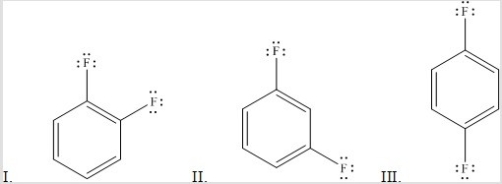
(Multiple Choice)
4.9/5 (88)
(88) According to the VSEPR model, the predicted molecular geometry of the SO3 molecule is
(Multiple Choice)
4.9/5 (81)
(81) 
Filters
- Essay(0)
- Multiple Choice(0)
- Short Answer(0)
- True False(0)
- Matching(0)