



 Chat with AI
Exam 18: Entropy, Free Energy, and Equilibrium

Exam 1: Chemistry: the Central Science133 Questions
Exam 2: Atoms, Molecules, and Ions124 Questions
Exam 3: Stoichiometry: Ratios of Combination137 Questions
Exam 4: Reactions in Aqueous Solutions146 Questions
Exam 5: Thermochemistry141 Questions
Exam 6: Quantum Theory and the Electronic Structure of Atoms135 Questions
Exam 7: Electron Configuration and the Periodic Table120 Questions
Exam 8: Chemical Bonding I: Basic Concepts102 Questions
Exam 9: Chemical Bonding II: Molecular Geometry and Bonding Theories139 Questions
Exam 10: Gases137 Questions
Exam 11: Intermolecular Forces and the Physical Properties of Liquids and Solids137 Questions
Exam 12: Modern Materials108 Questions
Exam 13: Physical Properties of Solutions151 Questions
Exam 14: Chemical Kinetics132 Questions
Exam 15: Chemical Equilibrium146 Questions
Exam 16: Acids and Bases137 Questions
Exam 17: Acid-Base Equilibria and Solubility Equilibria133 Questions
Exam 18: Entropy, Free Energy, and Equilibrium107 Questions
Exam 19: Electrochemistry122 Questions
Exam 20: Nuclear Chemistry127 Questions
Exam 21: Environmental Chemistry135 Questions
Exam 22: Coordination Chemistry132 Questions
Exam 23: Metallurgy and the Chemistry of Metals152 Questions
Exam 24: Nonmetallic Elements and Their Compounds117 Questions
Exam 25: Organic Chemistry121 Questions
Select questions type


Is the following process spontaneous? 

Free
(Multiple Choice)
4.8/5  (88)
(88) Correct Answer: Verified
E
The temperature at which the following process reaches equilibrium at 1.0 atm is the normal melting point for phosphoric acid. H3PO4(s)  H3PO4(l)
Use the following thermodynamic data at 298 K to estimate this temperature.

H3PO4(l)
Use the following thermodynamic data at 298 K to estimate this temperature. Free
(Multiple Choice)
4.8/5 (83)
(83) Correct Answer:Verified
VerifiedC
What is defined as a process that may occur under a specific set of conditions?
Free
(Multiple Choice)
4.9/5 (71)
(71) Correct Answer:Verified
VerifiedD
What is ΔS° for the reaction SO2(s) + NO2(g) → SO3(g) + NO(g)? 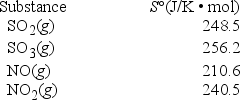
(Multiple Choice)
4.8/5 (77)
(77) Elemental boron can be formed by the reaction of boron trichloride with hydrogen. 2BCl3(g) + 3H2(g) → 2B(s) + 6HCl(g) 

(Multiple Choice)
4.8/5 (64)
(64) Elemental boron can be formed by the reaction of boron trichloride with hydrogen. 2BCl3(g) + 3H2(g) → 2B(s) + 6HCl(g)
What is ΔG°rxn for this reaction? 
(Multiple Choice)
4.8/5 (72)
(72) What is ΔG°rxn for the following reaction? SiCl4(g) + 2Mg(s) → 2MgCl2(s) + Si(s) 
(Multiple Choice)
4.9/5 (81)
(81) 
The ________ law of thermodynamics states that the entropy of the universe in a spontaneous process increases and is constant in equilibrium processes.
(Short Answer)
4.8/5 (83)
(83) In a spontaneous process, the entropy of the system always increases.
(True/False)
4.9/5 (95)
(95) How many types of vibrations does a diatomic molecule exhibit?
(Multiple Choice)
4.8/5 (87)
(87) The reaction of methane with water to form carbon dioxide and hydrogen is nonspontaneous at 98 K. At what temperature will this system make the transition from nonspontaneous to spontaneous? The following data are valid at 298 K: CH4(g) + 2H2O(g)  CO2(g) + 4H2(g)

CO2(g) + 4H2(g) (Multiple Choice)
4.9/5 (79)
(79) Which thermodynamic property is a measure of the disorder in the system?
(Short Answer)
4.8/5 (66)
(66) What is ΔS° at 25°C for the reduction of lead(II) oxide by charcoal? 2PbO(s) + C(s) → 2Pb(s) + CO2(g) 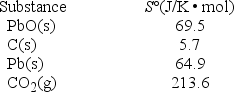
(Multiple Choice)
4.8/5 (93)
(93) If an endothermic process is spontaneous when |TΔS| >|ΔH|, then is ΔS is positive, negative, or equal to zero?
(Short Answer)
4.8/5 (69)
(69) Consider the figure below which shows ΔG° for a chemical process plotted against absolute temperature. From this plot, it is reasonable to conclude that: 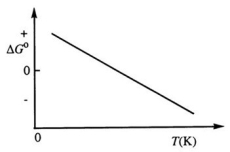
(Multiple Choice)
4.8/5 (84)
(84) Consider the figure below which shows ΔG° for a chemical process plotted against absolute temperature. From this plot, it is reasonable to conclude that: 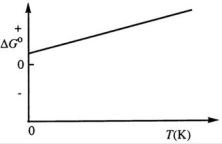
(Multiple Choice)
4.9/5 (73)
(73) 
Filters
- Essay(0)
- Multiple Choice(0)
- Short Answer(0)
- True False(0)
- Matching(0)