



 Chat with AI
Exam 18: Entropy, Free Energy, and Equilibrium

Exam 1: Chemistry: the Central Science133 Questions
Exam 2: Atoms, Molecules, and Ions124 Questions
Exam 3: Stoichiometry: Ratios of Combination137 Questions
Exam 4: Reactions in Aqueous Solutions146 Questions
Exam 5: Thermochemistry141 Questions
Exam 6: Quantum Theory and the Electronic Structure of Atoms135 Questions
Exam 7: Electron Configuration and the Periodic Table120 Questions
Exam 8: Chemical Bonding I: Basic Concepts102 Questions
Exam 9: Chemical Bonding II: Molecular Geometry and Bonding Theories139 Questions
Exam 10: Gases137 Questions
Exam 11: Intermolecular Forces and the Physical Properties of Liquids and Solids137 Questions
Exam 12: Modern Materials108 Questions
Exam 13: Physical Properties of Solutions151 Questions
Exam 14: Chemical Kinetics132 Questions
Exam 15: Chemical Equilibrium146 Questions
Exam 16: Acids and Bases137 Questions
Exam 17: Acid-Base Equilibria and Solubility Equilibria133 Questions
Exam 18: Entropy, Free Energy, and Equilibrium107 Questions
Exam 19: Electrochemistry122 Questions
Exam 20: Nuclear Chemistry127 Questions
Exam 21: Environmental Chemistry135 Questions
Exam 22: Coordination Chemistry132 Questions
Exam 23: Metallurgy and the Chemistry of Metals152 Questions
Exam 24: Nonmetallic Elements and Their Compounds117 Questions
Exam 25: Organic Chemistry121 Questions
Select questions type


What term is given to the fact that the entropy of a perfect crystalline solid is zero at absolute zero?
(Multiple Choice)
4.8/5  (80)
(80) The complete combustion of liquid benzene is represented by the equation:
C6H6(l) + 7  O2(g) → 6CO2(g) + 3H2O(l)
Using the data below, calculate, for this reaction
a. ΔH°
b. ΔG° at 25°C.

O2(g) → 6CO2(g) + 3H2O(l)
Using the data below, calculate, for this reaction
a. ΔH°
b. ΔG° at 25°C. (Short Answer)
5.0/5 (75)
(75) For a chemical reaction to be spontaneous at all temperatures, which conditions must be met?
(Multiple Choice)
4.7/5 (77)
(77) Which of these species has the highest entropy (S°) at 25°C?
(Multiple Choice)
4.8/5 (60)
(60) What is ΔS° for the combustion of propane? C3H8(g) + 5O2(g) → 3CO2(g) + 4H2O(g) 
(Multiple Choice)
4.9/5 (72)
(72) For a process that is spontaneous at high temperatures but not at low temperatures, the sign of ΔH is ________.
(Short Answer)
4.8/5 (74)
(74) What is ΔG°rxn for the following reaction? 3NO2(g) + H2O(l) → 2HNO3(l) + NO(g) 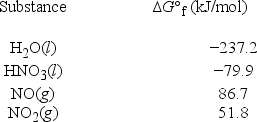
(Multiple Choice)
4.8/5 (62)
(62) In 1774 Joseph Priestly prepared oxygen by heating mercury(II) oxide according to the reaction HgO(l) <----> Hg(l) + ½O2(g), for which ΔHo = 90.84 kJ/mol and ΔSo = 108 J/K.mol. Which of the following statements is true for this reaction?
(Multiple Choice)
4.8/5 (75)
(75) Predict the sign of ΔS for the reaction 6CO2(g) + 6H2O(g) → C6H12O6(s) + 6O2(g).
(Short Answer)
4.8/5 (72)
(72) For a process where a gas condenses to a liquid, the entropy ________.
(Short Answer)
4.9/5 (80)
(80) As the molar mass of a compound increases, the entropy ________.
(Multiple Choice)
4.9/5 (79)
(79) What is ΔS° for the following reaction? 2Cl2(g) + SO2(g) → SOCl2(g) + Cl2O(g) 
(Multiple Choice)
4.7/5 (72)
(72) At constant temperature and pressure, which is the correct relationship between ΔG and other thermodynamic quantities?
(Multiple Choice)
4.8/5 (74)
(74) How many types of vibrations does a bent triatomic molecule exhibit?
(Multiple Choice)
4.8/5 (86)
(86) At temperatures below 273 K, it is observed that liquid water spontaneously freezes to form solid ice. What must be true about the entropy changes of the system and surroundings for this process?
(Multiple Choice)
4.9/5 (68)
(68) For the process C6H6(l) <-----> C6H6(s) at a temperature above the freezing point of C6H6,
(Multiple Choice)
4.9/5 (93)
(93) What is ΔS° for the following reaction? 4Cr(s) + 3O2(g) → 2Cr2O3(s) 
(Multiple Choice)
4.8/5 (84)
(84) 
Filters
- Essay(0)
- Multiple Choice(0)
- Short Answer(0)
- True False(0)
- Matching(0)