



 Chat with AI
Exam 18: Entropy, Free Energy, and Equilibrium

Exam 1: Chemistry: the Central Science133 Questions
Exam 2: Atoms, Molecules, and Ions124 Questions
Exam 3: Stoichiometry: Ratios of Combination137 Questions
Exam 4: Reactions in Aqueous Solutions146 Questions
Exam 5: Thermochemistry141 Questions
Exam 6: Quantum Theory and the Electronic Structure of Atoms135 Questions
Exam 7: Electron Configuration and the Periodic Table120 Questions
Exam 8: Chemical Bonding I: Basic Concepts102 Questions
Exam 9: Chemical Bonding II: Molecular Geometry and Bonding Theories139 Questions
Exam 10: Gases137 Questions
Exam 11: Intermolecular Forces and the Physical Properties of Liquids and Solids137 Questions
Exam 12: Modern Materials108 Questions
Exam 13: Physical Properties of Solutions151 Questions
Exam 14: Chemical Kinetics132 Questions
Exam 15: Chemical Equilibrium146 Questions
Exam 16: Acids and Bases137 Questions
Exam 17: Acid-Base Equilibria and Solubility Equilibria133 Questions
Exam 18: Entropy, Free Energy, and Equilibrium107 Questions
Exam 19: Electrochemistry122 Questions
Exam 20: Nuclear Chemistry127 Questions
Exam 21: Environmental Chemistry135 Questions
Exam 22: Coordination Chemistry132 Questions
Exam 23: Metallurgy and the Chemistry of Metals152 Questions
Exam 24: Nonmetallic Elements and Their Compounds117 Questions
Exam 25: Organic Chemistry121 Questions
Select questions type


For the reaction of xenon and fluorine gases to form solid XeF4, ΔH° = -251 kJ/mol
and ΔG° = -121 kJ/mol at 25°C. Calculate ΔS° for the reaction.
(Short Answer)
4.9/5  (82)
(82) Which of the following substances has the greatest entropy per mole?
(Multiple Choice)
4.7/5 (71)
(71) Which of the following will decrease the entropy of an inert gas system?
(Multiple Choice)
4.8/5 (69)
(69) As a chemical reaction proceeds toward equilibrium, the free energy of the system decreases at constant temperature and constant pressure.
(True/False)
4.9/5 (77)
(77) Sulfuryl dichloride may be formed from the reaction of sulfur dioxide and chlorine. SO2(g) + Cl2(g) → SO2Cl2(g)  What is ΔG°rxn for this reaction at 600 K?
 (Multiple Choice)
4.8/5 (69)
(69) What is defined as the measure of accessible energy levels of a substance at 1 atm?
(Multiple Choice)
4.9/5 (89)
(89) Which of the following results in a decrease in the entropy of the system?
(Multiple Choice)
4.9/5 (76)
(76) In living systems, thermodynamically favorable reactions provide the free energy needed to drive necessary but thermodynamically unfavorable reactions.
(True/False)
4.8/5 (78)
(78) What is ΔG°rxn for the combustion of propane? C3H8(g) + 5O2(g) → 3CO2(g) + 4H2O(g) 
(Multiple Choice)
4.9/5 (78)
(78) According to which scientific law does the entropy of the universe increase in spontaneous processes and remain unchanged in equilibrium processes?
(Multiple Choice)
4.9/5 (76)
(76) The element oxygen was prepared by Joseph Priestley in 1774 by heating mercury(II) oxide: HgO(s) → Hg(l) + ½O2(g), ΔH° = 90.84 kJ/mol. Estimate the temperature at which this reaction will become spontaneous under standard state conditions. 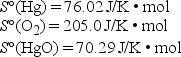
(Multiple Choice)
5.0/5 (68)
(68) Which species will have the greatest absolute entropy at 25°C?
(Multiple Choice)
4.9/5 (80)
(80) Hydrogen sulfide decomposes according to the following reaction: 2H2S(g) → 2H2(g) + S2(g)
For this reaction at 298 K, ΔS°rxn = 78.1 J/K • mol, ΔH°rxn = 169.4 kJ/mol, and ΔG°rxn = 146.1 kJ/mol. What is ΔG°rxn at 900. K?
(Multiple Choice)
4.9/5 (73)
(73) What is ΔS° for the following reaction? SiCl4(g) + 2Mg(s) → 2MgCl2(s) + Si(s) 
(Multiple Choice)
4.7/5 (79)
(79) a. Explain what is meant by a spontaneous process.
b. Is a spontaneous process necessarily a rapid one? Explain, and provide a real reaction as an example to illustrate your answer.
(Essay)
4.9/5 (78)
(78) Calculate ΔG° for the combustion of ethanol vapor, C2H5OH(g), at 750.°C in oxygen to form carbon dioxide and water vapor. The following data are valid at 25°C: 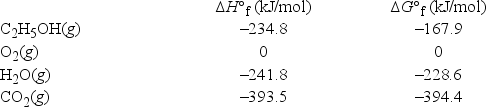
(Multiple Choice)
4.9/5 (86)
(86) Which, if any, of the following processes is spontaneous under the specified conditions?
(Multiple Choice)
4.8/5 (92)
(92) 
Filters
- Essay(0)
- Multiple Choice(0)
- Short Answer(0)
- True False(0)
- Matching(0)