



 Chat with AI
Exam 18: Entropy, Free Energy, and Equilibrium

Exam 1: Chemistry: the Central Science133 Questions
Exam 2: Atoms, Molecules, and Ions124 Questions
Exam 3: Stoichiometry: Ratios of Combination137 Questions
Exam 4: Reactions in Aqueous Solutions146 Questions
Exam 5: Thermochemistry141 Questions
Exam 6: Quantum Theory and the Electronic Structure of Atoms135 Questions
Exam 7: Electron Configuration and the Periodic Table120 Questions
Exam 8: Chemical Bonding I: Basic Concepts102 Questions
Exam 9: Chemical Bonding II: Molecular Geometry and Bonding Theories139 Questions
Exam 10: Gases137 Questions
Exam 11: Intermolecular Forces and the Physical Properties of Liquids and Solids137 Questions
Exam 12: Modern Materials108 Questions
Exam 13: Physical Properties of Solutions151 Questions
Exam 14: Chemical Kinetics132 Questions
Exam 15: Chemical Equilibrium146 Questions
Exam 16: Acids and Bases137 Questions
Exam 17: Acid-Base Equilibria and Solubility Equilibria133 Questions
Exam 18: Entropy, Free Energy, and Equilibrium107 Questions
Exam 19: Electrochemistry122 Questions
Exam 20: Nuclear Chemistry127 Questions
Exam 21: Environmental Chemistry135 Questions
Exam 22: Coordination Chemistry132 Questions
Exam 23: Metallurgy and the Chemistry of Metals152 Questions
Exam 24: Nonmetallic Elements and Their Compounds117 Questions
Exam 25: Organic Chemistry121 Questions
Select questions type


The heat of vaporization of 1-pentanol is 55.5 kJ/mol, and its entropy of vaporization is 148 J/K•mol. What is the approximate boiling point of 1-pentanol?
(Multiple Choice)
4.7/5  (80)
(80) Sodium carbonate can be made by heating sodium bicarbonate: 2NaHCO3(s) → Na2CO3(s) + CO2(g) + H2O(g)
At 25°C, for this reaction, ΔH°rxn = 128.9 kJ/mol and ΔG°rxn = 33.1 kJ/mol. Above what minimum temperature will the reaction become spontaneous under standard state conditions?
(Multiple Choice)
4.9/5 (80)
(80) What is defined as a measure of the randomness or disorder of a system?
(Multiple Choice)
4.9/5 (77)
(77) What is ΔG°rxn for the following reaction? 2NO(g) + Cl2(g) → 2NOCl(g) 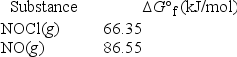
(Multiple Choice)
4.7/5 (73)
(73) For a chemical reaction to be spontaneous only at high temperatures, which conditions must be met?
(Multiple Choice)
4.8/5 (83)
(83) HI has a normal boiling point of -35.4°C, and its ΔHvap is 21.16 kJ/mol. What is the molar entropy of vaporization (ΔSvap) of HI?
(Multiple Choice)
4.7/5 (90)
(90) The reaction SiO2(s) + Pb(s) → PbO2(s) + Si(s) is spontaneous:
ΔG°f (PbO2(s)) = -217 kJ/mol
ΔG°f (SiO2(s)) = -856 kJ/mol
(True/False)
4.7/5 (87)
(87) Which species will have the lowest absolute entropy at 25°C?
(Multiple Choice)
4.9/5 (63)
(63) Ozone (O3) in the atmosphere can react with nitric oxide (NO) as follows. O3(g) + NO(g) → NO2(g) + O2(g). ΔH°rxn = -199 kJ/mol, ΔS°rxn = -4.1 J/K • mol
What is ΔG°rxn for this reaction at 25°C?
(Multiple Choice)
4.7/5 (61)
(61) The absolute standard entropy of atom X(g) is 100 J/K • mol. Which is a reasonable value for the absolute standard entropy of X2(g)?
(Multiple Choice)
4.7/5 (82)
(82) The higher the pressure of a gas sample, the greater is its entropy.
(True/False)
4.9/5 (80)
(80) The entropy change ΔS° at 298 K for the reaction NH4Cl(s) →NH3(g) + HCl(g) is negative.
(True/False)
4.8/5 (76)
(76) ________ is the pressure required for standard entropy conditions.
(Short Answer)
4.8/5 (92)
(92) The following reaction is spontaneous under standard state conditions at 25°C:
AgCl(s) → Ag+ (aq) + Cl- (aq) (ΔG° = 55 kJ/mol)
(True/False)
4.8/5 (73)
(73) Consider the figure below which shows ΔG° for a chemical process plotted against absolute temperature. Which one of the following is an incorrect conclusion, based on the information in the diagram? 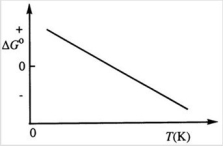
(Multiple Choice)
4.7/5 (82)
(82) What is ΔG°rxn at 298 K for the following reaction? 2Cl2(g) + SO2(g) → SOCl2(g) + Cl2O(g) 
(Multiple Choice)
4.9/5 (74)
(74) Which of the following is an example of a nonspontaneous process?
(Multiple Choice)
4.9/5 (93)
(93) 
Filters
- Essay(0)
- Multiple Choice(0)
- Short Answer(0)
- True False(0)
- Matching(0)