



 Chat with AI
Exam 20: Nuclear Chemistry

Exam 1: Chemistry: the Central Science133 Questions
Exam 2: Atoms, Molecules, and Ions124 Questions
Exam 3: Stoichiometry: Ratios of Combination137 Questions
Exam 4: Reactions in Aqueous Solutions146 Questions
Exam 5: Thermochemistry141 Questions
Exam 6: Quantum Theory and the Electronic Structure of Atoms135 Questions
Exam 7: Electron Configuration and the Periodic Table120 Questions
Exam 8: Chemical Bonding I: Basic Concepts102 Questions
Exam 9: Chemical Bonding II: Molecular Geometry and Bonding Theories139 Questions
Exam 10: Gases137 Questions
Exam 11: Intermolecular Forces and the Physical Properties of Liquids and Solids137 Questions
Exam 12: Modern Materials108 Questions
Exam 13: Physical Properties of Solutions151 Questions
Exam 14: Chemical Kinetics132 Questions
Exam 15: Chemical Equilibrium146 Questions
Exam 16: Acids and Bases137 Questions
Exam 17: Acid-Base Equilibria and Solubility Equilibria133 Questions
Exam 18: Entropy, Free Energy, and Equilibrium107 Questions
Exam 19: Electrochemistry122 Questions
Exam 20: Nuclear Chemistry127 Questions
Exam 21: Environmental Chemistry135 Questions
Exam 22: Coordination Chemistry132 Questions
Exam 23: Metallurgy and the Chemistry of Metals152 Questions
Exam 24: Nonmetallic Elements and Their Compounds117 Questions
Exam 25: Organic Chemistry121 Questions
Select questions type


It is believed that two carbon-12 nuclei can react in the core of a supergiant star to form sodium-23 and hydrogen-1. Calculate the energy released from this reaction for each mole of hydrogen formed. 
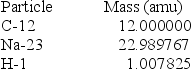 (1 kg = 6.022 × 1026 amu; NA = 6.022 × 10²³ mol-1;
C = 2.99792458 × 10⁸ m/s)
(1 kg = 6.022 × 1026 amu; NA = 6.022 × 10²³ mol-1;
C = 2.99792458 × 10⁸ m/s)
Free
(Multiple Choice)
4.7/5  (79)
(79) Correct Answer: Verified
C
Gamma rays are high energy electrons.
Free
(True/False)
5.0/5 (75)
(75) Correct Answer:Verified
VerifiedFalse
Which of the following is injected into the bloodstream to trace the flow of blood and detect possible constrictions or obstructions in the circulatory system?
Free
(Multiple Choice)
4.8/5 (89)
(89) Correct Answer:Verified
VerifiedD
What is the nuclear process called in which a heavy nuclear of mass number greater than 200 divides to form smaller nuclei of intermediate mass and one or more neutron(s)?
(Multiple Choice)
4.9/5 (81)
(81) Sodium-21 will emit positrons, each having an energy of 4.0 × 10⁻¹³ J. What is this energy in MeV? (1 MeV = 1.602 × 10⁻¹³ J)
(Multiple Choice)
5.0/5 (75)
(75) For stable atoms of elements having low atomic numbers (≤ 20), the neutron-to-proton ratio is close to zero.
(True/False)
5.0/5 (67)
(67) In passing through matter, alpha particles lose energy chiefly by causing
(Multiple Choice)
4.8/5 (67)
(67) Cobalt-60 is a beta emitter with a half-life of 5.3 years. Approximately what fraction of cobalt-60 atoms will remain in a particular sample after 26.5 years?
(Multiple Choice)
4.9/5 (73)
(73) Polonium-208 is an alpha emitter with a half-life of 2.90 years. How many milligrams of polonium from an original sample of 2.00 mg will remain after 8.00 years?
(Multiple Choice)
4.8/5 (69)
(69) What is the name for spontaneous emission of particles or electromagnetic radiation by certain nuclei?
(Multiple Choice)
4.9/5 (86)
(86) Which isotope, when bombarded with bismuth-209, would yield two neutrons and an isotope with atomic number 121 and mass number 299?
(Multiple Choice)
4.8/5 (88)
(88) Iodine-131, t1/2 = 8.0 days, is used in the diagnosis and treatment of thyroid gland diseases. If a laboratory sample of iodine-131 initially emits 9.95 × 10¹⁸ β particles per day, how long will it take for the activity to drop to 6.22 × 10¹⁷ β particles per day?
(Multiple Choice)
4.9/5 (73)
(73) Electron capture is the capture of an electron-usually a 1s electron-by the ________.
(Short Answer)
4.8/5 (92)
(92) Which is an incorrect representation of the indicated particle or nucleus?
(Multiple Choice)
4.8/5 (76)
(76) What is the nuclear binding energy per nucleon for  ? (1 kg = 6.022 × 1026 amu;
C = 2.99792458 × 10⁸ m/s)
Particle Mass (amu)
 24.985839
 1.007276
 1.008665
? (1 kg = 6.022 × 1026 amu;
C = 2.99792458 × 10⁸ m/s)
Particle Mass (amu) 24.985839 1.007276 1.008665 (Multiple Choice)
4.9/5 (79)
(79) Present-day plant life has a carbon-14 decay rate of 16 disintegrations per minute (dpm) per gram of carbon. If a contemporary wooden chair were preserved for the next 3900 years, what 14C decay rate should be expected from the wood used to make the chair? (t1/2 = 5730 yr)
(Multiple Choice)
4.9/5 (96)
(96) The carbon-14 activity of some ancient Indian corn was found to be 7.0 disintegrations per minute (dpm) per gram of carbon. If present-day plant life has 16 dpm per gram of carbon, how old is the Indian corn? (t1/2 = 5730 yr)
(Multiple Choice)
4.9/5 (89)
(89) What is the name for the minimum mass of fissionable material required to generate a self-sustaining nuclear chain reaction?
(Short Answer)
4.9/5 (83)
(83) In the following diagrams, A represents a radioactive isotope that decays into a new isotope, X. Each circle represents 1 mmol of atoms. t = 0: 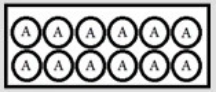 t = 25.0 s:
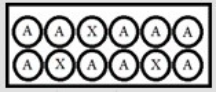 Over the first 25.0 s, what is the disintegration rate of A?
t = 25.0 s: Over the first 25.0 s, what is the disintegration rate of A? (Multiple Choice)
4.9/5 (78)
(78) Identify the missing species in the following nuclear transmutation. 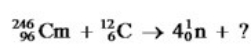
(Multiple Choice)
4.8/5 (92)
(92) 
Filters
- Essay(0)
- Multiple Choice(0)
- Short Answer(0)
- True False(0)
- Matching(0)