



 Chat with AI
Exam 20: Nuclear Chemistry

Exam 1: Chemistry: the Central Science133 Questions
Exam 2: Atoms, Molecules, and Ions124 Questions
Exam 3: Stoichiometry: Ratios of Combination137 Questions
Exam 4: Reactions in Aqueous Solutions146 Questions
Exam 5: Thermochemistry141 Questions
Exam 6: Quantum Theory and the Electronic Structure of Atoms135 Questions
Exam 7: Electron Configuration and the Periodic Table120 Questions
Exam 8: Chemical Bonding I: Basic Concepts102 Questions
Exam 9: Chemical Bonding II: Molecular Geometry and Bonding Theories139 Questions
Exam 10: Gases137 Questions
Exam 11: Intermolecular Forces and the Physical Properties of Liquids and Solids137 Questions
Exam 12: Modern Materials108 Questions
Exam 13: Physical Properties of Solutions151 Questions
Exam 14: Chemical Kinetics132 Questions
Exam 15: Chemical Equilibrium146 Questions
Exam 16: Acids and Bases137 Questions
Exam 17: Acid-Base Equilibria and Solubility Equilibria133 Questions
Exam 18: Entropy, Free Energy, and Equilibrium107 Questions
Exam 19: Electrochemistry122 Questions
Exam 20: Nuclear Chemistry127 Questions
Exam 21: Environmental Chemistry135 Questions
Exam 22: Coordination Chemistry132 Questions
Exam 23: Metallurgy and the Chemistry of Metals152 Questions
Exam 24: Nonmetallic Elements and Their Compounds117 Questions
Exam 25: Organic Chemistry121 Questions
Select questions type


A bottle of vintage red wine has lost its label. The concentration of tritium (  ) in the wine is 0.34 times that found in freshly bottled wines. If the half-life of tritium is 12.3 years, estimate the time elapsed since the wine was bottled.
 (Short Answer)
5.0/5  (84)
(84) In the equation below, what particle or type of radiation needs to be included to balance the equation? 234Th → ? + beta particle
(Multiple Choice)
4.9/5 (82)
(82) What is the nuclear process called where small nuclei are combined into larger ones?
(Multiple Choice)
4.8/5 (74)
(74) Which equation correctly represents electron capture by the  nucleus?
 (Multiple Choice)
5.0/5 (90)
(90) What is the energy equivalent of 1 amu? (c = 2.99792458 × 10⁸ m/s)
(Multiple Choice)
4.7/5 (78)
(78) When atoms of beryllium-9 are bombarded with alpha particles, neutrons are produced. What new isotope is also formed? 
(Multiple Choice)
4.9/5 (73)
(73) The 14C activity of some ancient Peruvian corn was found to be 10 disintegrations per minute per gram of carbon. If present-day plant life shows 15 dpm/g, how old is the Peruvian corn? (The half-life of 14C is 5730 yr.)
(Multiple Choice)
4.9/5 (73)
(73) Suppose you have two very sensitive balances that can measure the masses of individual particles, depicted below. In these figures, "p" corresponds to a proton, and "n" corresponds to a neutron. 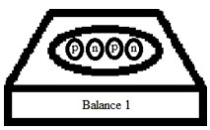
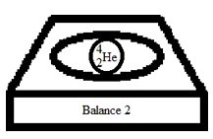 What is the relationship between the mass readings of the two balances? (Neglect differences due to experimental uncertainty.)
 (Multiple Choice)
4.7/5 (77)
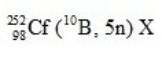
(77) Identify the missing species in the following nuclear transmutation. 
(Multiple Choice)
4.9/5 (87)
(87) The difference between the mass of an atom and the sum of the masses of its protons, neutrons, and electrons is called the ________ ________.
(Short Answer)
4.8/5 (72)
(72) Which isotope, when bombarded with nitrogen-15, yields four neutrons and the artificial isotope dubnium-260?
(Multiple Choice)
4.9/5 (68)
(68) The radiochemist, Will I. Glow, studied thorium-232 and found that 2.82 × 10⁻⁷ moles emitted 8.42 × 10⁶ α particles in one year. What is the decay constant for thorium-232?
(Multiple Choice)
4.9/5 (81)
(81) A rock contains 0.37 mg of Pb-206 and 0.95 mg of U-238. Approximately how many U-238 atoms were in the rock when it was formed billions of years ago? (The half life for 238U → 206Pb is 4.51 × 10⁹ yr.)
(Multiple Choice)
4.8/5 (69)
(69) Identify the missing species in the following nuclear transmutation. U-238 + ? → 1 neutron + Fm-249
(Multiple Choice)
4.9/5 (91)
(91) 
An isotope with a high value of N/Z will tend to decay through
(Multiple Choice)
4.9/5 (79)
(79) The ________ has the same mass as the electron, but bears a charge of +1.
(Short Answer)
4.9/5 (73)
(73) 
Filters
- Essay(0)
- Multiple Choice(0)
- Short Answer(0)
- True False(0)
- Matching(0)