



 Chat with AI
Exam 14: Chemical Kinetics

Exam 1: Chemistry: the Central Science133 Questions
Exam 2: Atoms, Molecules, and Ions124 Questions
Exam 3: Stoichiometry: Ratios of Combination137 Questions
Exam 4: Reactions in Aqueous Solutions146 Questions
Exam 5: Thermochemistry141 Questions
Exam 6: Quantum Theory and the Electronic Structure of Atoms135 Questions
Exam 7: Electron Configuration and the Periodic Table120 Questions
Exam 8: Chemical Bonding I: Basic Concepts102 Questions
Exam 9: Chemical Bonding II: Molecular Geometry and Bonding Theories139 Questions
Exam 10: Gases137 Questions
Exam 11: Intermolecular Forces and the Physical Properties of Liquids and Solids137 Questions
Exam 12: Modern Materials108 Questions
Exam 13: Physical Properties of Solutions151 Questions
Exam 14: Chemical Kinetics132 Questions
Exam 15: Chemical Equilibrium146 Questions
Exam 16: Acids and Bases137 Questions
Exam 17: Acid-Base Equilibria and Solubility Equilibria133 Questions
Exam 18: Entropy, Free Energy, and Equilibrium107 Questions
Exam 19: Electrochemistry122 Questions
Exam 20: Nuclear Chemistry127 Questions
Exam 21: Environmental Chemistry135 Questions
Exam 22: Coordination Chemistry132 Questions
Exam 23: Metallurgy and the Chemistry of Metals152 Questions
Exam 24: Nonmetallic Elements and Their Compounds117 Questions
Exam 25: Organic Chemistry121 Questions
Select questions type


Which is the correct unit for a zeroth-order rate constant?

Free
(Multiple Choice)
4.9/5  (59)
(59) Correct Answer: Verified
B
Cyclopropane is converted to propene in a first-order process. The rate constant is 5.4 × 10⁻² h-1. If the initial concentration of cyclopropane is 0.150 M, what will its concentration be after 22.0 hours?
Free
(Multiple Choice)
4.7/5 (69)
(69) Correct Answer:Verified
VerifiedA
What is the half-life for a first-order reaction?
Free
(Multiple Choice)
4.9/5 (87)
(87) Correct Answer:Verified
VerifiedE
The reaction A + 2B → Products was found to have the rate law, rate = k[A][B]2. Predict by what factor the rate of reaction will increase when the concentration of A is doubled and the concentration of B is also doubled.
(Multiple Choice)
5.0/5 (65)
(65) A ________-________ is a reaction whose rate depends on the concentration of one of the reactants squared.
(Short Answer)
4.8/5 (75)
(75) In the collision theory of reaction rates, the rate constant for a bimolecular reaction can be written as
k = A•exp(-Ea/RT)
Briefly explain the physical meaning (interpretation) of the following factors which appear in the above expression:
a. A
b. exp(-Ea/RT)
(Essay)
4.9/5 (83)
(83) Nitric oxide gas (NO) reacts with chlorine gas according to the equation NO +  Cl2 → NOCl.
The following initial rates of reaction have been measured for the given reagent concentrations.
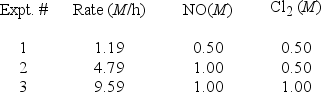 Which of the following is the rate law for this reaction?
Cl2 → NOCl.
The following initial rates of reaction have been measured for the given reagent concentrations. Which of the following is the rate law for this reaction? (Multiple Choice)
4.8/5 (65)
(65) For a zeroth-order reaction, if the concentration of reactant A is plotted vs. time, which corresponds to the slope of this plot?
(Multiple Choice)
4.9/5 (67)
(67) Carbon-14 is a radioactive isotope which decays with a half-life of 5730 years. What is the first-order rate constant for its decay?
(Multiple Choice)
4.7/5 (82)
(82) The first-order reaction SO2Cl2→ SO2 + Cl2 is 10% complete in 80. min. How long would it take for the reaction to be 95% complete?
(Multiple Choice)
4.7/5 (82)
(82) For the reaction 3A(g) + 2B(g) → 2C(g) + 2D(g)
The following data were collected at constant temperature. Determine the correct rate law for this reaction. 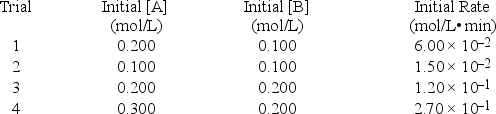
(Multiple Choice)
4.9/5 (70)
(70) The reaction A + 2B → Products was found to follow the rate law: rate = k[A]2[B]. Predict by what factor the rate of reaction will increase when the concentration of A is doubled, the concentration of B is tripled, and the temperature remains constant.
(Multiple Choice)
4.9/5 (72)
(72) Consider the following potential energy profile for the A → B reaction. How many elementary steps are there? 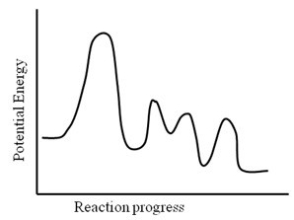
(Multiple Choice)
4.7/5 (86)
(86) Which of the following is the correct unit for a second-order rate constant?
(Multiple Choice)
4.8/5 (80)
(80) The data below were determined for the reaction S2O82-(aq) + 3I-(aq) → 2SO42-(aq) + I3-(aq). 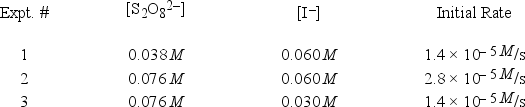 Which rate law is consistent with the experimental data for this reaction?
 (Multiple Choice)
4.8/5 (79)
(79) The radioactive isotope tritium decays with a first-order rate constant k of 0.056 yr-1. What fraction of the tritium initially in a sample is still present 30. years later?
(Multiple Choice)
4.9/5 (74)
(74) The oxidation of iodide ions by arsenic acid in acidic aqueous solution occurs according to the net reaction H3AsO4 + 3I - + 2H3O +→ H3AsO3 + I3- + 3H2O. The experimental rate law for this reaction is
Rate = k [H3AsO4] [I-] [H3O+].
According to the rate law for the reaction, an increase in the concentration of hydronium ion has what effect on this reaction?
(Short Answer)
4.8/5 (75)
(75) The rate law for the rearrangement of CH3NC to CH3CN at 800 K is rate = (1300 s-1)[CH3NC]. What is the half-life for this reaction?
(Multiple Choice)
4.8/5 (80)
(80) The elementary step of the reaction mechanism which only involves one reactant is called ________.
(Short Answer)
4.7/5 (70)
(70) 
Filters
- Essay(0)
- Multiple Choice(0)
- Short Answer(0)
- True False(0)
- Matching(0)