



 Chat with AI
Exam 14: Chemical Kinetics

Exam 1: Chemistry: the Central Science133 Questions
Exam 2: Atoms, Molecules, and Ions124 Questions
Exam 3: Stoichiometry: Ratios of Combination137 Questions
Exam 4: Reactions in Aqueous Solutions146 Questions
Exam 5: Thermochemistry141 Questions
Exam 6: Quantum Theory and the Electronic Structure of Atoms135 Questions
Exam 7: Electron Configuration and the Periodic Table120 Questions
Exam 8: Chemical Bonding I: Basic Concepts102 Questions
Exam 9: Chemical Bonding II: Molecular Geometry and Bonding Theories139 Questions
Exam 10: Gases137 Questions
Exam 11: Intermolecular Forces and the Physical Properties of Liquids and Solids137 Questions
Exam 12: Modern Materials108 Questions
Exam 13: Physical Properties of Solutions151 Questions
Exam 14: Chemical Kinetics132 Questions
Exam 15: Chemical Equilibrium146 Questions
Exam 16: Acids and Bases137 Questions
Exam 17: Acid-Base Equilibria and Solubility Equilibria133 Questions
Exam 18: Entropy, Free Energy, and Equilibrium107 Questions
Exam 19: Electrochemistry122 Questions
Exam 20: Nuclear Chemistry127 Questions
Exam 21: Environmental Chemistry135 Questions
Exam 22: Coordination Chemistry132 Questions
Exam 23: Metallurgy and the Chemistry of Metals152 Questions
Exam 24: Nonmetallic Elements and Their Compounds117 Questions
Exam 25: Organic Chemistry121 Questions
Select questions type


For the reaction A(g) + 2B(g) → 2C(g) + 2D(g)
The following data were collected at constant temperature. Determine the correct rate law for this reaction. 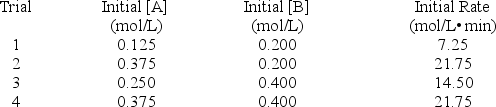
(Multiple Choice)
4.8/5  (80)
(80) A certain first-order reaction A → B is 25% complete in 42 min at 25°C. What is the half-life of the reaction?
(Multiple Choice)
4.8/5 (73)
(73) Consider the general reaction 5Br-(aq) + BrO3-(aq) + 6H+(aq) → 3Br2(aq) + 3H2O(aq)
For this reaction, which is equal to Δ[Br2]/Δt?
(Multiple Choice)
4.9/5 (70)
(70) The following is an Arrhenius plot of a first-order reaction. The rate constant is measured in units of s-1. 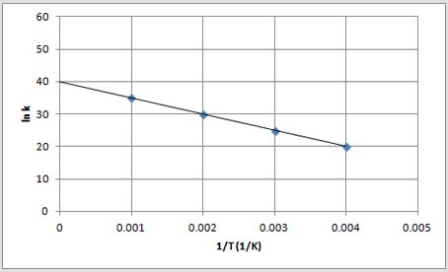 If a catalyst is added to the reaction, which could correspond to an Arrhenius plot of the catalyzed reaction?
 (Multiple Choice)
4.8/5 (74)
(74) Which is the correct unit for a first-order rate constant?
(Multiple Choice)
5.0/5 (91)
(91) The rate law predicted by the following two-step mechanism is Rate = k[A][B].
A → C + B (slow)
A + B → C + E (fast)
(True/False)
4.8/5 (79)
(79) The step of the reaction mechanism which is the slowest step is called ________-________.
(Short Answer)
4.8/5 (80)
(80) What is the name given to the slowest step in the mechanism of a reaction?
(Multiple Choice)
4.8/5 (89)
(89) Below is a plot of the reaction of A decomposing to form products. 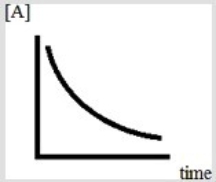 Based on the figure, which might be the order of the reaction with respect to A?
 (Multiple Choice)
4.8/5 (72)
(72) The reaction A + 2B → Products has been found to have the rate law, rate = k[A][B]2. While holding the concentration of A constant, the concentration of B is increased to three times its initial value. By what factor does the rate of reaction increase?
(Multiple Choice)
4.8/5 (93)
(93) The following initial rate data apply to the reaction F2(g) + 2Cl2O(g) → 2FClO2(g) + Cl2(g). 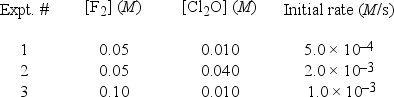 Which of the following is the rate law for this reaction?
 (Multiple Choice)
4.9/5 (69)
(69) 
Filters
- Essay(0)
- Multiple Choice(0)
- Short Answer(0)
- True False(0)
- Matching(0)