



 Chat with AI
Exam 15: Chemical Equilibrium

Exam 1: Chemistry: the Central Science133 Questions
Exam 2: Atoms, Molecules, and Ions124 Questions
Exam 3: Stoichiometry: Ratios of Combination137 Questions
Exam 4: Reactions in Aqueous Solutions146 Questions
Exam 5: Thermochemistry141 Questions
Exam 6: Quantum Theory and the Electronic Structure of Atoms135 Questions
Exam 7: Electron Configuration and the Periodic Table120 Questions
Exam 8: Chemical Bonding I: Basic Concepts102 Questions
Exam 9: Chemical Bonding II: Molecular Geometry and Bonding Theories139 Questions
Exam 10: Gases137 Questions
Exam 11: Intermolecular Forces and the Physical Properties of Liquids and Solids137 Questions
Exam 12: Modern Materials108 Questions
Exam 13: Physical Properties of Solutions151 Questions
Exam 14: Chemical Kinetics132 Questions
Exam 15: Chemical Equilibrium146 Questions
Exam 16: Acids and Bases137 Questions
Exam 17: Acid-Base Equilibria and Solubility Equilibria133 Questions
Exam 18: Entropy, Free Energy, and Equilibrium107 Questions
Exam 19: Electrochemistry122 Questions
Exam 20: Nuclear Chemistry127 Questions
Exam 21: Environmental Chemistry135 Questions
Exam 22: Coordination Chemistry132 Questions
Exam 23: Metallurgy and the Chemistry of Metals152 Questions
Exam 24: Nonmetallic Elements and Their Compounds117 Questions
Exam 25: Organic Chemistry121 Questions
Select questions type


Consider the equilibrium reaction: N2O4(g)  2NO2(g) Which of the following correctly describes the relationship between Kc and KP for the reaction?
Free
(Multiple Choice)
4.8/5  (72)
(72) Correct Answer: Verified
B
Find the temperature at which KP = 42.0 for the reaction H2(g) + I2(g)  2HI(g). [Given: at 25°C, for H2(g), ΔH°f = 0, S° = 131.0 J/mol • K; for I2(g), ΔH°f = 62.26 kJ/mol, S° = 260.6 J/mol • K; for HI(g), ΔH°f = 25.9 kJ/mol, S° = 206.3 J/mol • K; assume that ΔH° and ΔS° are independent of temperature.]
Free
(Multiple Choice)
4.7/5 (79)
(79) Correct Answer:Verified
VerifiedA
Which is the correct equilibrium constant expression for the following reaction? 2C6H6(g) + 15O2(g)  12CO2(g) + 6H2O(g)
Free
(Multiple Choice)
4.8/5 (92)
(92) Correct Answer:Verified
VerifiedB
The equilibrium constant, KP, has a value of 6.5 × 10⁻⁴ at 308 K for the reaction of nitrogen monoxide with chlorine. 2NO(g) + Cl2(g)  2NOCl(g)
What is the value of Kc? (R = 0.08206 L • atm/K • mol)
2NOCl(g)
What is the value of Kc? (R = 0.08206 L • atm/K • mol) (Multiple Choice)
4.9/5 (76)
(76) For the following reaction at equilibrium in a reaction vessel, which one of these changes would cause the I2 concentration to increase? 2NOI(g)  2NO(g) + I2(g), ΔHºrxn = 45.3 kJ/mol
 (Multiple Choice)
4.9/5 (76)
(76) Solid ammonium hydrogen sulfide is introduced into a 2.00-L flask, and the flask is sealed. If this solid decomposes according to the equation NH4HS(s)  NH3(g) + H2S(g), KP = 0.108 at 25°C,
What is the minimum mass of ammonium hydrogen sulfide that must be present in the flask initially if equilibrium is to be established at 25°C? (R = 0.08206 L • atm/K • mol)
NH3(g) + H2S(g), KP = 0.108 at 25°C,
What is the minimum mass of ammonium hydrogen sulfide that must be present in the flask initially if equilibrium is to be established at 25°C? (R = 0.08206 L • atm/K • mol) (Multiple Choice)
4.9/5 (94)
(94) a. State Le Châtelier's principle.
b. The following reaction is at equilibrium in a closed container:
2Fe(OH)3(s)  Fe2O3(s) + 3H2O(g); ΔH°rxn > 0
What effects, if any, will the following actions have on the position of equilibrium? In each case, state the direction of any shift in equilibrium, and give your reasons in one sentence.
(i) adding more Fe(OH)3
(ii) raising the temperature
(iii) adding a more water vapor
Fe2O3(s) + 3H2O(g); ΔH°rxn > 0
What effects, if any, will the following actions have on the position of equilibrium? In each case, state the direction of any shift in equilibrium, and give your reasons in one sentence.
(i) adding more Fe(OH)3
(ii) raising the temperature
(iii) adding a more water vapor (Essay)
4.7/5 (91)
(91) Stearic acid, nature's most common fatty acid, dimerizes when dissolved in hexane: 2C17H35COOH  (C17H35COOH)2; ΔH°rxn = -172 kJ/mol
The equilibrium constant for this reaction at 28°C is 2.9 × 10³. Estimate the equilibrium constant at 38°C. (R = 8.314 J/K• mol)
(C17H35COOH)2; ΔH°rxn = -172 kJ/mol
The equilibrium constant for this reaction at 28°C is 2.9 × 10³. Estimate the equilibrium constant at 38°C. (R = 8.314 J/K• mol) (Multiple Choice)
5.0/5 (78)
(78) In the gas phase, methyl isonitrile (CH3NC) isomerizes to acetonitrile (CH3CN), H3C-N≡C(g)  H3C-C≡N(g)
With ΔH° = -89.5 kJ/mol and ΔG° = - 73.8 kJ/mol at 25°C. Find the equilibrium constant for this reaction at 100°C.
H3C-C≡N(g)
With ΔH° = -89.5 kJ/mol and ΔG° = - 73.8 kJ/mol at 25°C. Find the equilibrium constant for this reaction at 100°C. (Multiple Choice)
4.9/5 (72)
(72) What is the free energy change, ΔG°, for the equilibrium between hydrogen iodide, hydrogen, and iodine at 453°C? (R = 8.314 J/K• mol) 2HI(g)  H2(g) + I2(g)Kc = 0.020 at T = 453°C
 (Multiple Choice)
4.7/5 (76)
(76) Iron(III) oxide can be reduced by carbon monoxide. Fe2O3(s) + 3CO(g)  2Fe(s) + 3CO2(g)
Use the following thermodynamic data at 298 K to determine the equilibrium constant at this temperature. (R = 8.314 J/K • mol)

2Fe(s) + 3CO2(g)
Use the following thermodynamic data at 298 K to determine the equilibrium constant at this temperature. (R = 8.314 J/K • mol) (Multiple Choice)
4.8/5 (68)
(68) If one starts with pure NO2(g) at a pressure of 0.500 atm, the total pressure inside the reaction vessel when 2NO2(g)  2NO(g) + O2(g) reaches equilibrium is 0.674 atm. What is the equilibrium partial pressure of NO2?
 (Multiple Choice)
4.7/5 (77)
(77) When the following reaction is at equilibrium, which relationship is always true? 2NOCl(g)  2NO(g) + Cl2(g)
 (Multiple Choice)
4.8/5 (82)
(82) Hydrogen iodide decomposes according to the equation 2HI(g)  H2(g) + I2(g), for which Kc = 0.0156 at 400ºC. Suppose 0.550 mol HI is injected into a 2.00-L reaction vessel at 400ºC. What is the concentration of HI at equilibrium?
 (Multiple Choice)
4.9/5 (76)
(76) A 6.0-L vessel was found to contain 1.0 mol BrCl3, 2.0 mol Br2 and 6.0 mol Cl2 at equilibrium. What is the equilibrium constant, Kc, for this equilibrium mixture for the reaction
2BrCl3(g)  Br2(g) + 3Cl2(g)?
 (Multiple Choice)
4.7/5 (74)
(74) For the endothermic reaction A2(g)  2A(g), a snapshot of an equilibrium mixture of A(g) and A2(g) may look as follows. (Each circle represents 1.0 mol of A atoms, and the volume of the box is 1.0 L.)
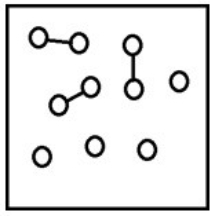 What is the equilibrium constant Kc for this reaction at 298 K? (R = 0.08206 L • atm/K • mol)
2A(g), a snapshot of an equilibrium mixture of A(g) and A2(g) may look as follows. (Each circle represents 1.0 mol of A atoms, and the volume of the box is 1.0 L.) What is the equilibrium constant Kc for this reaction at 298 K? (R = 0.08206 L • atm/K • mol) (Multiple Choice)
4.8/5 (76)
(76) Suppose 75.0 g of PCl5(g) is introduced into an evacuated 3.00-L vessel and allowed to reach equilibrium at 250ºC. PCl5(g)  PCl3(g) + Cl2(g)
If KP = 1.80 for this reaction, what is the total pressure inside the vessel at equilibrium? (R = 0.0821 atm • L/mol • K)
PCl3(g) + Cl2(g)
If KP = 1.80 for this reaction, what is the total pressure inside the vessel at equilibrium? (R = 0.0821 atm • L/mol • K) (Multiple Choice)
4.8/5 (74)
(74) When the substances in the equation below are at equilibrium, at pressure, P, and temperature, T, the equilibrium can be shifted to favor the products by CuO(s) + H2(g)  H2O(g) + Cu(s) ΔHºrxn = -2.0 kJ/mol
 (Multiple Choice)
4.8/5 (82)
(82) Suppose 15.00 g of solid ammonium hydrogen sulfide is introduced into a 500.-mL flask at 25°C, the flask is sealed, and the system is allowed to reach equilibrium. What is the partial pressure of ammonia in this flask if KP = 0.108 at 25°C for the following reaction? NH4HS(s)  NH3(g) + H2S(g)
 (Multiple Choice)
4.9/5 (78)
(78) 
Filters
- Essay(0)
- Multiple Choice(0)
- Short Answer(0)
- True False(0)
- Matching(0)