



 Chat with AI
Exam 15: Chemical Equilibrium

Exam 1: Chemistry: the Central Science133 Questions
Exam 2: Atoms, Molecules, and Ions124 Questions
Exam 3: Stoichiometry: Ratios of Combination137 Questions
Exam 4: Reactions in Aqueous Solutions146 Questions
Exam 5: Thermochemistry141 Questions
Exam 6: Quantum Theory and the Electronic Structure of Atoms135 Questions
Exam 7: Electron Configuration and the Periodic Table120 Questions
Exam 8: Chemical Bonding I: Basic Concepts102 Questions
Exam 9: Chemical Bonding II: Molecular Geometry and Bonding Theories139 Questions
Exam 10: Gases137 Questions
Exam 11: Intermolecular Forces and the Physical Properties of Liquids and Solids137 Questions
Exam 12: Modern Materials108 Questions
Exam 13: Physical Properties of Solutions151 Questions
Exam 14: Chemical Kinetics132 Questions
Exam 15: Chemical Equilibrium146 Questions
Exam 16: Acids and Bases137 Questions
Exam 17: Acid-Base Equilibria and Solubility Equilibria133 Questions
Exam 18: Entropy, Free Energy, and Equilibrium107 Questions
Exam 19: Electrochemistry122 Questions
Exam 20: Nuclear Chemistry127 Questions
Exam 21: Environmental Chemistry135 Questions
Exam 22: Coordination Chemistry132 Questions
Exam 23: Metallurgy and the Chemistry of Metals152 Questions
Exam 24: Nonmetallic Elements and Their Compounds117 Questions
Exam 25: Organic Chemistry121 Questions
Select questions type


For the following reaction at 25ºC, is 3 × 1024. 2SO2(g) + O2(g)  2SO3(g)
What is Kc at this temperature? (R = 0.08206 L • atm/K • mol)
2SO3(g)
What is Kc at this temperature? (R = 0.08206 L • atm/K • mol) (Multiple Choice)
4.9/5  (87)
(87) The equilibrium constants (expressed in atm) for the chemical reaction N2(g) + O2(g)  2NO(g) are KP = 1.1 × 10⁻³ and 3.6 × 10⁻³ at 2200 K and 2500 K, respectively.
Which statement is true?
2NO(g) are KP = 1.1 × 10⁻³ and 3.6 × 10⁻³ at 2200 K and 2500 K, respectively.
Which statement is true? (Multiple Choice)
4.9/5 (87)
(87) For the reaction SO2(g) + NO2(g)  SO3(g) + NO(g), the equilibrium constant Kc is 18.0 at 1200ºC. If 1.0 mole of SO2 and 2.0 moles of NO2 are placed in a 20.0-L container, what concentration of SO3 will be present at equilibrium?
 (Multiple Choice)
4.8/5 (75)
(75) If the system 3H2(g) + N2(g)  2NH3(g) is at equilibrium and more N2 is added, a net reaction that consumes some of the added N2 will occur until a new equilibrium is reached.
 (True/False)
4.9/5 (76)
(76) At 250ºC, the equilibrium constant, KP, for the reaction PCl5(g)  PCl3(g) + Cl2(g) is 1.80. Sufficient PCl5 is put into a reaction vessel to give an initial pressure of 2.74 atm at 250ºC. What is the partial pressure of PCl5 after the system has reached equilibrium.
 (Multiple Choice)
4.9/5 (95)
(95) When a reaction system reaches equilibrium, the forward and reverse reactions stop.
(True/False)
4.9/5 (80)
(80) When the concentrations of both the reactants and products remain constant because the forward and reverse reactions are occurring at the same rate then the system is ________.
(Short Answer)
4.9/5 (83)
(83) For the reaction HCONH2(g)  NH3(g) + CO(g), Kc = 4.84 at 400 K. If ΔH° for this reaction is 29 kJ/mol, find Kc at 500 K.
 (Multiple Choice)
4.8/5 (88)
(88) For the following reaction at equilibrium, which one of the changes below would cause the equilibrium to shift to the left? 2NOBr(g)  2NO(g) + Br2(g), ΔHºrxn = 30 kJ/mol
 (Multiple Choice)
4.8/5 (81)
(81) In the gas phase, formic acid forms a dimer, 2HCOOH(g)  (HCOOH)2(g). For this reaction, ΔH° = -60.1 kJ/mol and ΔG° = -13.9 kJ/mol at 25°C. Find the equilibrium constant (KP) for this reaction at 75 °C.
 (Multiple Choice)
4.9/5 (69)
(69) Which is the correct mass-action expression, Qc, for the following chemical reaction? Sn2+(aq) + ½ O2(g) + 3H2O(l)  SnO2(s) + 2H3O+(aq)
 (Multiple Choice)
4.9/5 (79)
(79) The equilibrium constant, Kc, for the reaction PCl3(g) + Cl2(g)  PCl5(g) is 49 at 230°C.
If 0.70 mol of PCl3 is added to 0.70 mol of Cl2 in a 1.00-L reaction vessel at 230°C, what is the concentration of PCl3 when equilibrium has been established?
PCl5(g) is 49 at 230°C.
If 0.70 mol of PCl3 is added to 0.70 mol of Cl2 in a 1.00-L reaction vessel at 230°C, what is the concentration of PCl3 when equilibrium has been established? (Multiple Choice)
4.9/5 (96)
(96) Suppose 4.2 mol of oxygen and 4.0 mol of NO are introduced to an evacuated 0.50-L reaction vessel. At a specific temperature, the equilibrium 2NO(g) + O2(g)  2NO2(g) is reached when [NO] = 1.6 M. Calculate Kc for the reaction at this temperature.
 (Short Answer)
4.9/5 (83)
(83) The equilibrium constant, KP, for the reaction H2(g) + I2(g)  2HI(g) is 55.2 at 425°C.
A rigid cylinder at that temperature contains 0.127 atm of hydrogen, 0.134 atm of iodine, and 1.055 atm of hydrogen iodide. Is the system at equilibrium?
2HI(g) is 55.2 at 425°C.
A rigid cylinder at that temperature contains 0.127 atm of hydrogen, 0.134 atm of iodine, and 1.055 atm of hydrogen iodide. Is the system at equilibrium? (Multiple Choice)
4.8/5 (85)
(85) For the endothermic reaction A2(g)  2A(g), a snapshot of an equilibrium mixture of A(g) and A2(g) at low temperature may look as follows. (Each circle represents 1.0 mol of A atoms, and the volume of the box is 1.0 L.)
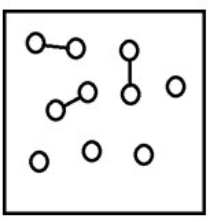 If the system pressure is lowered, what might the new equilibrium system look like?
2A(g), a snapshot of an equilibrium mixture of A(g) and A2(g) at low temperature may look as follows. (Each circle represents 1.0 mol of A atoms, and the volume of the box is 1.0 L.) If the system pressure is lowered, what might the new equilibrium system look like? (Multiple Choice)
4.8/5 (86)
(86) 
Filters
- Essay(0)
- Multiple Choice(0)
- Short Answer(0)
- True False(0)
- Matching(0)