



 Chat with AI
Exam 15: Chemical Equilibrium

Exam 1: Chemistry: the Central Science133 Questions
Exam 2: Atoms, Molecules, and Ions124 Questions
Exam 3: Stoichiometry: Ratios of Combination137 Questions
Exam 4: Reactions in Aqueous Solutions146 Questions
Exam 5: Thermochemistry141 Questions
Exam 6: Quantum Theory and the Electronic Structure of Atoms135 Questions
Exam 7: Electron Configuration and the Periodic Table120 Questions
Exam 8: Chemical Bonding I: Basic Concepts102 Questions
Exam 9: Chemical Bonding II: Molecular Geometry and Bonding Theories139 Questions
Exam 10: Gases137 Questions
Exam 11: Intermolecular Forces and the Physical Properties of Liquids and Solids137 Questions
Exam 12: Modern Materials108 Questions
Exam 13: Physical Properties of Solutions151 Questions
Exam 14: Chemical Kinetics132 Questions
Exam 15: Chemical Equilibrium146 Questions
Exam 16: Acids and Bases137 Questions
Exam 17: Acid-Base Equilibria and Solubility Equilibria133 Questions
Exam 18: Entropy, Free Energy, and Equilibrium107 Questions
Exam 19: Electrochemistry122 Questions
Exam 20: Nuclear Chemistry127 Questions
Exam 21: Environmental Chemistry135 Questions
Exam 22: Coordination Chemistry132 Questions
Exam 23: Metallurgy and the Chemistry of Metals152 Questions
Exam 24: Nonmetallic Elements and Their Compounds117 Questions
Exam 25: Organic Chemistry121 Questions
Select questions type


Hydrogen peroxide may decompose to form water and oxygen gas according to the following reaction. 2H2O2(g)  2H2O(g) + O2(g)
In a particular experiment, 1.75 moles of H2O2 were placed in a 2.5-L reaction chamber at 307ºC. After equilibrium was reached, 1.20 moles of H2O2 remained. What is Kc for the reaction?
2H2O(g) + O2(g)
In a particular experiment, 1.75 moles of H2O2 were placed in a 2.5-L reaction chamber at 307ºC. After equilibrium was reached, 1.20 moles of H2O2 remained. What is Kc for the reaction? (Multiple Choice)
4.9/5  (73)
(73) A change in a concentration will not change the position of equilibrium.
(True/False)
4.8/5 (71)
(71) The equilibrium constant KP at 427°C for the reaction N2(g) + 3H2(g)  2NH3(g) is 9.4 × 10⁻⁵. What is ΔG° for the reaction under these conditions? (R = 8.314 J/K • mol)
 (Multiple Choice)
4.8/5 (85)
(85) For the common allotropes of carbon (graphite and diamond), C(gr)  C(dia) with equilibrium constant K = 0.32. The molar volumes of graphite and diamond are, respectively, 5.30 cm3/mol and 3.42 cm3/mol; ΔHf of diamond is 1.90 kJ/mol. These data suggest that the formation of diamond is favored at
 (Multiple Choice)
4.8/5 (73)
(73) Consider the following reactions and their associated equilibrium constants: A + 2B  C K1
C
 D + E K2
For the reaction A + 2B
 D + E, having equilibrium constant Kc
C K1
C D + E K2
For the reaction A + 2B D + E, having equilibrium constant Kc (Multiple Choice)
4.8/5 (73)
(73) What is defined as a fraction with product concentrations in the numerator and reactant concentrations in the denominator and with each concentration raised to a power equal to the corresponding stoichiometric coefficient in the balanced chemical equation?
(Multiple Choice)
4.8/5 (80)
(80) Nitric oxide and bromine were allowed to react in a sealed container. When equilibrium was reached, the following partial pressures of three gases were measured: NO: 0.526 atm; Br2 : 1.59 atm; NOBr: 7.68 atm. Calculate KP for the reaction. 2NO(g) + Br2(g)  2NOBr(g)
 (Multiple Choice)
4.7/5 (82)
(82) For the endothermic reaction A2 (g)  2A(g), a snapshot of an equilibrium mixture of A(g) and A2 (g) at low temperature may look as follows. (Each circle represents 1.0 mol of A atoms, and the volume of the box is 1.0 L.)
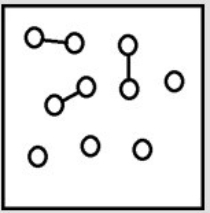 If the temperature is raised, what might the new equilibrium system look like?
2A(g), a snapshot of an equilibrium mixture of A(g) and A2 (g) at low temperature may look as follows. (Each circle represents 1.0 mol of A atoms, and the volume of the box is 1.0 L.) If the temperature is raised, what might the new equilibrium system look like? (Multiple Choice)
4.8/5 (82)
(82) Calculate KP for the reaction 2NOCl(g)  2NO(g) + Cl2(g) at 400.°C if Kc at 400.°C for this reaction is 2.1 × 10⁻². (R = 0.08206 L • atm/K • mol)
 (Multiple Choice)
4.7/5 (73)
(73) The standard free energy of formation of gaseous hydrogen iodide is 1.30 kJ/mol at 25°C. What is KP for the reaction H2(g) + I2(g)  2HI(g) at this temperature?
 (Multiple Choice)
5.0/5 (68)
(68) Calculate the equilibrium constant at 25°C for the reaction of methane with water to form carbon dioxide and hydrogen. The data below are values at 25°C.(R = 8.314 J/K • mol) CH4(g) + 2H2O(g)  CO2(g) + 4H2(g)

CO2(g) + 4H2(g) (Multiple Choice)
4.8/5 (88)
(88) Compounds A, B, and C react according to the following equation. 3A(g) + 2B(g)  2C(g)
At 100°C a mixture of these gases at equilibrium showed that [A] = 0.855 M, [B] = 1.23 M, and [C] = 1.75 M. What is the value of Kc for this reaction?
2C(g)
At 100°C a mixture of these gases at equilibrium showed that [A] = 0.855 M, [B] = 1.23 M, and [C] = 1.75 M. What is the value of Kc for this reaction? (Multiple Choice)
4.9/5 (86)
(86) In which of these gas-phase equilibria is the yield of products increased by increasing the total pressure on the reaction mixture?
(Multiple Choice)
4.9/5 (80)
(80) Which of the following statements is incorrect regarding equilibrium?
(Multiple Choice)
4.8/5 (76)
(76) For the reaction of A + B  C + D + heat, the reverse reaction is exothermic.
 (True/False)
4.7/5 (80)
(80) For the following reaction at equilibrium, which choice gives a change that will shift the position of equilibrium to favor formation of more products? 2NOBr(g)  2NO(g) + Br2(g), ΔHºrxn = 30 kJ/mol
 (Multiple Choice)
4.8/5 (66)
(66) Suppose 25.0 g of HI(g) is injected into a 4.00-L reaction vessel that contains 20.0 g of I2(g). When the system comes to equilibrium at 400.ºC, what will be the total pressure inside the reaction vessel? (R = 0.08206 L • atm/K • mol) 2HI(g)  H2(g) + I2(g), Kc = 0.0156 at 400.ºC
 (Multiple Choice)
4.9/5 (77)
(77) Which represents the correct relationship between the Gibbs free energy and the equilibrium constant?
(Multiple Choice)
4.9/5 (88)
(88) The following reaction is at equilibrium in a sealed container. N2(g) + 3H2(g)  2NH3(g); ΔH°rxn < 0
Which, if any, of the following actions will increase the value of the equilibrium constant, Kc?
2NH3(g); ΔH°rxn < 0
Which, if any, of the following actions will increase the value of the equilibrium constant, Kc? (Multiple Choice)
4.9/5 (75)
(75) A(n) ________ means that the products of the reaction can react to form reactants.
(Short Answer)
4.9/5 (75)
(75) 
Filters
- Essay(0)
- Multiple Choice(0)
- Short Answer(0)
- True False(0)
- Matching(0)