



 Chat with AI
Exam 15: Chemical Equilibrium

Exam 1: Chemistry: the Central Science133 Questions
Exam 2: Atoms, Molecules, and Ions124 Questions
Exam 3: Stoichiometry: Ratios of Combination137 Questions
Exam 4: Reactions in Aqueous Solutions146 Questions
Exam 5: Thermochemistry141 Questions
Exam 6: Quantum Theory and the Electronic Structure of Atoms135 Questions
Exam 7: Electron Configuration and the Periodic Table120 Questions
Exam 8: Chemical Bonding I: Basic Concepts102 Questions
Exam 9: Chemical Bonding II: Molecular Geometry and Bonding Theories139 Questions
Exam 10: Gases137 Questions
Exam 11: Intermolecular Forces and the Physical Properties of Liquids and Solids137 Questions
Exam 12: Modern Materials108 Questions
Exam 13: Physical Properties of Solutions151 Questions
Exam 14: Chemical Kinetics132 Questions
Exam 15: Chemical Equilibrium146 Questions
Exam 16: Acids and Bases137 Questions
Exam 17: Acid-Base Equilibria and Solubility Equilibria133 Questions
Exam 18: Entropy, Free Energy, and Equilibrium107 Questions
Exam 19: Electrochemistry122 Questions
Exam 20: Nuclear Chemistry127 Questions
Exam 21: Environmental Chemistry135 Questions
Exam 22: Coordination Chemistry132 Questions
Exam 23: Metallurgy and the Chemistry of Metals152 Questions
Exam 24: Nonmetallic Elements and Their Compounds117 Questions
Exam 25: Organic Chemistry121 Questions
Select questions type


At equilibrium, the rate of the forward reaction is equal to the rate of the reverse reaction.
(True/False)
4.9/5  (68)
(68) At 25°C, the equilibrium constant, Kc, for the reaction 2A(g)  B(g) + C(g) is 0.0350.
A mixture of 8.00 moles of B and 12.00 moles of C in a 20.0-L container is allowed to come to equilibrium. What is the equilibrium concentration of A?
B(g) + C(g) is 0.0350.
A mixture of 8.00 moles of B and 12.00 moles of C in a 20.0-L container is allowed to come to equilibrium. What is the equilibrium concentration of A? (Multiple Choice)
4.9/5 (85)
(85) At 450°C, tert-butyl alcohol decomposes into water and isobutene. (CH3)3COH(g)  (CH3)2CCH2(g) + H2O(g)
A reaction vessel contains these compounds at equilibrium. What will happen if the volume of the container is reduced by 50% at constant temperature?
(CH3)2CCH2(g) + H2O(g)
A reaction vessel contains these compounds at equilibrium. What will happen if the volume of the container is reduced by 50% at constant temperature? (Multiple Choice)
4.9/5 (71)
(71) What is used to explain the effect of a stress that has been applied to a system at equilibrium?
(Short Answer)
4.8/5 (90)
(90) A sample of solid naphthalene is introduced into an evacuated flask. Using the data below, what is the equilibrium vapor pressure of naphthalene (C10H8) in the flask at 35°C? 
(Multiple Choice)
4.9/5 (75)
(75) The solubility product constant, Ksp, at 25°C for AgI(s) in water has the value 8.3 × 10⁻¹⁷. Calculate ΔG at 25°C for the process AgI(s)  Ag+(aq) + I-(aq) where [Ag+] = 9.1 × 10⁻⁹ M and [I-] = 9.1 × 10⁻⁹ M. (R = 8.314 J/K • mol)
 (Multiple Choice)
4.9/5 (79)
(79) What is defined as a fraction with equilibrium product concentrations in the numerator and equilibrium reactant concentrations in the denominator and each concentration raised to a power equal to the corresponding stoichiometric coefficient in the balanced chemical equation?
(Multiple Choice)
4.8/5 (71)
(71) At 340. K, KP = 69 for the reaction H2(g) + I2(g)  2HI(g). Suppose 50.0 g of HI is injected into an evacuated 5.00-L rigid cylinder at 340. K. What is the total pressure inside the cylinder when the system comes to equilibrium?
 (Multiple Choice)
4.8/5 (76)
(76) When the reaction 2H2S(g)  2H2(g) + S2(g) is carried out at 1065°C, KP = 0.012. Starting with pure H2S at 1065°C, what must the initial pressure of H2S be if the equilibrated mixture at this temperature is to contain 0.250 atm of H2(g)?
 (Multiple Choice)
4.9/5 (61)
(61) At 850°C, the equilibrium constant, KP, for the reaction C(s) + CO2(g)  2CO(g) has a value of 10.7.
If the total pressure in the system at equilibrium is 1.000 atm, what is the partial pressure of carbon monoxide at equilibrium?
2CO(g) has a value of 10.7.
If the total pressure in the system at equilibrium is 1.000 atm, what is the partial pressure of carbon monoxide at equilibrium? (Multiple Choice)
4.9/5 (89)
(89) Based on the following data, what is Ksp at 298 K of barium carbonate, BaCO3? (R = 8.314 J/K • mol) 
(Multiple Choice)
4.7/5 (91)
(91) Carbon tetrachloride reacts at high temperatures with oxygen to produce two toxic gases, phosgene and chlorine. CCl4(g) + ½O2(g)  COCl2(g) + Cl2(g), Kc = 4.4 × 10⁹ at 1000 K
What is Kc for the following reaction?
2CCl4(g) + O2(g)
 2COCl2(g) + 2Cl2(g)
COCl2(g) + Cl2(g), Kc = 4.4 × 10⁹ at 1000 K
What is Kc for the following reaction?
2CCl4(g) + O2(g) 2COCl2(g) + 2Cl2(g) (Multiple Choice)
4.8/5 (65)
(65) Which of the following is the expression that relates Kc to KP?
(Multiple Choice)
4.8/5 (94)
(94) Suppose 50.0 g of N2O4 is introduced into an evacuated 2.00-L vessel and allowed to come to equilibrium with its decomposition product, N2O4(g)  2NO2(g). For this reaction Kc = 0.133. Once the system has reached equilibrium, 5.00 g of NO2 is injected into the vessel, and the system is allowed to equilibrate once again. What is the mass of NO2 in the final equilibrium mixture?
 (Multiple Choice)
4.8/5 (84)
(84) For the endothermic reaction A2(g)  2A(g), a snapshot of an equilibrium mixture of A(g) and A2(g) may look as follows. (Each circle represents 1.0 mol of A atoms, and the volume of the box is 1.0 L.)
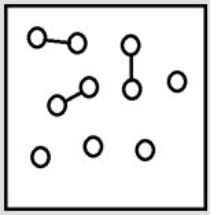 What is the equilibrium constant KP for this reaction at 298 K? (R = 0.08206 L • atm/K • mol)
2A(g), a snapshot of an equilibrium mixture of A(g) and A2(g) may look as follows. (Each circle represents 1.0 mol of A atoms, and the volume of the box is 1.0 L.) What is the equilibrium constant KP for this reaction at 298 K? (R = 0.08206 L • atm/K • mol) (Multiple Choice)
4.8/5 (70)
(70) At elevated temperatures, hydrogen iodide may decompose to form hydrogen gas and iodine gas, as follows. 2HI(g)  H2(g) + I2(g)
In a particular experiment, the concentrations at equilibrium were measured to be [HI] = 0.85 mol/L, [I2] = 0.60 mol/L, and [H2] = 0.27 mol/L. What is Kc for the above reaction?
H2(g) + I2(g)
In a particular experiment, the concentrations at equilibrium were measured to be [HI] = 0.85 mol/L, [I2] = 0.60 mol/L, and [H2] = 0.27 mol/L. What is Kc for the above reaction? (Multiple Choice)
5.0/5 (68)
(68) The reaction system POBr3(g)  POBr(g) + Br2(g) is at equilibrium. Which of the following statements describes the behavior of the system if POBr is added to the container?
 (Multiple Choice)
4.8/5 (95)
(95) The equilibrium constant for the reaction AgBr(s)  Ag+(aq) + Br- (aq) is the solubility product constant, Ksp = 7.7 × 10⁻¹³ at 25°C. Calculate ΔG for the reaction when [Ag+] = 1.0 × 10⁻² M and [Br-] = 1.0 × 10⁻³ M. Is the reaction spontaneous or nonspontaneous at these concentrations? (R = 8.314 J/K • mol)
 (Multiple Choice)
4.9/5 (86)
(86) The reaction system POBr3(g)  POBr(g) + Br2(g) is at equilibrium. Which of the following statements describes the behavior of the system if the partial pressure of bromine is reduced by 75% as equilibrium is established?
 (Multiple Choice)
4.8/5 (76)
(76) Hydrogen sulfide can be formed in the following reaction: H2(g) +  S2(g)
 H2S(g); ΔH°rxn = -92 kJ/mol
The equilibrium constant,KP,is 106 at 1023 K. Estimate the value of KP at 1218 K. (R = 8.314 J/K • mol)
S2(g) H2S(g); ΔH°rxn = -92 kJ/mol
The equilibrium constant,KP,is 106 at 1023 K. Estimate the value of KP at 1218 K. (R = 8.314 J/K • mol) (Multiple Choice)
4.8/5 (78)
(78) 
Filters
- Essay(0)
- Multiple Choice(0)
- Short Answer(0)
- True False(0)
- Matching(0)