



 Chat with AI
Exam 15: Chemical Equilibrium

Exam 1: Chemistry: the Central Science133 Questions
Exam 2: Atoms, Molecules, and Ions124 Questions
Exam 3: Stoichiometry: Ratios of Combination137 Questions
Exam 4: Reactions in Aqueous Solutions146 Questions
Exam 5: Thermochemistry141 Questions
Exam 6: Quantum Theory and the Electronic Structure of Atoms135 Questions
Exam 7: Electron Configuration and the Periodic Table120 Questions
Exam 8: Chemical Bonding I: Basic Concepts102 Questions
Exam 9: Chemical Bonding II: Molecular Geometry and Bonding Theories139 Questions
Exam 10: Gases137 Questions
Exam 11: Intermolecular Forces and the Physical Properties of Liquids and Solids137 Questions
Exam 12: Modern Materials108 Questions
Exam 13: Physical Properties of Solutions151 Questions
Exam 14: Chemical Kinetics132 Questions
Exam 15: Chemical Equilibrium146 Questions
Exam 16: Acids and Bases137 Questions
Exam 17: Acid-Base Equilibria and Solubility Equilibria133 Questions
Exam 18: Entropy, Free Energy, and Equilibrium107 Questions
Exam 19: Electrochemistry122 Questions
Exam 20: Nuclear Chemistry127 Questions
Exam 21: Environmental Chemistry135 Questions
Exam 22: Coordination Chemistry132 Questions
Exam 23: Metallurgy and the Chemistry of Metals152 Questions
Exam 24: Nonmetallic Elements and Their Compounds117 Questions
Exam 25: Organic Chemistry121 Questions
Select questions type


5.00 mol of ammonia are introduced into a 5.00-L reactor vessel in which it partially dissociates at high temperatures.
2NH3(g)  3H2(g) + N2(g)
At equilibrium at a particular temperature, 1.00 mole of ammonia remains. Calculate Kc for the reaction.
3H2(g) + N2(g)
At equilibrium at a particular temperature, 1.00 mole of ammonia remains. Calculate Kc for the reaction. (Short Answer)
4.7/5  (72)
(72) Phosgene, COCl2, a poisonous gas, decomposes as follows. COCl2(g)  CO(g) + Cl2(g).
At 900.ºC, Kc = 0.083. What is KP at this temperature? (R = 0.08206 L • atm/K • mol)
CO(g) + Cl2(g).
At 900.ºC, Kc = 0.083. What is KP at this temperature? (R = 0.08206 L • atm/K • mol) (Multiple Choice)
4.9/5 (88)
(88) Nitrosyl chloride (NOCl) decomposes at elevated temperatures according to the equation 2NOCl(g)  2NO(g) + Cl2(g). What is KP for this reaction at 227°C?
For this reaction ΔH° = 81.2 kJ/mol and ΔS° = 128 J/K • mol. (R = 8.314 J/K • mol)
2NO(g) + Cl2(g). What is KP for this reaction at 227°C?
For this reaction ΔH° = 81.2 kJ/mol and ΔS° = 128 J/K • mol. (R = 8.314 J/K • mol) (Multiple Choice)
4.9/5 (82)
(82) For the reaction 2X(g) + Y(g)  2Z(g), Kc = 1.00 ×10³ at 500 K. If at equilibrium the concentration of X is 0.20 M and the concentration of Y is 0.50 M, what is the equilibrium concentration of Z?
 (Multiple Choice)
5.0/5 (85)
(85) During a chemical reaction, what defines when the concentrations of the reactants and products reach a constant level?
(Multiple Choice)
4.9/5 (89)
(89) For the equilibrium A2(g)  2A(g), if a sample of A2(g) is placed in a sealed container and allowed to come to equilibrium, which graph best represents the relationship between Kc and time as equilibrium is established?
 (Multiple Choice)
4.8/5 (78)
(78) Hydrogen iodide decomposes according to the equation 2HI(g)  H2(g) + I2(g), for which Kc = 0.0156 at 400ºC. Suppose 0.550 mol HI was injected into a 2.00-L reaction vessel at 400ºC. What is the concentration of H2 at equilibrium?
 (Multiple Choice)
4.7/5 (76)
(76) Nitric oxide is formed in automobile exhaust when nitrogen and oxygen in air react at high temperatures. N2(g) + O2(g)  2NO(g)
The equilibrium constant KP for the reaction is 0.0025 at 2127°C. If a container is charged with 8.00 atm of nitrogen and 5.00 atm of oxygen and the mixture is allowed to reach equilibrium, what will be the equilibrium partial pressure of nitrogen?
2NO(g)
The equilibrium constant KP for the reaction is 0.0025 at 2127°C. If a container is charged with 8.00 atm of nitrogen and 5.00 atm of oxygen and the mixture is allowed to reach equilibrium, what will be the equilibrium partial pressure of nitrogen? (Multiple Choice)
4.7/5 (88)
(88) For the reaction 2NOCl(g)  2NO(g) + Cl2(g), Kc = 8.0 at a certain temperature. What concentration of NOCl must be put into an empty 4.00 - reaction vessel in order that the equilibrium concentration of NOCl is 1.00 M?
 (Multiple Choice)
4.9/5 (90)
(90) For the nitrogen fixation reaction, 3H2(g) + N2(g)  2NH3(g), Kc = 6.0 × 10⁻² at 500°C. If 0.250 M H2 and 0.050 M NH3 are present at equilibrium, what is the equilibrium concentration of N2?
 (Multiple Choice)
4.7/5 (88)
(88) When a reaction reaches ________, the concentration of the reactants and products will no longer change.
(Short Answer)
4.8/5 (80)
(80) Changing the amount of reactant or product in an equilibrium reaction will always change the equilibrium position, regardless of the physical state of the substance involved.
(True/False)
4.7/5 (73)
(73) The reaction 2H2O2(g)  2H2O(g) + O2(g) is exothermic, ΔHºrxn = -210 kJ/mol. Which one of the following is correct?
 (Multiple Choice)
4.8/5 (79)
(79) Consider the reaction N2(g) + 3H2(g)  2NH3(g). If nitrogen is added to the system at equilibrium, what will happen to the ammonia concentration?
 (Short Answer)
4.9/5 (92)
(92) Consider the reaction N2(g) + O2(g)  2NO(g), for which Kc = 0.10 at 2000ºC. Starting with initial concentrations of 0.040 M for N2 and 0.040 M for O2 what is the equilibrium concentration of NO?
 (Multiple Choice)
4.9/5 (73)
(73) The following reactions occur at 500 K. Arrange them in order of increasing tendency to proceed to completion (least completion → greatest completion). 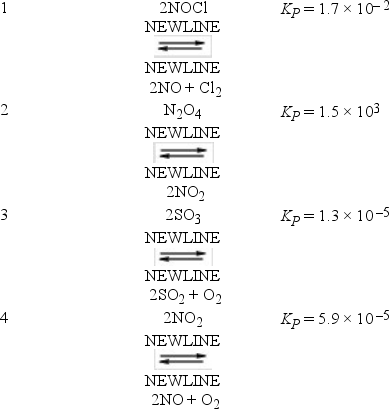
(Multiple Choice)
4.8/5 (76)
(76) A container was charged with hydrogen, nitrogen, and ammonia gases at 120°C and the system was allowed to reach equilibrium. What will happen if the volume of the container is increased at constant temperature? 3H2(g) + N2(g)  2NH3(g)
 (Multiple Choice)
4.9/5 (84)
(84) At 400ºC, Kc = 64 for the equilibrium H2(g) + I2(g)  2HI(g). If 3.00 mol H2 and 3.00 mol I2 are introduced into an empty 4.0-L vessel, what is the equilibrium concentration of HI at 400ºC?
 (Multiple Choice)
4.8/5 (90)
(90) At what temperature is KP = 4.00 for the reaction N2O4(g)  2NO2(g)?
 (R = 8.314 J/K • mol)
2NO2(g)? (R = 8.314 J/K • mol) (Multiple Choice)
4.8/5 (77)
(77) 
Filters
- Essay(0)
- Multiple Choice(0)
- Short Answer(0)
- True False(0)
- Matching(0)