



 Chat with AI
Exam 14: Chemical Kinetics

Exam 1: Chemistry: the Central Science133 Questions
Exam 2: Atoms, Molecules, and Ions124 Questions
Exam 3: Stoichiometry: Ratios of Combination137 Questions
Exam 4: Reactions in Aqueous Solutions146 Questions
Exam 5: Thermochemistry141 Questions
Exam 6: Quantum Theory and the Electronic Structure of Atoms135 Questions
Exam 7: Electron Configuration and the Periodic Table120 Questions
Exam 8: Chemical Bonding I: Basic Concepts102 Questions
Exam 9: Chemical Bonding II: Molecular Geometry and Bonding Theories139 Questions
Exam 10: Gases137 Questions
Exam 11: Intermolecular Forces and the Physical Properties of Liquids and Solids137 Questions
Exam 12: Modern Materials108 Questions
Exam 13: Physical Properties of Solutions151 Questions
Exam 14: Chemical Kinetics132 Questions
Exam 15: Chemical Equilibrium146 Questions
Exam 16: Acids and Bases137 Questions
Exam 17: Acid-Base Equilibria and Solubility Equilibria133 Questions
Exam 18: Entropy, Free Energy, and Equilibrium107 Questions
Exam 19: Electrochemistry122 Questions
Exam 20: Nuclear Chemistry127 Questions
Exam 21: Environmental Chemistry135 Questions
Exam 22: Coordination Chemistry132 Questions
Exam 23: Metallurgy and the Chemistry of Metals152 Questions
Exam 24: Nonmetallic Elements and Their Compounds117 Questions
Exam 25: Organic Chemistry121 Questions
Select questions type


For the chemical reaction A → C, a plot of 1/[A]t versus time was found to give a straight line with a positive slope. What is the order of reaction?
(Multiple Choice)
4.8/5  (73)
(73) The rate law for the reaction 3A → 2B is rate = k[A] with a rate constant of 0.0447 h-1. What is the half-life of the reaction?
(Multiple Choice)
4.9/5 (87)
(87) The oxidation of iodide ions by arsenic acid in acidic aqueous solution occurs according to the net reaction H3AsO4 + 3I- + 2H3O + → H3AsO3 + I3- + 3H2O. The experimental rate law for this reaction is Rate = k [H3AsO4] [I-] [H3O+].
What is the order of the reaction with respect to I-?
(Short Answer)
5.0/5 (77)
(77) The ________ is the name given to the sequence of steps that sum to give the overall reaction.
(Short Answer)
4.9/5 (96)
(96) The units of the rate constant depend on the order of the reaction.
(True/False)
4.7/5 (94)
(94) It takes 42.0 min for the concentration of a reactant in a first-order reaction to drop from 0.45 M to 0.32 M at 25°C. How long will it take for the reaction to be 90% complete?
(Multiple Choice)
4.9/5 (72)
(72) For the reaction 2A + B + 2C → D + E
The following initial rate data were collected at constant temperature. What is the correct rate law for this reaction? 
(Multiple Choice)
4.9/5 (77)
(77) What is the rate expression for the production of X, which is a gas, at constant volume?
(Multiple Choice)
4.9/5 (81)
(81) The activation energy for the following reaction is 60. kJ/mol. Sn2+ + 2Co3+ → Sn4+ + 2Co2+
By what factor will the rate constant increase when the temperature is raised from 10°C to 28°C? (R = 8.314 J/mol• K)
(Multiple Choice)
5.0/5 (81)
(81) The elementary reaction HBr(g) + Br(g) → H(g) + Br2 (g) is endothermic.
Would you expect the rate constant for the back reaction to be smaller or larger than that for the forward reaction? Explain, briefly.
(Essay)
4.9/5 (79)
(79) A catalyst increases the rate of the reaction and is recovered completely at the end of the reaction.
(True/False)
4.8/5 (91)
(91) A reactant R is being consumed in a first-order reaction. What fraction of the initial R is consumed in 4.0 half-lives?
(Multiple Choice)
4.8/5 (73)
(73) What is the activation energy for a reaction if k = 1.89 × 10⁻⁸ s-1 at 540. K and k = 2.45 × 10⁻⁷ s-1 at 601 K?
(Multiple Choice)
4.9/5 (76)
(76) For the reaction C6H14(g) → C6H6(g) + 4H2(g), ΔP(H2)/Δt was found to be 2.5 × 10⁻² atm/s, where ΔP(H2) is the change in pressure of hydrogen. Determine ΔP(C6H14)/Δt for this reaction at the same time.
(Multiple Choice)
4.9/5 (80)
(80) Consider the following potential energy profile for the A → B reaction. How many intermediates are formed? 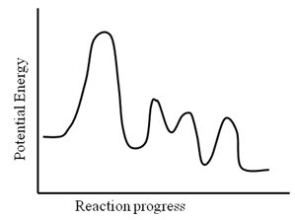
(Multiple Choice)
4.9/5 (82)
(82) The reaction CH3NC(g) → CH3CN(g) is first order with respect to methyl isocyanide, CH3NC. If it takes 10.3 minutes for exactly one quarter of the initial amount of methyl isocyanide to react, what is the rate constant in units of min-1?
(Multiple Choice)
4.8/5 (76)
(76) The following diagram represents the second-order decomposition of A to form X according to the following balanced chemical equation: A → X. Each sphere represents 1.0 mmol of atoms, and the volume of the box is 1.0 L. 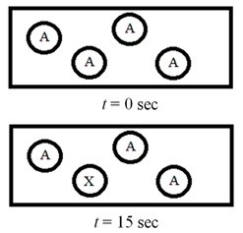 What is the half-life of the reaction?
 (Multiple Choice)
5.0/5 (87)
(87) A first-order reaction has a rate constant of 3.00 × 10⁻³ s-1. The time required for the reaction to be 75.0% complete is
(Multiple Choice)
4.9/5 (87)
(87) According to the collision theory of reaction rates, what are the three requirements which must be met before an elementary reaction between two molecules can occur?
(Essay)
4.9/5 (83)
(83) Consider the following potential energy profile for the A → B reaction. Assuming that the frequency factor for the reaction is 5.5 × 10¹⁰ s-1, what is the rate constant of this first-order reaction at 310 K? 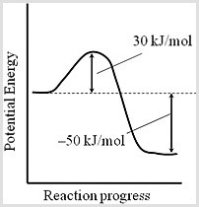
(Multiple Choice)
5.0/5 (92)
(92) 
Filters
- Essay(0)
- Multiple Choice(0)
- Short Answer(0)
- True False(0)
- Matching(0)