



 Chat with AI
Exam 14: Chemical Kinetics

Exam 1: Chemistry: the Central Science133 Questions
Exam 2: Atoms, Molecules, and Ions124 Questions
Exam 3: Stoichiometry: Ratios of Combination137 Questions
Exam 4: Reactions in Aqueous Solutions146 Questions
Exam 5: Thermochemistry141 Questions
Exam 6: Quantum Theory and the Electronic Structure of Atoms135 Questions
Exam 7: Electron Configuration and the Periodic Table120 Questions
Exam 8: Chemical Bonding I: Basic Concepts102 Questions
Exam 9: Chemical Bonding II: Molecular Geometry and Bonding Theories139 Questions
Exam 10: Gases137 Questions
Exam 11: Intermolecular Forces and the Physical Properties of Liquids and Solids137 Questions
Exam 12: Modern Materials108 Questions
Exam 13: Physical Properties of Solutions151 Questions
Exam 14: Chemical Kinetics132 Questions
Exam 15: Chemical Equilibrium146 Questions
Exam 16: Acids and Bases137 Questions
Exam 17: Acid-Base Equilibria and Solubility Equilibria133 Questions
Exam 18: Entropy, Free Energy, and Equilibrium107 Questions
Exam 19: Electrochemistry122 Questions
Exam 20: Nuclear Chemistry127 Questions
Exam 21: Environmental Chemistry135 Questions
Exam 22: Coordination Chemistry132 Questions
Exam 23: Metallurgy and the Chemistry of Metals152 Questions
Exam 24: Nonmetallic Elements and Their Compounds117 Questions
Exam 25: Organic Chemistry121 Questions
Select questions type


For a second-order reaction, if [A]-1 is plotted vs. time, which corresponds to the slope of this plot?
(Multiple Choice)
4.9/5  (86)
(86) The isomerization of cyclopropane follows first-order kinetics. The rate constant at 700. K is 6.20 × 10⁻⁴ min-1, and the half-life at 760. K is 29.0 min. What is the activation energy for this reaction? (R = 8.314 J/mol• K)
(Multiple Choice)
4.9/5 (77)
(77) For each of the following terms/concepts, give a brief explanation or definition.
a. order of a reaction
b. elementary reaction
c. reaction intermediate
(Essay)
4.9/5 (86)
(86) What statement below best describes the graph representing the integrated second-order rate law?
(Multiple Choice)
4.8/5 (90)
(90) The rate law for the reaction H2O2 + 2H+ + 2I- → I2 + 2H2O is rate = k[H2O2][I-]. The following mechanism has been suggested. H2O2 + I- → HOI + OH- (slow)
OH- + H+ → H2O (fast)
HOI + H+ + I- → I2 + H2O (fast)
Identify all intermediates included in this mechanism.
(Multiple Choice)
4.8/5 (72)
(72) What is the slope of a plot of ln k vs. 1/T for the Arrhenius equation k = Ae-(Ea/RT)?
(Multiple Choice)
4.9/5 (95)
(95) The rate constant for a reaction is 4.65 L • mol-1 • s-1. What is the overall order of the reaction?
(Multiple Choice)
4.8/5 (75)
(75) What is the name given to the equation that relates the rate of reaction to the concentrations of reactants?
(Short Answer)
4.9/5 (75)
(75) The following is an Arrhenius plot of a first-order reaction. The rate constant is measured in units of s-1. 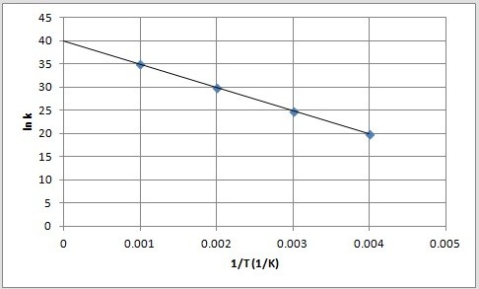 Based on this Arrhenius plot, what is the activation energy of the reaction? (R = 8.314 J/K •mol)
 (Multiple Choice)
4.8/5 (92)
(92) The isomerization of methyl isocyanide, CH3NC → CH3CN, follows first-order kinetics. The half-lives were found to be 161 min at 199°C and 12.5 min at 230.°C. Calculate the activation energy for this reaction. (R = 8.314 J/mol • K)
(Multiple Choice)
4.8/5 (78)
(78) A reaction intermediate is a species corresponding to a local energy maximum on a reaction energy diagram.
(True/False)
4.8/5 (82)
(82) For the overall chemical reaction shown below, which one of the following statements can be rightly assumed? 2H2S(g) + O2(g) → 2S(s) + 2H2O(l)
(Multiple Choice)
4.8/5 (78)
(78) The ________ is the equation relating the rate of the reaction to the concentration of molecule.
(Short Answer)
4.8/5 (69)
(69) For the following reaction, ΔP(C6H14)/Δt was found to be -6.2 × 10⁻³ atm/s. C6H14(g) → C6H6(g) + 4H2(g)
Determine ΔP(H2)/Δt for this reaction at the same time.
(Multiple Choice)
4.8/5 (86)
(86) For the chemical reaction A → B + C, a plot of [A]t versus time is found to give a straight line with a negative slope. What is the order of reaction with respect to A?
(Multiple Choice)
4.7/5 (79)
(79) Ammonium ion (NH4+) reacts with nitrite ion (NO2-) to yield nitrogen gas and liquid water. The following initial rates of reaction have been measured for the given reactant concentrations. 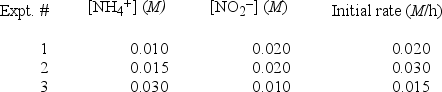 Which of the following is the rate law (rate equation) for this reaction?
 (Multiple Choice)
4.8/5 (93)
(93) The intermediate in a reaction appears in the mechanism of the reaction and in the overall balanced equation.
(True/False)
4.9/5 (85)
(85) ________ describes the reaction rate as being directly proportional to the number of molecular collisions per second.
(Short Answer)
4.8/5 (90)
(90) When the reaction A → B + C is studied, a plot 1/[A]t vs. time gives a straight line with a positive slope. What is the order of the reaction with respect to A?
(Multiple Choice)
4.7/5 (75)
(75) 
Filters
- Essay(0)
- Multiple Choice(0)
- Short Answer(0)
- True False(0)
- Matching(0)