



 Chat with AI
Exam 14: Chemical Kinetics

Exam 1: Chemistry: the Central Science133 Questions
Exam 2: Atoms, Molecules, and Ions124 Questions
Exam 3: Stoichiometry: Ratios of Combination137 Questions
Exam 4: Reactions in Aqueous Solutions146 Questions
Exam 5: Thermochemistry141 Questions
Exam 6: Quantum Theory and the Electronic Structure of Atoms135 Questions
Exam 7: Electron Configuration and the Periodic Table120 Questions
Exam 8: Chemical Bonding I: Basic Concepts102 Questions
Exam 9: Chemical Bonding II: Molecular Geometry and Bonding Theories139 Questions
Exam 10: Gases137 Questions
Exam 11: Intermolecular Forces and the Physical Properties of Liquids and Solids137 Questions
Exam 12: Modern Materials108 Questions
Exam 13: Physical Properties of Solutions151 Questions
Exam 14: Chemical Kinetics132 Questions
Exam 15: Chemical Equilibrium146 Questions
Exam 16: Acids and Bases137 Questions
Exam 17: Acid-Base Equilibria and Solubility Equilibria133 Questions
Exam 18: Entropy, Free Energy, and Equilibrium107 Questions
Exam 19: Electrochemistry122 Questions
Exam 20: Nuclear Chemistry127 Questions
Exam 21: Environmental Chemistry135 Questions
Exam 22: Coordination Chemistry132 Questions
Exam 23: Metallurgy and the Chemistry of Metals152 Questions
Exam 24: Nonmetallic Elements and Their Compounds117 Questions
Exam 25: Organic Chemistry121 Questions
Select questions type


A first-order reaction has a rate constant of 7.5 × 10⁻³ s-1. The time required for the reaction to be 60% complete is
(Multiple Choice)
4.7/5  (73)
(73) Consider the following reaction 8A(g) + 5B(g) → 8C(g) + 6D(g)
If [C] is increasing at the rate of 4.0 mol L-1 • s-1, at what rate is [B] changing?
(Multiple Choice)
4.9/5 (75)
(75) Consider reactions A, B, and C, which have the potential energy profiles shown. Assuming that the reactions have roughly the same frequency factors, which reaction is the slowest? 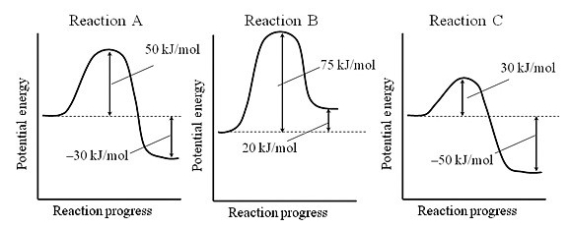
(Multiple Choice)
4.9/5 (74)
(74) The rate law cannot be predicted from the stoichiometry of a reaction.
(True/False)
4.8/5 (81)
(81) A study of the decomposition reaction 3RX2 → 3R + 6X yields the following initial rates. 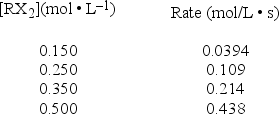 What is the rate constant for the reaction?
 (Multiple Choice)
4.9/5 (78)
(78) 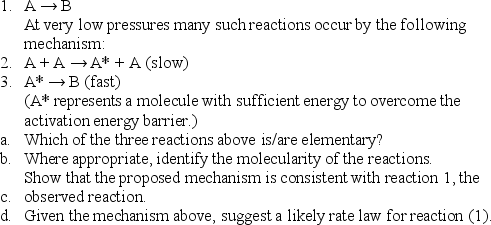
A certain reaction A → products is second order in A. If this reaction is 85% complete in 12 minutes, how long would it take for the reaction to be 15% complete?
(Multiple Choice)
4.9/5 (78)
(78) The following diagram represents the first-order decomposition of A to form X according to the following balanced chemical equation: A → X. Each sphere represents 1.0 mmol of atoms, and the volume of the box is 1.0 L. 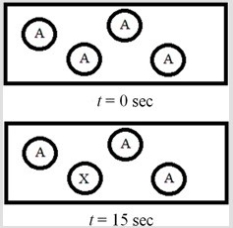 What is the rate constant?
 (Multiple Choice)
4.9/5 (85)
(85) A rate constant obeys the Arrhenius equation, the factor A being 2.2 × 10¹³ s-1 and the activation energy being 150. kJ mol-1. What is the value of the rate constant at 227°C? (R = 8.314 J/mol• K)
(Multiple Choice)
4.9/5 (84)
(84) What is the integrated rate law for a second-order reaction?
(Multiple Choice)
4.9/5 (81)
(81) What is defined as the minimum amount of energy required to initiate a chemical reaction?
(Multiple Choice)
4.7/5 (74)
(74) When the reaction A → B + C is studied, a plot of ln[A]t vs. time gives a straight line with a negative slope. What is the order of the reaction with respect to A?
(Multiple Choice)
4.9/5 (69)
(69) Which equation best describes the average rate for the reaction shown? A(aq) + B(aq) → C(aq) + D(aq)
(Multiple Choice)
4.8/5 (78)
(78) For the reaction BrO3- + 5Br- + 6H+ → 3Br2 + 3H2O at a particular time, -Δ[BrO3-]/Δt = 1.5 × 10⁻² M/s. What is -Δ[Br-]/Δt at the same instant?
(Multiple Choice)
4.9/5 (78)
(78) The rate constant for the reaction 3A → 4B is 6.00 × 10⁻³ L • mol-1 • min-1. How long will it take the concentration of A to drop from 0.75 M to 0.25 M?
(Multiple Choice)
4.8/5 (81)
(81) The thermal decomposition of acetaldehyde, CH3CHO → CH4 + CO, is a second-order reaction. The following data were obtained at 518°C. 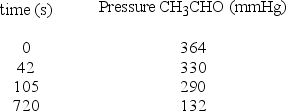 Calculate the rate constant for the decomposition of acetaldehyde from the above data.
 (Multiple Choice)
4.9/5 (79)
(79) Sulfuryl chloride, SO2Cl2(g), decomposes at high temperature to form SO2(g) and Cl2(g). The rate constant at a certain temperature is 4.68 × 10⁻⁵ s-1. What is the order of the reaction?
(Multiple Choice)
4.8/5 (87)
(87) Tetrafluoroethylene, C2F4, can be converted to octafluorocyclobutane, which can be used as a refrigerant or an aerosol propellant. A plot of 1/[C2F4] vs. time gives a straight line with a slope of 0.0448 L •mol-1 • s-1. What is the rate law for this reaction?
(Multiple Choice)
4.8/5 (93)
(93) 
Filters
- Essay(0)
- Multiple Choice(0)
- Short Answer(0)
- True False(0)
- Matching(0)