



 Chat with AI
Exam 14: Chemical Kinetics

Exam 1: Chemistry: the Central Science133 Questions
Exam 2: Atoms, Molecules, and Ions124 Questions
Exam 3: Stoichiometry: Ratios of Combination137 Questions
Exam 4: Reactions in Aqueous Solutions146 Questions
Exam 5: Thermochemistry141 Questions
Exam 6: Quantum Theory and the Electronic Structure of Atoms135 Questions
Exam 7: Electron Configuration and the Periodic Table120 Questions
Exam 8: Chemical Bonding I: Basic Concepts102 Questions
Exam 9: Chemical Bonding II: Molecular Geometry and Bonding Theories139 Questions
Exam 10: Gases137 Questions
Exam 11: Intermolecular Forces and the Physical Properties of Liquids and Solids137 Questions
Exam 12: Modern Materials108 Questions
Exam 13: Physical Properties of Solutions151 Questions
Exam 14: Chemical Kinetics132 Questions
Exam 15: Chemical Equilibrium146 Questions
Exam 16: Acids and Bases137 Questions
Exam 17: Acid-Base Equilibria and Solubility Equilibria133 Questions
Exam 18: Entropy, Free Energy, and Equilibrium107 Questions
Exam 19: Electrochemistry122 Questions
Exam 20: Nuclear Chemistry127 Questions
Exam 21: Environmental Chemistry135 Questions
Exam 22: Coordination Chemistry132 Questions
Exam 23: Metallurgy and the Chemistry of Metals152 Questions
Exam 24: Nonmetallic Elements and Their Compounds117 Questions
Exam 25: Organic Chemistry121 Questions
Select questions type


At 25°C the rate constant for the first-order decomposition of a pesticide solution is 6.40 × 10⁻³ min-1. If the starting concentration of pesticide is 0.0314 M, what concentration will remain after 62.0 min at 25°C?
(Multiple Choice)
4.9/5  (73)
(73) Is a bimolecular reaction necessarily second-order? Is a second order reaction necessarily bimolecular? Answer, with explanations and clarifications.
(Essay)
4.9/5 (76)
(76) What is the name given for the study of how fast reactions take place?
(Multiple Choice)
4.8/5 (96)
(96) The compound RX3 decomposes according to the equation 3RX3 → R + R2X3 + 3X2
In an experiment the following data were collected for the decomposition at 100°C. What is the average rate of change of RX3 over the entire experiment? 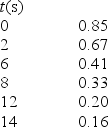
(Multiple Choice)
4.8/5 (67)
(67) The rate of a ________-________ is a constant that is independent of reactant concentration.
(Short Answer)
4.8/5 (97)
(97) A transition state is a species (or state) corresponding to an energy maximum on a reaction energy diagram.
(True/False)
4.9/5 (84)
(84) A ________-________ is a reaction whose rate depends on the concentration of one of the reactants raised to the first power.
(Short Answer)
4.8/5 (83)
(83) A(n) ________ increases the reaction rate without being consumed.
(Short Answer)
4.8/5 (82)
(82) Consider the reaction 2NH3(g) → N2(g) + 3H2(g)
If the rate Δ[H2]/Δt is 0.030 mol L-1 • s-1, what is Δ[NH3]/Δt?
(Multiple Choice)
4.9/5 (81)
(81) For a zeroth-order reaction, if the concentration of reactant A is plotted vs. time, which corresponds to the slope of this plot?
(Multiple Choice)
4.7/5 (95)
(95) A reaction has the following rate law: rate = k[A][B]2
In experiment 1, the concentrations of A and B are both 0.10 mol • L-1; in experiment 2, the concentrations are both 0.30 mol • L-1. If the temperature stays constant, what is the value of the ratio, rate(2)/rate(1)?
(Multiple Choice)
4.7/5 (92)
(92) 
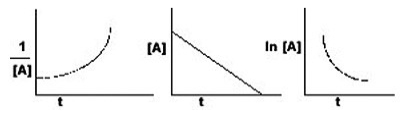
The following diagram represents the first-order decomposition of A to form X according to the following balanced chemical equation: A → X. Each sphere represents 1.0 mmol of atoms, and the volume of the box is 1.0 L. 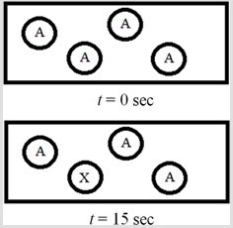 What is the half-life of the reaction?
 (Multiple Choice)
4.8/5 (62)
(62) The rate of a reaction is determined by the rate of the fastest step in the mechanism.
(True/False)
4.8/5 (94)
(94) What rate constant can be determined from only the half-life of a reaction?
(Multiple Choice)
4.8/5 (81)
(81) What is the integrated rate law for a first-order reaction?
(Multiple Choice)
4.9/5 (83)
(83) Consider the following potential energy profile for the A → B reaction. The overall reaction is ________. 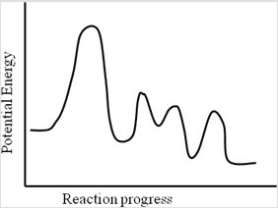
(Multiple Choice)
4.8/5 (89)
(89) What is the molecularity of the following elementary reaction? NHCl2(aq) + OH-(aq) → NCl2-(aq) +H2O(l)
(Multiple Choice)
4.9/5 (78)
(78) Which is true concerning the following potential energy diagram? 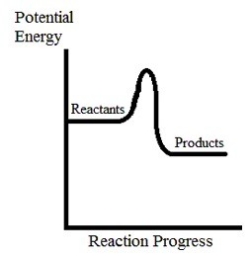
(Multiple Choice)
4.9/5 (85)
(85) 
Filters
- Essay(0)
- Multiple Choice(0)
- Short Answer(0)
- True False(0)
- Matching(0)