



 Chat with AI
Exam 20: Nuclear Chemistry

Exam 1: Chemistry: the Central Science133 Questions
Exam 2: Atoms, Molecules, and Ions124 Questions
Exam 3: Stoichiometry: Ratios of Combination137 Questions
Exam 4: Reactions in Aqueous Solutions146 Questions
Exam 5: Thermochemistry141 Questions
Exam 6: Quantum Theory and the Electronic Structure of Atoms135 Questions
Exam 7: Electron Configuration and the Periodic Table120 Questions
Exam 8: Chemical Bonding I: Basic Concepts102 Questions
Exam 9: Chemical Bonding II: Molecular Geometry and Bonding Theories139 Questions
Exam 10: Gases137 Questions
Exam 11: Intermolecular Forces and the Physical Properties of Liquids and Solids137 Questions
Exam 12: Modern Materials108 Questions
Exam 13: Physical Properties of Solutions151 Questions
Exam 14: Chemical Kinetics132 Questions
Exam 15: Chemical Equilibrium146 Questions
Exam 16: Acids and Bases137 Questions
Exam 17: Acid-Base Equilibria and Solubility Equilibria133 Questions
Exam 18: Entropy, Free Energy, and Equilibrium107 Questions
Exam 19: Electrochemistry122 Questions
Exam 20: Nuclear Chemistry127 Questions
Exam 21: Environmental Chemistry135 Questions
Exam 22: Coordination Chemistry132 Questions
Exam 23: Metallurgy and the Chemistry of Metals152 Questions
Exam 24: Nonmetallic Elements and Their Compounds117 Questions
Exam 25: Organic Chemistry121 Questions
Select questions type


Exposure to 10 nCi for 10 minutes is more hazardous for a child than for an adult because
(Multiple Choice)
4.9/5  (84)
(84) Select the nuclide that completes the following nuclear reaction 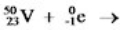 ?
? (Multiple Choice)
4.8/5 (89)
(89) If a captured electron combines with a proton in the nucleus to form a neutron, what happens to the atomic number and the mass number?
(Essay)
4.9/5 (82)
(82) Naturally occurring uranium contains approximately 1% U-235 and 99% U-238. Of these, the isotope that undergoes fission in a nuclear reactor is U-238.
(True/False)
4.8/5 (85)
(85) How old is the oldest object that can reliably be dated using 14C dating?
(Multiple Choice)
4.7/5 (87)
(87) Which of the following is used to test the activity of the thyroid?
(Multiple Choice)
4.8/5 (82)
(82) Rubidium-87 decays by beta decay with a half-life of 4.9 × 10¹⁰ yr. How many 87Rb atoms are in a moon rock sample that has a rubidium decay rate of 3500 disintegrations per hour?
(Multiple Choice)
4.8/5 (76)
(76) What other particle is emitted when a neutron is converted to a proton in a nucleus?
(Multiple Choice)
4.9/5 (84)
(84) A sample of a radioisotope shows an activity of 999 disintegrations per minute due to beta decay. If after 1.10 years the activity is 952 disintegrations per minute, what is the half-life of this radioisotope?
(Multiple Choice)
4.9/5 (77)
(77) The half-life of 14C is 5730 yr. Assuming some charcoal from a campfire 29,000 years old was found, what fraction of the original C-14 would remain today?
(Multiple Choice)
4.8/5 (87)
(87) What is the name given to the nuclear process that results from the bombardment of nuclei by neutrons, protons, or other nuclei?
(Multiple Choice)
4.9/5 (85)
(85) In the equation below, what particle or type of radiation needs to be included to balance the equation? 208Pb → ? + 204Hg
(Multiple Choice)
4.7/5 (82)
(82) In the following diagrams, A represents a radioactive isotope that decays into a new isotope, X. Each circle represents 1 mmol of atoms. t = 0: 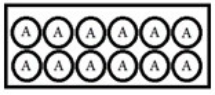 t = 25.0 s:
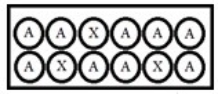 Which diagram best represents the sample at t = 50.0 s?
t = 25.0 s: Which diagram best represents the sample at t = 50.0 s? (Multiple Choice)
4.7/5 (73)
(73) Which of the following is an advantage of nuclear power plants over coal-burning plants? Nuclear power plants
(Multiple Choice)
4.9/5 (91)
(91) Calculate the energy released in joules when one mole of polonium-214 decays according to the following equation. 
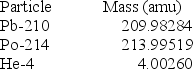 (1 kg = 6.022 × 1026 amu; NA = 6.022 × 10²³ mol-1;
C = 2.99792458 × 10⁸ m/s)
(1 kg = 6.022 × 1026 amu; NA = 6.022 × 10²³ mol-1;
C = 2.99792458 × 10⁸ m/s) (Multiple Choice)
4.9/5 (101)
(101) What fraction of radioactive atoms remains in a sample after six half-lives?
(Multiple Choice)
4.8/5 (92)
(92) Which type of nuclear process requires an extremely high temperature (millions of degrees)?
(Multiple Choice)
5.0/5 (78)
(78) 
Filters
- Essay(0)
- Multiple Choice(0)
- Short Answer(0)
- True False(0)
- Matching(0)