



 Chat with AI
Exam 9: Chemical Bonding II: Molecular Geometry and Bonding Theories

Exam 1: Chemistry: the Central Science133 Questions
Exam 2: Atoms, Molecules, and Ions124 Questions
Exam 3: Stoichiometry: Ratios of Combination137 Questions
Exam 4: Reactions in Aqueous Solutions146 Questions
Exam 5: Thermochemistry141 Questions
Exam 6: Quantum Theory and the Electronic Structure of Atoms135 Questions
Exam 7: Electron Configuration and the Periodic Table120 Questions
Exam 8: Chemical Bonding I: Basic Concepts102 Questions
Exam 9: Chemical Bonding II: Molecular Geometry and Bonding Theories139 Questions
Exam 10: Gases137 Questions
Exam 11: Intermolecular Forces and the Physical Properties of Liquids and Solids137 Questions
Exam 12: Modern Materials108 Questions
Exam 13: Physical Properties of Solutions151 Questions
Exam 14: Chemical Kinetics132 Questions
Exam 15: Chemical Equilibrium146 Questions
Exam 16: Acids and Bases137 Questions
Exam 17: Acid-Base Equilibria and Solubility Equilibria133 Questions
Exam 18: Entropy, Free Energy, and Equilibrium107 Questions
Exam 19: Electrochemistry122 Questions
Exam 20: Nuclear Chemistry127 Questions
Exam 21: Environmental Chemistry135 Questions
Exam 22: Coordination Chemistry132 Questions
Exam 23: Metallurgy and the Chemistry of Metals152 Questions
Exam 24: Nonmetallic Elements and Their Compounds117 Questions
Exam 25: Organic Chemistry121 Questions
Select questions type


Which is the most reasonable prediction for the H-C-H bond angle in CH4?
(Multiple Choice)
4.9/5  (82)
(82) For different structural arrangements of atoms having the formula XeF2Cl2, which structures represent polar molecules? (Black = Xe, Yellow = F, Green = Cl) 
(Multiple Choice)
4.9/5 (83)
(83) What is the predicted molecular geometry of the CH4 molecule according to the VSEPR model?
(Multiple Choice)
4.7/5 (66)
(66) What is the predicted molecular geometry of the H2O molecule according to the VSEPR model?
(Multiple Choice)
4.8/5 (87)
(87) Pi bonds are covalent bonds in which the electron density is concentrated above and below the plane of the nuclei of the bonding atoms.
(True/False)
5.0/5 (88)
(88) According to the VSEPR model, the predicted molecular geometry of SiCl4 is
(Multiple Choice)
4.7/5 (80)
(80) Using the VSEPR model, predict the molecular geometry around the central atom in SO32-.
(Multiple Choice)
4.8/5 (93)
(93) A molecule with the formula AB4 and a square planar molecular geometry uses ________ to form its σ bonds.
(Multiple Choice)
4.8/5 (75)
(75) What is the molecular geometry of NOCl as predicted by the VSEPR model? 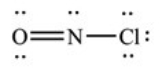
(Multiple Choice)
4.9/5 (89)
(89) According to the VSEPR model, a molecule with the general formula AB2 with two lone pairs on the central atom will have a ________ molecular geometry.
(Multiple Choice)
4.8/5 (69)
(69) What is the molecular geometry of ClO3F as predicted by the VSEPR model? 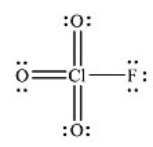
(Multiple Choice)
4.9/5 (92)
(92) According to the VSEPR model, which molecule is predicted to be linear?
(Multiple Choice)
5.0/5 (76)
(76) In the valence bond treatment, overlap of an s orbital on one atom with an sp3 orbital on another atom gives rise to a σ bond.
(True/False)
4.9/5 (80)
(80) A molecule with the formula AB4 and a tetrahedral molecular geometry uses ________ to form its σ bonds.
(Multiple Choice)
4.8/5 (89)
(89) When molecules that exhibit separation of charges are placed in an electric field, they become oriented positive end to negative plate and negative end to positive plate.
(True/False)
4.9/5 (93)
(93) What is the total number of electron domains around the central atom for a molecule having a square planar molecular geometry, such as XeBr4?
(Multiple Choice)
4.8/5 (69)
(69) 
Filters
- Essay(0)
- Multiple Choice(0)
- Short Answer(0)
- True False(0)
- Matching(0)