



 Chat with AI
Exam 29: Heredity

Exam 1: The Human Body: an Orientation100 Questions
Exam 2: Chemistry Comes Alive120 Questions
Exam 3: Cells: the Living Units119 Questions
Exam 4: Tissue: the Living Fabric97 Questions
Exam 5: The Integumentary System107 Questions
Exam 6: Bones and Skeletal Tissues94 Questions
Exam 7: The Skeleton102 Questions
Exam 8: Joints105 Questions
Exam 9: Muscles and Muscle Tissue109 Questions
Exam 10: The Muscular System109 Questions
Exam 11: Fundamentals of the Nervous System and Nervous Tissue95 Questions
Exam 12: The Central Nervous System132 Questions
Exam 13: The Peripheral Nervous System and Reflex Activity97 Questions
Exam 14: The Autonomic Nervous System96 Questions
Exam 15: The Special Senses127 Questions
Exam 16: The Endocrine System119 Questions
Exam 17: Blood99 Questions
Exam 18: The Cardiovascular System: the Heart94 Questions
Exam 19: The Cardiovascular System: Blood Vessels107 Questions
Exam 20: The Lymphatic System and Lymphoid Organs and Tissues95 Questions
Exam 21: The Immune System: Innate and Adaptive Body Defensives118 Questions
Exam 22: The Respiratory System120 Questions
Exam 23: The Digestive System145 Questions
Exam 24: Nutrition, Metabolism, and Body Temperature Regulation114 Questions
Exam 25: The Urinary System116 Questions
Exam 26: Fluid, Electrolyte, and Acid-Base Balance94 Questions
Exam 27: The Reproductive System126 Questions
Exam 28: Pregnancy and Human Development97 Questions
Exam 29: Heredity90 Questions
Select questions type


This is a first pregnancy for a 22- year- old woman. She is in her 16th week of pregnancy. She is scheduled for an amniocentesis and expresses concern that the "baby will be stuck with the needle." What should the nurse say to the woman?
(Essay)
4.8/5  (77)
(77) In humans, farsightedness is inherited by possession of a dominant gene. If a man who is homozygous for normal vision (aa) marries a woman who is heterozygous for farsightedness, what proportion of their children would be expected to be farsighted?
(Essay)
4.7/5 (75)
(75) Is genetic diversity due entirely to inherited genes on the sex chromosomes?
(Multiple Choice)
5.0/5 (73)
(73) Two tall red pea plants, when crossed, produced some offspring that were white and dwarf. Assuming that tallness and redness are dominant, what are the genotypes of the parents?
(Essay)
4.8/5 (80)
(80) Jane and Allen have just discovered that their son is a hemophiliac. Neither of them has hemophilia, and Allen claims that no such condition was ever expressed in his family. Jane was told that her father was a hemophiliac and that problems resulting from this condition caused his death. Allen has also been told that hemophilia can only be passed on to an offspring by parents and not by grandparents; he believes that Jane was unfaithful and that the child is not his. If you were a genetic counselor, what would you tell Allen?
(Essay)
4.9/5 (66)
(66) A couple whose blood types are A (IAi) and B (IBi) may have a child with which of the following blood types?
(Multiple Choice)
4.8/5 (85)
(85) 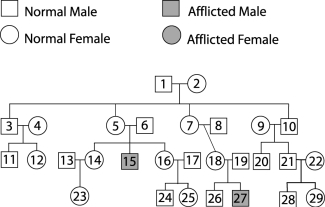 Figure 29.2
Use Figure 29.2 to answer the following:
-Describe briefly the three mechanisms that lead to genetic variability.
Figure 29.2
Use Figure 29.2 to answer the following:
-Describe briefly the three mechanisms that lead to genetic variability. (Essay)
4.7/5 (74)
(74) The gene responsible for the condition known as sickle- cell anemia demonstrates _.
(Multiple Choice)
4.7/5 (82)
(82) Recessive genes are usually expressed in humans only when .
(Multiple Choice)
4.8/5 (75)
(75) When two genes are on the same chromosome, they are considered linked.
(True/False)
4.8/5 (90)
(90) The same allele can have a different effect depending on which parent it comes from.
(True/False)
5.0/5 (69)
(69) Among members of the Fuzzy Wuzzy tribe, we will consider two pairs of genes: F = fuzzy hair vs. f = straight hair, and T = long hair vs. t = short hair. A homozygous, straight- shorthaired male marries a homozygous, fuzzy- longhaired female (P1 generation). Their offspring (the F1 generation) intermarry and produce progeny (second generation) of four types:
fuzzy- longhaired, fuzzy- shorthaired, straight- longhaired, and straight- shorthaired. The results follow a standard dihybrid pattern.
-The 23rd pair of human chromosomes are called chromosomes.
(Short Answer)
4.7/5 (73)
(73) 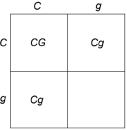 Figure 29.1
-Which of the following statements is true concerning genetic screening?
Figure 29.1
-Which of the following statements is true concerning genetic screening? (Multiple Choice)
4.8/5 (85)
(85) Dominant alleles are so called because under most circumstances they _ .
(Multiple Choice)
4.8/5 (86)
(86) Figure 29.1
-Two alleles expressing exactly the same information for a trait are designated as .
Figure 29.1
-Two alleles expressing exactly the same information for a trait are designated as . (Multiple Choice)
4.9/5 (84)
(84) Among members of the Fuzzy Wuzzy tribe, we will consider two pairs of genes: F = fuzzy hair vs. f = straight hair, and T = long hair vs. t = short hair. A homozygous, straight- shorthaired male marries a homozygous, fuzzy- longhaired female (P1 generation). Their offspring (the F1 generation) intermarry and produce progeny (second generation) of four types:
fuzzy- longhaired, fuzzy- shorthaired, straight- longhaired, and straight- shorthaired. The results follow a standard dihybrid pattern.
-Define karyotype.
(Essay)
4.8/5 (89)
(89) 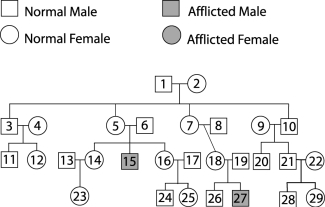 Figure 29.2
Use Figure 29.2 to answer the following:
-Removing a sample of the fluid surrounding the fetus for the purpose of studying the chromosomes is a procedure called .
Figure 29.2
Use Figure 29.2 to answer the following:
-Removing a sample of the fluid surrounding the fetus for the purpose of studying the chromosomes is a procedure called . (Short Answer)
4.9/5 (75)
(75) Among members of the Fuzzy Wuzzy tribe, we will consider two pairs of genes: F = fuzzy hair vs. f = straight hair, and T = long hair vs. t = short hair. A homozygous, straight- shorthaired male marries a homozygous, fuzzy- longhaired female (P1 generation). Their offspring (the F1 generation) intermarry and produce progeny (second generation) of four types:
fuzzy- longhaired, fuzzy- shorthaired, straight- longhaired, and straight- shorthaired. The results follow a standard dihybrid pattern.
-What is (are) the genotype(s) of the first- generation offspring?
(Short Answer)
4.9/5 (75)
(75) 
Filters
- Essay(0)
- Multiple Choice(0)
- Short Answer(0)
- True False(0)
- Matching(0)