



 Chat with AI
Exam 29: Heredity

Exam 1: The Human Body: an Orientation100 Questions
Exam 2: Chemistry Comes Alive120 Questions
Exam 3: Cells: the Living Units119 Questions
Exam 4: Tissue: the Living Fabric97 Questions
Exam 5: The Integumentary System107 Questions
Exam 6: Bones and Skeletal Tissues94 Questions
Exam 7: The Skeleton102 Questions
Exam 8: Joints105 Questions
Exam 9: Muscles and Muscle Tissue109 Questions
Exam 10: The Muscular System109 Questions
Exam 11: Fundamentals of the Nervous System and Nervous Tissue95 Questions
Exam 12: The Central Nervous System132 Questions
Exam 13: The Peripheral Nervous System and Reflex Activity97 Questions
Exam 14: The Autonomic Nervous System96 Questions
Exam 15: The Special Senses127 Questions
Exam 16: The Endocrine System119 Questions
Exam 17: Blood99 Questions
Exam 18: The Cardiovascular System: the Heart94 Questions
Exam 19: The Cardiovascular System: Blood Vessels107 Questions
Exam 20: The Lymphatic System and Lymphoid Organs and Tissues95 Questions
Exam 21: The Immune System: Innate and Adaptive Body Defensives118 Questions
Exam 22: The Respiratory System120 Questions
Exam 23: The Digestive System145 Questions
Exam 24: Nutrition, Metabolism, and Body Temperature Regulation114 Questions
Exam 25: The Urinary System116 Questions
Exam 26: Fluid, Electrolyte, and Acid-Base Balance94 Questions
Exam 27: The Reproductive System126 Questions
Exam 28: Pregnancy and Human Development97 Questions
Exam 29: Heredity90 Questions
Select questions type


Among members of the Fuzzy Wuzzy tribe, we will consider two pairs of genes: F = fuzzy hair vs. f = straight hair, and T long hair vs. t = short hair. A homozygous, straight- shorthaired male marries a homozygous, fuzzy- longhaired female (P1 generation). Their offspring (the F1 generation) intermarry and produce progeny (second generation) of four types:
fuzzy- longhaired, fuzzy- shorthaired, straight- longhaired, and straight- shorthaired. The results follow a standard dihybrid pattern.
-The second- generation phenotypes would follow what ratio? (Pair the number with a phenotype in each case.)
(Short Answer)
4.8/5  (73)
(73) For which of the following are newborn infants not routinely screened at birth?
(Multiple Choice)
4.9/5 (81)
(81) 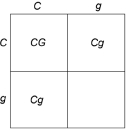 Figure 29.1
-Gene mutations in the sex chromosomes of the human would tend to become visibly expressed
)
Figure 29.1
-Gene mutations in the sex chromosomes of the human would tend to become visibly expressed
) (Multiple Choice)
4.9/5 (93)
(93) A 40- year- old pregnant woman is concerned about possible genetic defects in her unborn fetus. Her physician recommends prenatal testing and advises her of two methods. Compare and contrast amniocentesis with chorionic villus sampling relative to the time each can be performed, and the relative advantages and disadvantages of each.
(Essay)
4.9/5 (86)
(86) The expression of all physical traits is strictly due to the inheritance of specific genes.
(True/False)
4.8/5 (83)
(83) An individual who is heterozygous for a particular trait, yet expresses both alleles of that trait, is an example of _ _.
(Multiple Choice)
4.8/5 (89)
(89) Among members of the Fuzzy Wuzzy tribe, we will consider two pairs of genes: F = fuzzy hair vs. f = straight hair, and T = long hair vs. t = short hair. A homozygous, straight- shorthaired male marries a homozygous, fuzzy- longhaired female (P1 generation). Their offspring (the F1 generation) intermarry and produce progeny (second generation) of four types:
fuzzy- longhaired, fuzzy- shorthaired, straight- longhaired, and straight- shorthaired. The results follow a standard dihybrid pattern.
-How might carriers of deleterious genes be recognized?
(Essay)
4.9/5 (91)
(91) 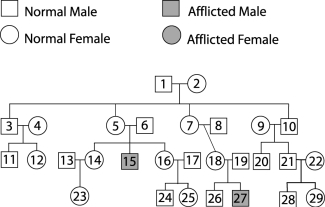 Figure 29.2
Use Figure 29.2 to answer the following:
-Are there any afflicted females?
Figure 29.2
Use Figure 29.2 to answer the following:
-Are there any afflicted females? (Short Answer)
5.0/5 (76)
(76) It is possible for a baby to have type O blood if neither parent is type O.
(True/False)
4.8/5 (87)
(87) Small RNAs control the timing of programmed cell death during development.
(True/False)
4.9/5 (76)
(76) Hemophilia is an X- linked condition caused by a recessive gene.
(True/False)
4.8/5 (82)
(82) 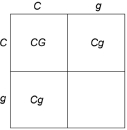 Figure 29.1
-Given the information in Figure 29.1, what would the genotype ratio be for the offspring?
Figure 29.1
-Given the information in Figure 29.1, what would the genotype ratio be for the offspring? (Multiple Choice)
4.8/5 (80)
(80) 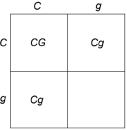 Figure 29.1
-Given the information in Figure 29.1, what is the phenotype ratio (assuming C is dominant and there is no incomplete dominance)?
Figure 29.1
-Given the information in Figure 29.1, what is the phenotype ratio (assuming C is dominant and there is no incomplete dominance)? (Multiple Choice)
4.8/5 (73)
(73) Among members of the Fuzzy Wuzzy tribe, we will consider two pairs of genes: F = fuzzy hair vs. f = straight hair, and T = long hair vs. t = short hair. A homozygous, straight- shorthaired male marries a homozygous, fuzzy- longhaired female (P1 generation). Their offspring (the F1 generation) intermarry and produce progeny (second generation) of four types:
fuzzy- longhaired, fuzzy- shorthaired, straight- longhaired, and straight- shorthaired. The results follow a standard dihybrid pattern.
-The second- generation types would have what phenotypes?
(Short Answer)
4.8/5 (73)
(73) Parents are informed after an amniocentesis that the results show a baby who has an extra number 21 chromosome. Should there be concern and what might the problem be?
(Essay)
4.9/5 (86)
(86) 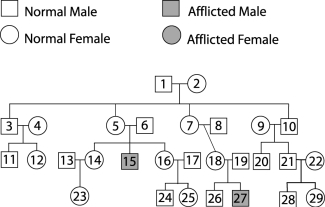 Figure 29.2
Use Figure 29.2 to answer the following:
-Is the trait sex- linked?
Figure 29.2
Use Figure 29.2 to answer the following:
-Is the trait sex- linked? (Short Answer)
4.7/5 (96)
(96) A nurse is providing genetic counseling to a couple who both have the sickle- cell anemia trait, but not the disease. The couple is trying to decide whether or not to have a child. What is the possibility that a child would inherit the disease? What is one reason they might consider not having a child?
(Essay)
4.9/5 (83)
(83) Among members of the Fuzzy Wuzzy tribe, we will consider two pairs of genes: F = fuzzy hair vs. f = straight hair, and T long hair vs. t = short hair. A homozygous, straight- shorthaired male marries a homozygous, fuzzy- longhaired female (P1 generation). Their offspring (the F1 generation) intermarry and produce progeny (second generation) of four types:
fuzzy- longhaired, fuzzy- shorthaired, straight- longhaired, and straight- shorthaired. The results follow a standard dihybrid pattern.
-What were the genotypes of the parental (P1) individuals?
(Short Answer)
4.9/5 (87)
(87) 
Filters
- Essay(0)
- Multiple Choice(0)
- Short Answer(0)
- True False(0)
- Matching(0)