



 Chat with AI
Exam 8: Joints

Exam 1: The Human Body: an Orientation100 Questions
Exam 2: Chemistry Comes Alive120 Questions
Exam 3: Cells: the Living Units119 Questions
Exam 4: Tissue: the Living Fabric97 Questions
Exam 5: The Integumentary System107 Questions
Exam 6: Bones and Skeletal Tissues94 Questions
Exam 7: The Skeleton102 Questions
Exam 8: Joints105 Questions
Exam 9: Muscles and Muscle Tissue109 Questions
Exam 10: The Muscular System109 Questions
Exam 11: Fundamentals of the Nervous System and Nervous Tissue95 Questions
Exam 12: The Central Nervous System132 Questions
Exam 13: The Peripheral Nervous System and Reflex Activity97 Questions
Exam 14: The Autonomic Nervous System96 Questions
Exam 15: The Special Senses127 Questions
Exam 16: The Endocrine System119 Questions
Exam 17: Blood99 Questions
Exam 18: The Cardiovascular System: the Heart94 Questions
Exam 19: The Cardiovascular System: Blood Vessels107 Questions
Exam 20: The Lymphatic System and Lymphoid Organs and Tissues95 Questions
Exam 21: The Immune System: Innate and Adaptive Body Defensives118 Questions
Exam 22: The Respiratory System120 Questions
Exam 23: The Digestive System145 Questions
Exam 24: Nutrition, Metabolism, and Body Temperature Regulation114 Questions
Exam 25: The Urinary System116 Questions
Exam 26: Fluid, Electrolyte, and Acid-Base Balance94 Questions
Exam 27: The Reproductive System126 Questions
Exam 28: Pregnancy and Human Development97 Questions
Exam 29: Heredity90 Questions
Select questions type


After reading a medical report, you learn that a 45- year- old female has the following symptoms: inflammation of synovial membranes, accumulation of synovial fluid, pain and tenderness about the joints, pannus formation, and some immobility at certain joints. On the basis of these symptoms, what would the patient probably have?
(Short Answer)
4.7/5  (81)
(81) 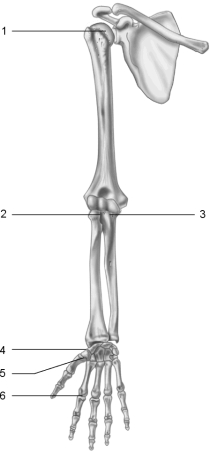 Figure 8.2
Using Figure 8.2, what type of axis does each joint have?
-Joint 5.
Figure 8.2
Using Figure 8.2, what type of axis does each joint have?
-Joint 5. (Short Answer)
4.8/5 (95)
(95) The only movement allowed between the first two cervical vertebrae is flexion.
(True/False)
4.7/5 (77)
(77) Many inflammations of joint areas can be treated by injections of cortisone into the area. Why don't we continually get injections rather than operations?
(Essay)
4.8/5 (82)
(82) The major role of ligaments at synovial joints is to help direct movement and restrict undesirable movement.
(True/False)
4.8/5 (81)
(81) Farhad begins typing his term paper on his new computer early one morning. After 8 hours of typing, he notices that his wrists are stiff and very sore. The next morning, Farhad begins to finish his paper, but soon finds his wrists hurt worse than last night. What is wrong?
(Essay)
4.9/5 (67)
(67) On the basis of structural classification, which joint is fibrous connective tissue?
(Multiple Choice)
4.8/5 (83)
(83) Susan was bitten by a deer tick and now complains of joint pain, flu- like symptoms, and difficulty thinking. What might be her diagnosis and the treatment required to alleviate her symptoms?
(Essay)
4.8/5 (72)
(72) Which of the following is not a factor that contributes to keeping the articular surfaces of diarthroses in contact?
(Multiple Choice)
4.8/5 (87)
(87) Flexion of the ankle so that the superior aspect of the foot approaches the shin is called dorsiflexion.
(True/False)
4.8/5 (93)
(93) Dislocations in the TMJ almost always dislocate posteriorly with the mandibular condyles ending up in the infratemporal fossa.
(True/False)
4.9/5 (73)
(73) Saddle joints have concave and convex surfaces. Identify the saddle joint of the skeleton.
(Multiple Choice)
4.8/5 (81)
(81) 
Filters
- Essay(0)
- Multiple Choice(0)
- Short Answer(0)
- True False(0)
- Matching(0)