



 Chat with AI
Exam 8: Joints

Exam 1: The Human Body: an Orientation100 Questions
Exam 2: Chemistry Comes Alive120 Questions
Exam 3: Cells: the Living Units119 Questions
Exam 4: Tissue: the Living Fabric97 Questions
Exam 5: The Integumentary System107 Questions
Exam 6: Bones and Skeletal Tissues94 Questions
Exam 7: The Skeleton102 Questions
Exam 8: Joints105 Questions
Exam 9: Muscles and Muscle Tissue109 Questions
Exam 10: The Muscular System109 Questions
Exam 11: Fundamentals of the Nervous System and Nervous Tissue95 Questions
Exam 12: The Central Nervous System132 Questions
Exam 13: The Peripheral Nervous System and Reflex Activity97 Questions
Exam 14: The Autonomic Nervous System96 Questions
Exam 15: The Special Senses127 Questions
Exam 16: The Endocrine System119 Questions
Exam 17: Blood99 Questions
Exam 18: The Cardiovascular System: the Heart94 Questions
Exam 19: The Cardiovascular System: Blood Vessels107 Questions
Exam 20: The Lymphatic System and Lymphoid Organs and Tissues95 Questions
Exam 21: The Immune System: Innate and Adaptive Body Defensives118 Questions
Exam 22: The Respiratory System120 Questions
Exam 23: The Digestive System145 Questions
Exam 24: Nutrition, Metabolism, and Body Temperature Regulation114 Questions
Exam 25: The Urinary System116 Questions
Exam 26: Fluid, Electrolyte, and Acid-Base Balance94 Questions
Exam 27: The Reproductive System126 Questions
Exam 28: Pregnancy and Human Development97 Questions
Exam 29: Heredity90 Questions
Select questions type


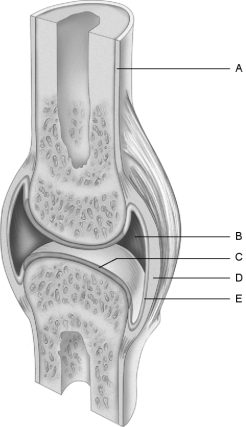 Figure 8.1
Using Figure 8.1, match the following:
-Fibrous capsule.
Figure 8.1
Using Figure 8.1, match the following:
-Fibrous capsule. (Short Answer)
4.7/5  (80)
(80) Which of the following statements best describes angular movements?
(Multiple Choice)
4.8/5 (82)
(82) Why is muscle tone the most important stabilizing factor for most joints?
(Essay)
4.9/5 (74)
(74) Synovial fluid contains phagocytic cells that protect the cavity from invasion by microbes or other debris.
(True/False)
4.9/5 (86)
(86) The gripping of the trochlea by the trochlear notch constitutes the "hinge" for the elbow joint.
(True/False)
4.9/5 (78)
(78) 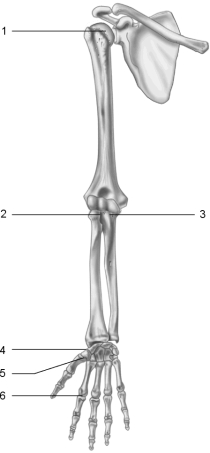 Figure 8.2
Using Figure 8.2, identify each type of synovial joint by name.
-Joint 2.
Figure 8.2
Using Figure 8.2, identify each type of synovial joint by name.
-Joint 2. (Short Answer)
4.9/5 (80)
(80) Steven, a football player, complained of severe pain and the inability to use his right arm and shoulder after having been tackled during a game. What would you guess might be his problem?
(Essay)
4.8/5 (73)
(73) For each of the following movements, indicate the specific kind of joint involved (e.g., hinge, etc.) and the movement performed (e.g., extension, etc.).
a. Bending the elbow: , _ .
b. Turning head side to side: _ _, _ .
c. Lowering your arm to your side: _ , _ .
d. Turning the sole of foot medially: , _.
(Essay)
4.8/5 (69)
(69) In symphysis joints the articular surfaces of the bones are covered with _.
(Multiple Choice)
4.9/5 (78)
(78) The articular surfaces of synovial joints play a minimal role in joint stability.
(True/False)
4.8/5 (78)
(78) A nurse is instructing the patient care assistants (PCAs) on transfer techniques. For patients needing to be slid toward the head of the bed, the nurse tells the PCAs use a draw sheet under the patient's torso. She tells them to avoid pulling on their hands or arms. Based on your knowledge of the shoulder joint, explain why pulling on the extremities should be avoided.
(Essay)
4.9/5 (76)
(76) Synovial fluid is a viscous material that is derived by filtration from blood.
(True/False)
5.0/5 (97)
(97) 
Filters
- Essay(0)
- Multiple Choice(0)
- Short Answer(0)
- True False(0)
- Matching(0)