



 Chat with AI
Exam 12: Dna: the Molecule of Heredity

Exam 1: An Introduction to Life on Earth85 Questions
Exam 2: Atoms, Molecules, and Life90 Questions
Exam 3: Biological Molecules98 Questions
Exam 4: Cell Structure and Function90 Questions
Exam 5: Cell Membrane Structure and Function95 Questions
Exam 6: Energy Flow in the Life of a Cell90 Questions
Exam 7: Capturing Solar Energy: Photosynthesis102 Questions
Exam 8: Harvesting Energy: Glycolysis and Cellular Respiration97 Questions
Exam 9: Cellular Reproduction133 Questions
Exam 10: Meiosis: the Basis of Sexual Reproduction103 Questions
Exam 11: Patterns of Inheritance98 Questions
Exam 12: Dna: the Molecule of Heredity97 Questions
Exam 13: Gene Expression and Regulation93 Questions
Exam 14: Biotechnology91 Questions
Exam 15: Principles of Evolution97 Questions
Exam 16: How Populations Evolve109 Questions
Exam 17: The Origin of Species89 Questions
Exam 18: The History of Life125 Questions
Exam 19: Systematics: Seeking Order Amid Diversity90 Questions
Exam 20: The Diversity of Prokaryotes and Viruses97 Questions
Exam 21: The Diversity of Protists102 Questions
Exam 22: The Diversity of Plants115 Questions
Exam 23: The Diversity of Fungi107 Questions
Exam 24: Animal Diversity I: Invertebrates101 Questions
Exam 25: Animal Diversity II: Vertebrates118 Questions
Exam 26: Animal Behavior116 Questions
Exam 27: Population Growth and Regulation114 Questions
Exam 28: Community Interactions125 Questions
Exam 29: Energy Flow and Nutrient Cycling in Ecosystems122 Questions
Exam 30: Earths Diverse Ecosystems126 Questions
Exam 31: Conserving Earths Biodiversity109 Questions
Exam 32: Homeostasis and the Organization of the Animal Body95 Questions
Exam 33: Circulation89 Questions
Exam 34: Respiration92 Questions
Exam 35: Nutrition and Digestion91 Questions
Exam 36: The Urinary System99 Questions
Exam 37: Defenses Against Disease104 Questions
Exam 38: Chemical Control of the Animal Body: the Endocrine System133 Questions
Exam 39: The Nervous System118 Questions
Exam 40: The Senses94 Questions
Exam 41: Action and Support: the Muscles and Skeleton90 Questions
Exam 42: Animal Reproduction120 Questions
Exam 43: Animal Development122 Questions
Exam 44: Plant Anatomy and Nutrient Transport95 Questions
Exam 45: Plant Reproduction and Development90 Questions
Exam 46: Plant Responses to the Environment87 Questions
Select questions type


In one strand of DNA, the nucleotide sequence is 5'- A- T- G- C- 3'. The complementary sequence in the other strand must be
(Multiple Choice)
4.8/5  (70)
(70) Hershey and Chase concluded that is the hereditary molecule by examining how radioactively labeled molecules moved between a virus and bacteria.
(Multiple Choice)
4.8/5 (81)
(81) Based on this figure, which molecule would attach to the 5' phosphate end of the DNA strand on the right? 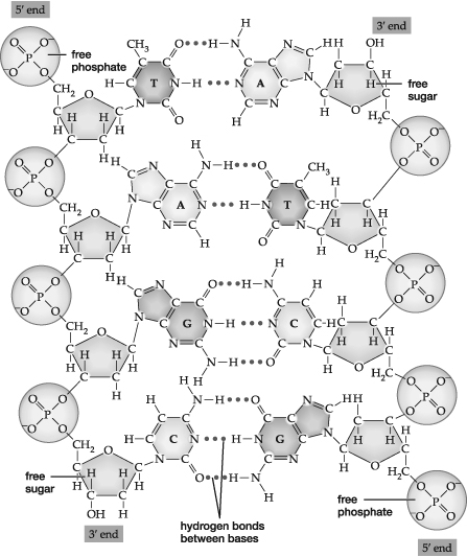
(Multiple Choice)
4.9/5 (72)
(72) If the DNA sequence is G- C- C- T- A- T in one polynucleotide chain, then the sequence found in the other polynucleotide chain must be
(Multiple Choice)
4.9/5 (70)
(70) When DNA polymerase encounters thymine in the parental strand, what does it add to the growing daughter strand?
(Multiple Choice)
4.9/5 (89)
(89) DNA ligase is important in the replication process because it can join together segments of DNA into a single daughter strand.
(True/False)
4.8/5 (80)
(80) DNA breaks the hydrogen bonds between complementary base pairs during DNA replication.
(Short Answer)
5.0/5 (88)
(88) Regarding the structure of DNA, which of the following is like a spiral staircase?
(Multiple Choice)
4.7/5 (67)
(67) Suppose a scientist working on a new drug for cancer developed a chemical that irreversibly breaks the hydrogen bonds in the DNA molecules within cancerous cells but leaves all of the covalent bonds intact. Hydrogen bonds are relatively weak compared to covalent bonds, and they are routinely broken and reformed as the DNA molecule is replicated in a normal cell. Their stability is nonetheless critical for maintaining certain aspects of the structure and function of the DNA molecule. Based on this scenario and your knowledge of DNA, how would this newly discovered chemical affect the "mole heredity" in a human cancer cell?
(Multiple Choice)
4.9/5 (86)
(86) In the comparison of a DNA molecule to a twisted ladder, the upright sides of the ladder are
(Multiple Choice)
4.8/5 (79)
(79) DNA polymerase has the ability to match the nucleotide base in the parental strand with a free nucleotide that is complementary to that base. It then forms the covalent bonds between the nucleotides in the growing daughter strand of DNA.
(True/False)
4.9/5 (82)
(82) Regarding the structure of DNA, which of the following joins deoxyribose to phosphate?
(Multiple Choice)
4.9/5 (94)
(94) DNA helicase is involved in "rewinding" the strands of DNA back into a helix after replication.
(True/False)
5.0/5 (83)
(83) Name the four types of nitrogen- containing bases in DNA. Which bases are complementary?
(Essay)
4.9/5 (68)
(68) The X- ray diffraction studies of the scientists named and were essential for the discovery of the structure of the DNA molecule.
(Short Answer)
4.8/5 (86)
(86) 
Filters
- Essay(0)
- Multiple Choice(0)
- Short Answer(0)
- True False(0)
- Matching(0)