



 Chat with AI
Exam 22: The Diversity of Plants

Exam 1: An Introduction to Life on Earth85 Questions
Exam 2: Atoms, Molecules, and Life90 Questions
Exam 3: Biological Molecules98 Questions
Exam 4: Cell Structure and Function90 Questions
Exam 5: Cell Membrane Structure and Function95 Questions
Exam 6: Energy Flow in the Life of a Cell90 Questions
Exam 7: Capturing Solar Energy: Photosynthesis102 Questions
Exam 8: Harvesting Energy: Glycolysis and Cellular Respiration97 Questions
Exam 9: Cellular Reproduction133 Questions
Exam 10: Meiosis: the Basis of Sexual Reproduction103 Questions
Exam 11: Patterns of Inheritance98 Questions
Exam 12: Dna: the Molecule of Heredity97 Questions
Exam 13: Gene Expression and Regulation93 Questions
Exam 14: Biotechnology91 Questions
Exam 15: Principles of Evolution97 Questions
Exam 16: How Populations Evolve109 Questions
Exam 17: The Origin of Species89 Questions
Exam 18: The History of Life125 Questions
Exam 19: Systematics: Seeking Order Amid Diversity90 Questions
Exam 20: The Diversity of Prokaryotes and Viruses97 Questions
Exam 21: The Diversity of Protists102 Questions
Exam 22: The Diversity of Plants115 Questions
Exam 23: The Diversity of Fungi107 Questions
Exam 24: Animal Diversity I: Invertebrates101 Questions
Exam 25: Animal Diversity II: Vertebrates118 Questions
Exam 26: Animal Behavior116 Questions
Exam 27: Population Growth and Regulation114 Questions
Exam 28: Community Interactions125 Questions
Exam 29: Energy Flow and Nutrient Cycling in Ecosystems122 Questions
Exam 30: Earths Diverse Ecosystems126 Questions
Exam 31: Conserving Earths Biodiversity109 Questions
Exam 32: Homeostasis and the Organization of the Animal Body95 Questions
Exam 33: Circulation89 Questions
Exam 34: Respiration92 Questions
Exam 35: Nutrition and Digestion91 Questions
Exam 36: The Urinary System99 Questions
Exam 37: Defenses Against Disease104 Questions
Exam 38: Chemical Control of the Animal Body: the Endocrine System133 Questions
Exam 39: The Nervous System118 Questions
Exam 40: The Senses94 Questions
Exam 41: Action and Support: the Muscles and Skeleton90 Questions
Exam 42: Animal Reproduction120 Questions
Exam 43: Animal Development122 Questions
Exam 44: Plant Anatomy and Nutrient Transport95 Questions
Exam 45: Plant Reproduction and Development90 Questions
Exam 46: Plant Responses to the Environment87 Questions
Select questions type


Which of the following is most likely to be successful and thrive in a desert ecosystem?
(Multiple Choice)
4.9/5  (86)
(86) While walking in a tropical forest, you come upon a 6- meter- tall plant that shows no evidence of seed production. The plant is most likely a(n)
(Multiple Choice)
4.7/5 (72)
(72) 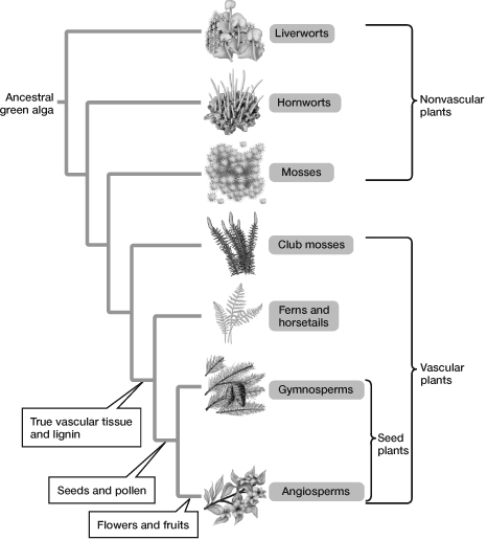 -While walking in a forest, you find a plant with what appears to be unfertilized seeds located at the bases of woody scales exposed to the air. Yellow dust- like particles coat the surface of the unfertilized seeds. This plant is probably a(n)
 (Multiple Choice)
4.8/5 (73)
(73) On a trip to the beach, you find a multicellular organism whose cells have chloroplasts and cell walls. Based on this description, you know that the organism could be a brown alga, a red alga, a green alga, or a land plant washed into the ocean. The presence of which of the following would allow you to definitively identify this organism as a plant?
(Multiple Choice)
4.9/5 (76)
(76) With regard to reproduction, how do gymnosperms differ from angiosperms?
(Essay)
4.9/5 (81)
(81) Taxol and vinblastine are plant- derived medicines used to treat .
(Short Answer)
4.8/5 (65)
(65) During photosynthesis, plants remove _ _ from and add to the atmosphere.
(Short Answer)
4.8/5 (73)
(73) You've stumbled upon a thick mat of moss in the woods. Upon closer inspection, you observe sporophytes emerging from the gametophytes. From your previous biology course, you know that the sporophyte is attached to a(n)
(Multiple Choice)
4.7/5 (83)
(83) Pollen production by the anthers of a flower is characteristic of
(Multiple Choice)
4.8/5 (89)
(89) Which evolutionary plant innovation eliminated the need for sperm to swim through water in order to fertilize an egg, resulting in plants being truly adapted for reproduction on land?
(Multiple Choice)
4.8/5 (79)
(79) 
Filters
- Essay(0)
- Multiple Choice(0)
- Short Answer(0)
- True False(0)
- Matching(0)