



 Chat with AI
Exam 32: Homeostasis and the Organization of the Animal Body

Exam 1: An Introduction to Life on Earth85 Questions
Exam 2: Atoms, Molecules, and Life90 Questions
Exam 3: Biological Molecules98 Questions
Exam 4: Cell Structure and Function90 Questions
Exam 5: Cell Membrane Structure and Function95 Questions
Exam 6: Energy Flow in the Life of a Cell90 Questions
Exam 7: Capturing Solar Energy: Photosynthesis102 Questions
Exam 8: Harvesting Energy: Glycolysis and Cellular Respiration97 Questions
Exam 9: Cellular Reproduction133 Questions
Exam 10: Meiosis: the Basis of Sexual Reproduction103 Questions
Exam 11: Patterns of Inheritance98 Questions
Exam 12: Dna: the Molecule of Heredity97 Questions
Exam 13: Gene Expression and Regulation93 Questions
Exam 14: Biotechnology91 Questions
Exam 15: Principles of Evolution97 Questions
Exam 16: How Populations Evolve109 Questions
Exam 17: The Origin of Species89 Questions
Exam 18: The History of Life125 Questions
Exam 19: Systematics: Seeking Order Amid Diversity90 Questions
Exam 20: The Diversity of Prokaryotes and Viruses97 Questions
Exam 21: The Diversity of Protists102 Questions
Exam 22: The Diversity of Plants115 Questions
Exam 23: The Diversity of Fungi107 Questions
Exam 24: Animal Diversity I: Invertebrates101 Questions
Exam 25: Animal Diversity II: Vertebrates118 Questions
Exam 26: Animal Behavior116 Questions
Exam 27: Population Growth and Regulation114 Questions
Exam 28: Community Interactions125 Questions
Exam 29: Energy Flow and Nutrient Cycling in Ecosystems122 Questions
Exam 30: Earths Diverse Ecosystems126 Questions
Exam 31: Conserving Earths Biodiversity109 Questions
Exam 32: Homeostasis and the Organization of the Animal Body95 Questions
Exam 33: Circulation89 Questions
Exam 34: Respiration92 Questions
Exam 35: Nutrition and Digestion91 Questions
Exam 36: The Urinary System99 Questions
Exam 37: Defenses Against Disease104 Questions
Exam 38: Chemical Control of the Animal Body: the Endocrine System133 Questions
Exam 39: The Nervous System118 Questions
Exam 40: The Senses94 Questions
Exam 41: Action and Support: the Muscles and Skeleton90 Questions
Exam 42: Animal Reproduction120 Questions
Exam 43: Animal Development122 Questions
Exam 44: Plant Anatomy and Nutrient Transport95 Questions
Exam 45: Plant Reproduction and Development90 Questions
Exam 46: Plant Responses to the Environment87 Questions
Select questions type


glands are a form of epithelial tissue that secretes substances through a duct.
(Short Answer)
4.8/5  (73)
(73) The body temperature of an changes to match the temperature of the external environment.
(Short Answer)
4.9/5 (73)
(73) Which tissue type is most suited to areas of the body in which the cells need continuous replacement to repair damage from daily wear and tear?
(Multiple Choice)
4.9/5 (81)
(81) For an organism to maintain proper neurological function, sodium and potassium levels must be maintained within narrow ranges. How would the body respond if a person took in excessive amounts of potassium?
(Essay)
4.8/5 (67)
(67) A(n) is made up of two or more tissue types that work together to carry out body functions.
(Short Answer)
5.0/5 (77)
(77) A calcium phosphate matrix is characteristic of _, a specialized connective tissue.
(Short Answer)
4.8/5 (95)
(95) In stratified epithelium, such as the epidermis of the skin, cell division occurs
(Multiple Choice)
4.8/5 (91)
(91) Hypertension damages the lining of the arterioles of the kidneys, which results in the release of molecules that further raise blood pressure. This is an example of a(n)
(Multiple Choice)
4.9/5 (83)
(83) The extracellular matrix in dense connective tissue contains large amounts of calcium, which causes the tissue to harden and become solid.
(True/False)
4.9/5 (70)
(70) Organisms that can maintain a fairly consistent internal body temperature through metabolic reactions are known as .
(Short Answer)
4.7/5 (75)
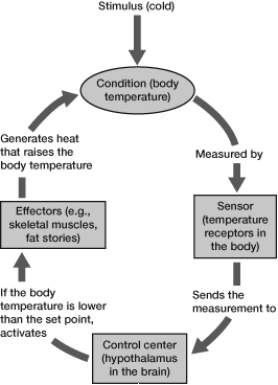
(75) 

Filters
- Essay(0)
- Multiple Choice(0)
- Short Answer(0)
- True False(0)
- Matching(0)