



 Chat with AI
Exam 46: Plant Responses to the Environment

Exam 1: An Introduction to Life on Earth85 Questions
Exam 2: Atoms, Molecules, and Life90 Questions
Exam 3: Biological Molecules98 Questions
Exam 4: Cell Structure and Function90 Questions
Exam 5: Cell Membrane Structure and Function95 Questions
Exam 6: Energy Flow in the Life of a Cell90 Questions
Exam 7: Capturing Solar Energy: Photosynthesis102 Questions
Exam 8: Harvesting Energy: Glycolysis and Cellular Respiration97 Questions
Exam 9: Cellular Reproduction133 Questions
Exam 10: Meiosis: the Basis of Sexual Reproduction103 Questions
Exam 11: Patterns of Inheritance98 Questions
Exam 12: Dna: the Molecule of Heredity97 Questions
Exam 13: Gene Expression and Regulation93 Questions
Exam 14: Biotechnology91 Questions
Exam 15: Principles of Evolution97 Questions
Exam 16: How Populations Evolve109 Questions
Exam 17: The Origin of Species89 Questions
Exam 18: The History of Life125 Questions
Exam 19: Systematics: Seeking Order Amid Diversity90 Questions
Exam 20: The Diversity of Prokaryotes and Viruses97 Questions
Exam 21: The Diversity of Protists102 Questions
Exam 22: The Diversity of Plants115 Questions
Exam 23: The Diversity of Fungi107 Questions
Exam 24: Animal Diversity I: Invertebrates101 Questions
Exam 25: Animal Diversity II: Vertebrates118 Questions
Exam 26: Animal Behavior116 Questions
Exam 27: Population Growth and Regulation114 Questions
Exam 28: Community Interactions125 Questions
Exam 29: Energy Flow and Nutrient Cycling in Ecosystems122 Questions
Exam 30: Earths Diverse Ecosystems126 Questions
Exam 31: Conserving Earths Biodiversity109 Questions
Exam 32: Homeostasis and the Organization of the Animal Body95 Questions
Exam 33: Circulation89 Questions
Exam 34: Respiration92 Questions
Exam 35: Nutrition and Digestion91 Questions
Exam 36: The Urinary System99 Questions
Exam 37: Defenses Against Disease104 Questions
Exam 38: Chemical Control of the Animal Body: the Endocrine System133 Questions
Exam 39: The Nervous System118 Questions
Exam 40: The Senses94 Questions
Exam 41: Action and Support: the Muscles and Skeleton90 Questions
Exam 42: Animal Reproduction120 Questions
Exam 43: Animal Development122 Questions
Exam 44: Plant Anatomy and Nutrient Transport95 Questions
Exam 45: Plant Reproduction and Development90 Questions
Exam 46: Plant Responses to the Environment87 Questions
Select questions type


Why does removing an overripe, mushy apple from a container of otherwise good apples help preserve the good apples?
(Multiple Choice)
4.9/5  (84)
(84) To encourage the formation of well- developed, heavily branched roots, you should treat cuttings with
(Multiple Choice)
5.0/5 (76)
(76) Ripening fruits are attached firmly to their trees, but once they are mature, the trees must release them. How does this happen?
(Essay)
4.7/5 (82)
(82) Based on the figure, which of the following plants will NOT flower under long- day or interrupted- night conditions? 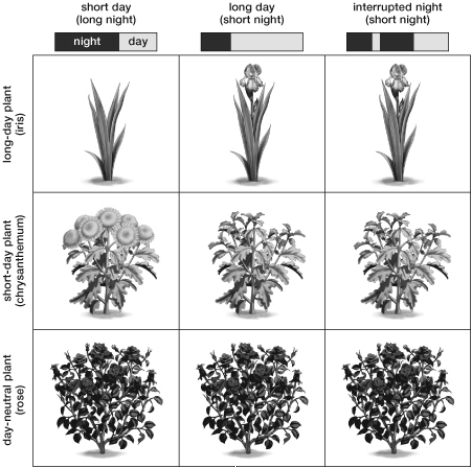
(Multiple Choice)
4.9/5 (67)
(67) Plants that flower in the United States in July (when nights are short) are plants.
(Multiple Choice)
4.8/5 (90)
(90) Most scientists believe that the lateral buds farthest from the top of a tree are the least inhibited from sprouting because they
(Multiple Choice)
4.9/5 (82)
(82) A group of plant geneticists discovers a mutant plant that has a deficiency in gibberellin production. All other ho including auxins, cytokinins, florigens, ethylene, and abscisic acid, are produced in normal quantities and are no affected by this mutation. Based on this scenario, the mutant plant most likely exhibits
(Multiple Choice)
4.9/5 (78)
(78) Tomatoes that are planted upside down still grow upright, displaying
(Multiple Choice)
4.8/5 (83)
(83) Cutting a hedge with a trimmer stimulates it to become bushy because
(Multiple Choice)
4.8/5 (72)
(72) When auxin accumulates on the lower side of the root of a germinating seed, it
(Multiple Choice)
4.8/5 (75)
(75) The phytochrome that is active and absorbs far- red light is
(Multiple Choice)
4.8/5 (73)
(73) What caterpillar saliva- based chemical stimulates a corn plant to release an alarm signal?
(Multiple Choice)
4.8/5 (76)
(76) How do auxin and cytokinin interact to affect the shape and growth of a plant?
(Essay)
4.9/5 (71)
(71) In the late winter, as seeds prepare to germinate, the levels of in seeds should be declining as the levels of are increasing.
(Short Answer)
4.9/5 (74)
(74) The hormone was named after the fungus that causes "foolish seedling" disease in rice.
(Multiple Choice)
4.9/5 (88)
(88) If a plant is living under conditions that limit root growth, shoot growth is
(Multiple Choice)
4.8/5 (91)
(91) In 2007, research confirmed the existence of hormones that control the timing of flowering. These hormones are called
(Multiple Choice)
4.7/5 (89)
(89) Auxins are used in rooting powders to encourage the formation of well- branched roots.
(True/False)
4.8/5 (78)
(78) 
Filters
- Essay(0)
- Multiple Choice(0)
- Short Answer(0)
- True False(0)
- Matching(0)