



 Chat with AI
Exam 9: Cellular Reproduction

Exam 1: An Introduction to Life on Earth85 Questions
Exam 2: Atoms, Molecules, and Life90 Questions
Exam 3: Biological Molecules98 Questions
Exam 4: Cell Structure and Function90 Questions
Exam 5: Cell Membrane Structure and Function95 Questions
Exam 6: Energy Flow in the Life of a Cell90 Questions
Exam 7: Capturing Solar Energy: Photosynthesis102 Questions
Exam 8: Harvesting Energy: Glycolysis and Cellular Respiration97 Questions
Exam 9: Cellular Reproduction133 Questions
Exam 10: Meiosis: the Basis of Sexual Reproduction103 Questions
Exam 11: Patterns of Inheritance98 Questions
Exam 12: Dna: the Molecule of Heredity97 Questions
Exam 13: Gene Expression and Regulation93 Questions
Exam 14: Biotechnology91 Questions
Exam 15: Principles of Evolution97 Questions
Exam 16: How Populations Evolve109 Questions
Exam 17: The Origin of Species89 Questions
Exam 18: The History of Life125 Questions
Exam 19: Systematics: Seeking Order Amid Diversity90 Questions
Exam 20: The Diversity of Prokaryotes and Viruses97 Questions
Exam 21: The Diversity of Protists102 Questions
Exam 22: The Diversity of Plants115 Questions
Exam 23: The Diversity of Fungi107 Questions
Exam 24: Animal Diversity I: Invertebrates101 Questions
Exam 25: Animal Diversity II: Vertebrates118 Questions
Exam 26: Animal Behavior116 Questions
Exam 27: Population Growth and Regulation114 Questions
Exam 28: Community Interactions125 Questions
Exam 29: Energy Flow and Nutrient Cycling in Ecosystems122 Questions
Exam 30: Earths Diverse Ecosystems126 Questions
Exam 31: Conserving Earths Biodiversity109 Questions
Exam 32: Homeostasis and the Organization of the Animal Body95 Questions
Exam 33: Circulation89 Questions
Exam 34: Respiration92 Questions
Exam 35: Nutrition and Digestion91 Questions
Exam 36: The Urinary System99 Questions
Exam 37: Defenses Against Disease104 Questions
Exam 38: Chemical Control of the Animal Body: the Endocrine System133 Questions
Exam 39: The Nervous System118 Questions
Exam 40: The Senses94 Questions
Exam 41: Action and Support: the Muscles and Skeleton90 Questions
Exam 42: Animal Reproduction120 Questions
Exam 43: Animal Development122 Questions
Exam 44: Plant Anatomy and Nutrient Transport95 Questions
Exam 45: Plant Reproduction and Development90 Questions
Exam 46: Plant Responses to the Environment87 Questions
Select questions type


What causes the rhythmic change in cyclin concentration in the cell cycle?
(Multiple Choice)
4.8/5  (80)
(80) The units of inheritance, called , are segments of the DNA of a chromosome, ranging from a few hundred to many thousands of nucleotides in length.
(Short Answer)
4.7/5 (75)
(75) Which of the following statements about stem cells is TRUE?
(Multiple Choice)
4.9/5 (75)
(75) During which phase of mitosis do sister chromatids separate from each other?
(Multiple Choice)
4.8/5 (73)
(73) Proteins that resemble beads on which DNA molecules are wound are called
(Multiple Choice)
4.8/5 (82)
(82) Which of the following is the correct structure of a nucleotide?
(Multiple Choice)
4.8/5 (82)
(82) The uncoiled DNA in a eukaryotic cell is much longer than the cell itself.
(True/False)
4.8/5 (72)
(72) For the question below, suppose that the somatic cells of humanoid X contain a total of 4 chromosomes [2N = 4] (or 2 pairs of chromosomes, [N = 2]). How many chromatids and chromosomes are present at the following stage mitosis? Answers should be filled in for the blank spaces in the table below. 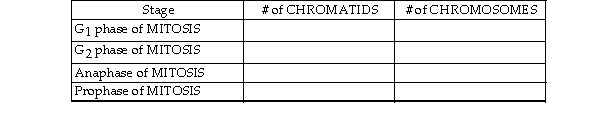
(Essay)
5.0/5 (87)
(87) Heritable information exists as discrete units called genes, which are located on .
(Short Answer)
4.8/5 (87)
(87) 
Filters
- Essay(0)
- Multiple Choice(0)
- Short Answer(0)
- True False(0)
- Matching(0)