



 Chat with AI
Exam 20: Income Inequality and Poverty

Exam 1: Ten Principles of Economics455 Questions
Exam 2: Thinking Like an Economist643 Questions
Exam 3: Interdependence and the Gains From Trade547 Questions
Exam 4: The Market Forces of Supply and Demand693 Questions
Exam 5: Elasticity and Its Application626 Questions
Exam 6: Supply, Demand, and Government Policies668 Questions
Exam 7: Consumers, Producers, and the Efficiency of Markets547 Questions
Exam 8: Applications: the Costs of Taxation509 Questions
Exam 9: Application: International Trade521 Questions
Exam 10: Externalities543 Questions
Exam 11: Public Goods and Common Resources452 Questions
Exam 12: The Design of the Tax System664 Questions
Exam 13: The Costs of Production649 Questions
Exam 14: Firms in Competitive Markets604 Questions
Exam 15: Monopoly662 Questions
Exam 16: Monopolistic Competition649 Questions
Exam 17: Oligopoly522 Questions
Exam 18: The Markets for the Factors of Production592 Questions
Exam 19: Earnings and Discrimination511 Questions
Exam 20: Income Inequality and Poverty478 Questions
Exam 21: The Theory of Consumer Choice570 Questions
Exam 22: Frontiers in Microeconomics461 Questions
Exam 23: Measuring a Nation S Income547 Questions
Exam 24: Measuring the Cost of Living565 Questions
Exam 25: Production and Growth527 Questions
Exam 26: Saving, Investment, and the Financial System637 Questions
Exam 27: Tools of Finance534 Questions
Exam 28: Unemployment and Its Natural Rate701 Questions
Exam 29: The Monetary System540 Questions
Exam 30: Money Growth and Inflation504 Questions
Exam 31: Open-Economy Macroeconomics: Basic Concepts540 Questions
Exam 32: A Macroeconomic Theory of the Open Economy511 Questions
Exam 33: Aggregate Demand and Aggregate Supply572 Questions
Exam 34: The Influence of Monetary and Fiscal Policy on Aggregate Demand523 Questions
Exam 35: The Short-Run Tradeoff Between Inflation and Unemployment536 Questions
Exam 36: Six Debates Over Macroeconomic Policy354 Questions
Select questions type


Scenario 20-7
Suppose the government implemented a negative income tax and used the following formula to compute a family's tax liability:
Taxes owed = (1/6 of income) - $24,000
-Refer to Scenario 20-7. This negative income tax would guarantee what minimum level of income to every family?
(Multiple Choice)
4.8/5  (73)
(73) The poverty line in the country of Inequalia is $7,800. The distribution of income for Inequalia is as follows: 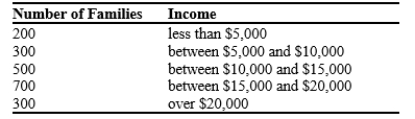 The poverty rate in Inequalia is
 (Multiple Choice)
4.9/5 (86)
(86) Which of the following formulas is most representative of a negative income tax proposal?
(Multiple Choice)
4.8/5 (85)
(85) The concept of diminishing marginal utility is embedded in the utilitarian rationale for
(Multiple Choice)
4.9/5 (98)
(98) Table 20-1
The following table shows the distribution of income in Marysville. 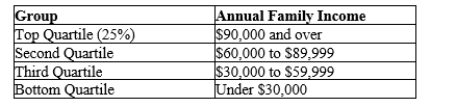 -Refer to Table 20-1. Seventy-five percent of all families have incomes below what level?
 (Multiple Choice)
4.8/5 (92)
(92) The typical economic life cycle illustrates how people tend to
(Multiple Choice)
4.8/5 (70)
(70) Figure 20-3 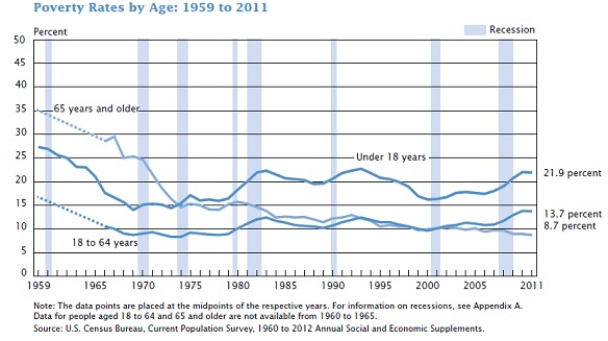 -Refer to Figure 20-3. In 2011, the percent of elderly aged 65 and over in poverty is
 (Multiple Choice)
4.8/5 (84)
(84) Raising the welfare of the worst-off person in society is an important goal of which political philosophy?
(Multiple Choice)
4.8/5 (83)
(83) About four out of five millionaires in the United States earned their money rather than inherited it.
(True/False)
4.8/5 (91)
(91) Which of the following groups has the lowest poverty rate?
(Multiple Choice)
4.8/5 (71)
(71) Table 20-6 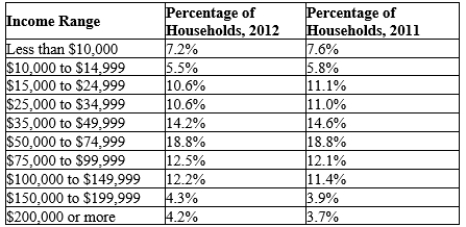 -Refer to Table 20-6. A person who is concerned that income inequality has worsened between 2011 and 2012 would cite which of the following statistics to support her position?
 (Multiple Choice)
4.8/5 (84)
(84) Of the four countries below, the country that has the most income equality is
(Multiple Choice)
4.9/5 (100)
(100) Table 20-13
The following table shows the distribution of income in Widgetapolis. 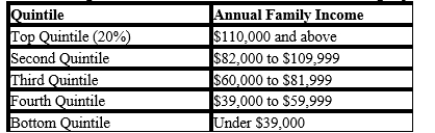
-Refer to Table 20-13. Twenty percent of all families have incomes above what level?
-Refer to Table 20-13. Twenty percent of all families have incomes above what level? (Multiple Choice)
4.7/5 (93)
(93) Briefly describe the three prominent schools of thought in political philosophy. Identify one of the most well-known philosophers in each school.
(Essay)
4.9/5 (78)
(78) Caroline earns more than John. Under a new tax system, some of the taxes paid by Caroline would go to John. A libertarian would
(Multiple Choice)
4.8/5 (70)
(70) 
Filters
- Essay(0)
- Multiple Choice(0)
- Short Answer(0)
- True False(0)
- Matching(0)