



 Chat with AI
Exam 20: Income Inequality and Poverty

Exam 1: Ten Principles of Economics455 Questions
Exam 2: Thinking Like an Economist643 Questions
Exam 3: Interdependence and the Gains From Trade547 Questions
Exam 4: The Market Forces of Supply and Demand693 Questions
Exam 5: Elasticity and Its Application626 Questions
Exam 6: Supply, Demand, and Government Policies668 Questions
Exam 7: Consumers, Producers, and the Efficiency of Markets547 Questions
Exam 8: Applications: the Costs of Taxation509 Questions
Exam 9: Application: International Trade521 Questions
Exam 10: Externalities543 Questions
Exam 11: Public Goods and Common Resources452 Questions
Exam 12: The Design of the Tax System664 Questions
Exam 13: The Costs of Production649 Questions
Exam 14: Firms in Competitive Markets604 Questions
Exam 15: Monopoly662 Questions
Exam 16: Monopolistic Competition649 Questions
Exam 17: Oligopoly522 Questions
Exam 18: The Markets for the Factors of Production592 Questions
Exam 19: Earnings and Discrimination511 Questions
Exam 20: Income Inequality and Poverty478 Questions
Exam 21: The Theory of Consumer Choice570 Questions
Exam 22: Frontiers in Microeconomics461 Questions
Exam 23: Measuring a Nation S Income547 Questions
Exam 24: Measuring the Cost of Living565 Questions
Exam 25: Production and Growth527 Questions
Exam 26: Saving, Investment, and the Financial System637 Questions
Exam 27: Tools of Finance534 Questions
Exam 28: Unemployment and Its Natural Rate701 Questions
Exam 29: The Monetary System540 Questions
Exam 30: Money Growth and Inflation504 Questions
Exam 31: Open-Economy Macroeconomics: Basic Concepts540 Questions
Exam 32: A Macroeconomic Theory of the Open Economy511 Questions
Exam 33: Aggregate Demand and Aggregate Supply572 Questions
Exam 34: The Influence of Monetary and Fiscal Policy on Aggregate Demand523 Questions
Exam 35: The Short-Run Tradeoff Between Inflation and Unemployment536 Questions
Exam 36: Six Debates Over Macroeconomic Policy354 Questions
Select questions type


Table 20-1
The following table shows the distribution of income in Marysville. 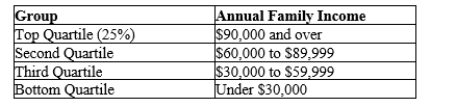 -Refer to Table 20-1. Fifty percent of all families have incomes below what level?
 (Multiple Choice)
4.8/5  (78)
(78) If greater equality is the benefit of government intervention into the allocation of society's resources, what is the cost?
(Short Answer)
4.8/5 (84)
(84) Which of the three political philosophies discussed in the textbook, if any, think the government should not take from some individuals and give to others to achieve any particular distribution of income?
(Short Answer)
4.8/5 (79)
(79) Aniella believes that the demand for unskilled labor is relatively inelastic. Carmella believes that the demand for unskilled labor is relatively elastic. Which believes that a minimum-wage law will result in significant unemployment?
(Short Answer)
4.7/5 (99)
(99) A family's ability to buy goods and services depends largely on its
(Multiple Choice)
4.9/5 (72)
(72) Which of the following lists correctly ranks countries from most equal to least equal distribution of income?
(Multiple Choice)
5.0/5 (69)
(69) The rule for redistribution proposed by John Rawls in his book A Theory of Justice is called the
(Multiple Choice)
4.7/5 (77)
(77) Critics argue that a disadvantage of minimum-wage laws is that they do not effectively target the working poor because many minimum-wage workers are the teenage children of middle-income families.
(True/False)
4.8/5 (86)
(86) Table 20-14
Income Inequality in the United States
The values in the table reflect the percentages of pre-tax-and transfer income.  Source: US Census Bureau
-Refer to Table 20-14. If the distribution of income were completely equal, what percentage of income would the bottom fifth of the population earn?
Source: US Census Bureau
-Refer to Table 20-14. If the distribution of income were completely equal, what percentage of income would the bottom fifth of the population earn? (Short Answer)
4.8/5 (68)
(68) A goal of libertarians is to provide citizens with equal opportunities rather than to ensure equal outcomes.
(True/False)
4.8/5 (75)
(75) Table 20-11
Poverty Thresholds in 2011, by Size of Family and Number of Related Children Under 18 Years
[Dollars] 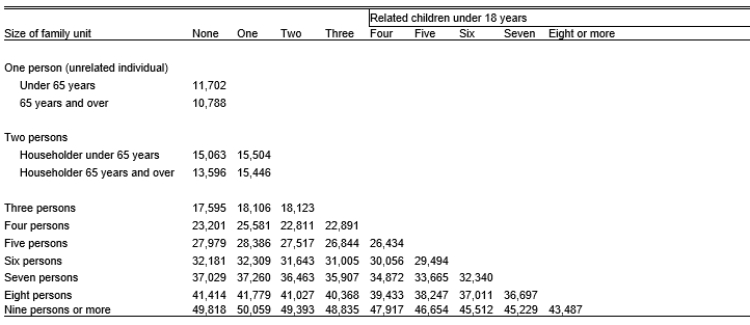 Source: U. S. Bureau of the Census, Current Population Survey.
-Refer to Table 20-11. What is the poverty line for a family with one 68-year-old adult and one child?
Source: U. S. Bureau of the Census, Current Population Survey.
-Refer to Table 20-11. What is the poverty line for a family with one 68-year-old adult and one child? (Multiple Choice)
4.8/5 (73)
(73) The poverty rate is the percentage of the population that have a family income level below the
(Multiple Choice)
4.7/5 (83)
(83) About half of black and Hispanic children in female-headed households live in poverty.
(True/False)
4.8/5 (65)
(65) Table 20-14
Income Inequality in the United States
The values in the table reflect the percentages of pre-tax-and transfer income. Source: US Census Bureau
-Refer to Table 20-14. In 2010, what percentage of total income in the US did the bottom 20% of families have?
Source: US Census Bureau
-Refer to Table 20-14. In 2010, what percentage of total income in the US did the bottom 20% of families have? (Short Answer)
4.8/5 (78)
(78) Scenario 20-7
Suppose the government implemented a negative income tax and used the following formula to compute a family's tax liability:
Taxes owed = (1/6 of income) - $24,000
-Refer to Scenario 20-7. A family earning $60,000 before taxes would pay how much in taxes?
(Multiple Choice)
4.8/5 (69)
(69) The economic life cycle describes how young people usually have higher savings rates than middle-aged people.
(True/False)
4.9/5 (72)
(72) The poverty line is adjusted each year to reflect changes in the
(Multiple Choice)
4.8/5 (85)
(85) 
Filters
- Essay(0)
- Multiple Choice(0)
- Short Answer(0)
- True False(0)
- Matching(0)