



 Chat with AI
Exam 20: Income Inequality and Poverty

Exam 1: Ten Principles of Economics455 Questions
Exam 2: Thinking Like an Economist643 Questions
Exam 3: Interdependence and the Gains From Trade547 Questions
Exam 4: The Market Forces of Supply and Demand693 Questions
Exam 5: Elasticity and Its Application626 Questions
Exam 6: Supply, Demand, and Government Policies668 Questions
Exam 7: Consumers, Producers, and the Efficiency of Markets547 Questions
Exam 8: Applications: the Costs of Taxation509 Questions
Exam 9: Application: International Trade521 Questions
Exam 10: Externalities543 Questions
Exam 11: Public Goods and Common Resources452 Questions
Exam 12: The Design of the Tax System664 Questions
Exam 13: The Costs of Production649 Questions
Exam 14: Firms in Competitive Markets604 Questions
Exam 15: Monopoly662 Questions
Exam 16: Monopolistic Competition649 Questions
Exam 17: Oligopoly522 Questions
Exam 18: The Markets for the Factors of Production592 Questions
Exam 19: Earnings and Discrimination511 Questions
Exam 20: Income Inequality and Poverty478 Questions
Exam 21: The Theory of Consumer Choice570 Questions
Exam 22: Frontiers in Microeconomics461 Questions
Exam 23: Measuring a Nation S Income547 Questions
Exam 24: Measuring the Cost of Living565 Questions
Exam 25: Production and Growth527 Questions
Exam 26: Saving, Investment, and the Financial System637 Questions
Exam 27: Tools of Finance534 Questions
Exam 28: Unemployment and Its Natural Rate701 Questions
Exam 29: The Monetary System540 Questions
Exam 30: Money Growth and Inflation504 Questions
Exam 31: Open-Economy Macroeconomics: Basic Concepts540 Questions
Exam 32: A Macroeconomic Theory of the Open Economy511 Questions
Exam 33: Aggregate Demand and Aggregate Supply572 Questions
Exam 34: The Influence of Monetary and Fiscal Policy on Aggregate Demand523 Questions
Exam 35: The Short-Run Tradeoff Between Inflation and Unemployment536 Questions
Exam 36: Six Debates Over Macroeconomic Policy354 Questions
Select questions type


Suppose that Angelo and Sonia each win $500 in a charity raffle. Angelo spends his winnings on a new ipad. Sonia saves her winnings. Which of the following is correct?
(Multiple Choice)
4.9/5  (72)
(72) Table 20-3
The Distribution of Income in Edgerton 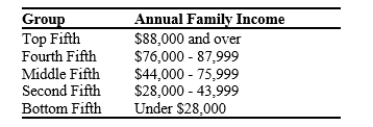 -Refer to Table 20-3. If the poverty rate is 26%, where is the poverty line in Edgerton?
 (Multiple Choice)
4.9/5 (88)
(88) Many economists believe that a family bases its spending decisions on its permanent, or average, income rather than on transitory income.
(True/False)
4.9/5 (85)
(85) Which of the following does not explain why data on income distribution and the poverty rate give an incomplete picture of inequality?
(Multiple Choice)
4.7/5 (64)
(64) The lack of progress in reducing the poverty rate since the early 1970s is most closely related with which of the following factors?
(Multiple Choice)
4.8/5 (84)
(84) Which of the following is not a finding of Cox and Alm regarding the gap between rich and poor?
(Multiple Choice)
5.0/5 (97)
(97) One way of expressing the tradeoff between income equality and efficiency is to say the more equally the pie is divided, the .
(Short Answer)
4.9/5 (90)
(90) John Rawls, who developed the way of thinking called liberalism, argued that government policies should be aimed at maximizing the sum of utility of everyone in society.
(True/False)
4.8/5 (85)
(85) Figure 20-3 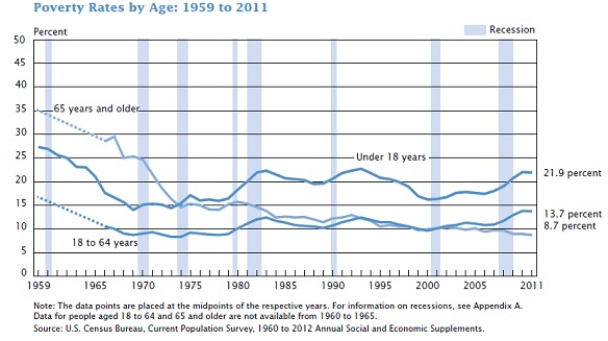 -Refer to Figure 20-3. In 2011, the percent of adults between ages 18 and 64 in poverty is
 (Multiple Choice)
4.9/5 (65)
(65) In the parable of the leaky bucket, a fundamental problem with government redistribution programs is identified. As long as the government only has "leaky buckets" at its disposal,
(Multiple Choice)
4.9/5 (73)
(73) A tax provision that works much like a negative income tax is the
(Multiple Choice)
4.8/5 (71)
(71) Figure 20-3
-Refer to Figure 20-3. Which of the following is consistent with the data reported in the figure?
-Refer to Figure 20-3. Which of the following is consistent with the data reported in the figure? (Multiple Choice)
4.9/5 (86)
(86) Suppose the government used the following formula to compute a family's tax liability:
Taxes owed = 28% of income - $8,000. How much would a family that earned $20,000 owe?
(Multiple Choice)
4.9/5 (73)
(73) Scenario 20-3
Suppose that a society is made up of five families whose incomes are as follows:
$120,000; $90,000; $30,000; $30,000; and $18,000.
The federal government is considering two potential income tax plans:
Plan A is a negative income tax plan where the taxes owed equal 1/3 of income minus $20,000.
Plan B is a two-tiered plan where families earning less than $35,000 pay no income tax and families earning more than $35,000 pay 10% of their income in taxes. The income tax revenue collected from those families earning over $35,000 is then redistributed equally to those families earning less than $35,000.
-Refer to Scenario 20-3. Assuming that utility is directly proportional to the cash value of after-tax income, which government policy would an advocate of liberalism prefer?
(Multiple Choice)
4.7/5 (73)
(73) 
Filters
- Essay(0)
- Multiple Choice(0)
- Short Answer(0)
- True False(0)
- Matching(0)