



 Chat with AI
Exam 20: Income Inequality and Poverty

Exam 1: Ten Principles of Economics455 Questions
Exam 2: Thinking Like an Economist643 Questions
Exam 3: Interdependence and the Gains From Trade547 Questions
Exam 4: The Market Forces of Supply and Demand693 Questions
Exam 5: Elasticity and Its Application626 Questions
Exam 6: Supply, Demand, and Government Policies668 Questions
Exam 7: Consumers, Producers, and the Efficiency of Markets547 Questions
Exam 8: Applications: the Costs of Taxation509 Questions
Exam 9: Application: International Trade521 Questions
Exam 10: Externalities543 Questions
Exam 11: Public Goods and Common Resources452 Questions
Exam 12: The Design of the Tax System664 Questions
Exam 13: The Costs of Production649 Questions
Exam 14: Firms in Competitive Markets604 Questions
Exam 15: Monopoly662 Questions
Exam 16: Monopolistic Competition649 Questions
Exam 17: Oligopoly522 Questions
Exam 18: The Markets for the Factors of Production592 Questions
Exam 19: Earnings and Discrimination511 Questions
Exam 20: Income Inequality and Poverty478 Questions
Exam 21: The Theory of Consumer Choice570 Questions
Exam 22: Frontiers in Microeconomics461 Questions
Exam 23: Measuring a Nation S Income547 Questions
Exam 24: Measuring the Cost of Living565 Questions
Exam 25: Production and Growth527 Questions
Exam 26: Saving, Investment, and the Financial System637 Questions
Exam 27: Tools of Finance534 Questions
Exam 28: Unemployment and Its Natural Rate701 Questions
Exam 29: The Monetary System540 Questions
Exam 30: Money Growth and Inflation504 Questions
Exam 31: Open-Economy Macroeconomics: Basic Concepts540 Questions
Exam 32: A Macroeconomic Theory of the Open Economy511 Questions
Exam 33: Aggregate Demand and Aggregate Supply572 Questions
Exam 34: The Influence of Monetary and Fiscal Policy on Aggregate Demand523 Questions
Exam 35: The Short-Run Tradeoff Between Inflation and Unemployment536 Questions
Exam 36: Six Debates Over Macroeconomic Policy354 Questions
Select questions type


Which of the Ten Principles of Economics do governments run into when they redistribute income to achieve greater equality?
(Multiple Choice)
4.7/5  (63)
(63) Table 20-13
Distribution of Income in Imagination  -Refer to Table 20-13. If the poverty rate in Imagination is 10%, what is the poverty line?
 (Short Answer)
4.9/5 (73)
(73) Scenario 20-2
The government is proposing switching from a progressive tax system, in which families pay 15% of the first $40,000 earned, 30% of the next $40,000 earned, and 45% of any income over $80,000 to a tax system in which every family pays 1/4 of its income regardless of how much they earn and all income redistribution is eliminated. That is, the tax revenue generated is used only for infrastructure, public administration, and national defense.
-Refer to Scenario 20-2. Which group would be most in favor of the proposed change in tax policy?
(Multiple Choice)
4.9/5 (84)
(84) Standard measurements of the degree of income inequality take both money income and in-kind transfers into account.
(True/False)
5.0/5 (75)
(75) Table 20-14
James, Luke, Peter, Micah, and Sarah are the only five inhabits of Marketsville. The following table shows their income. 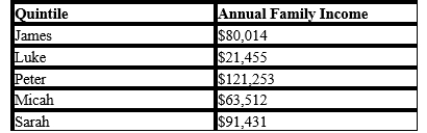
-Refer to Table 20-14. According to the table, what percentage of individuals in Marketsville have an income below $64,000?
-Refer to Table 20-14. According to the table, what percentage of individuals in Marketsville have an income below $64,000? (Multiple Choice)
4.8/5 (86)
(86) Which of the following represents a problem in measuring inequality?
(Multiple Choice)
4.8/5 (85)
(85) Government programs that take money from high-income people and give it to low-income people typically
(Multiple Choice)
4.9/5 (79)
(79) The utilitarian justification for redistributing income is based on the assumption of diminishing marginal utility.
(True/False)
4.8/5 (69)
(69) Table 20-14
James, Luke, Peter, Micah, and Sarah are the only five inhabits of Marketsville. The following table shows their income.
-Refer to Table 20-14. Where would the government of Marketsville set the poverty line to have a poverty rate of 20 percent?
-Refer to Table 20-14. Where would the government of Marketsville set the poverty line to have a poverty rate of 20 percent? (Multiple Choice)
4.9/5 (82)
(82) Which of the following is not an example of in-kind transfers?
(Multiple Choice)
4.7/5 (82)
(82) Explain the concept of diminishing marginal utility, and describe the role that it plays in the utilitarian argument for the redistribution of income.
(Essay)
4.9/5 (74)
(74) In 2011, what percentage of U.S. families had income levels above $115,866?
(Multiple Choice)
4.8/5 (92)
(92) Figure 20-1
Number of Poor 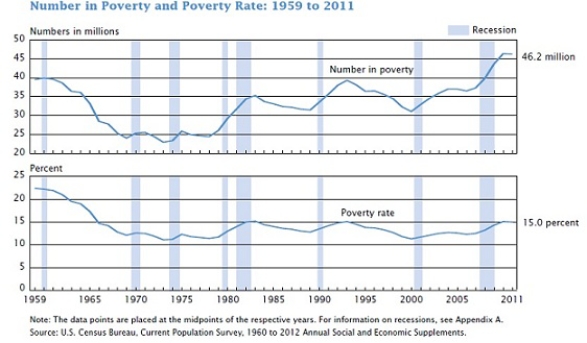 -Refer to Figure 20-1. Between 1959 and 2011 the poverty rate has
 (Multiple Choice)
4.8/5 (80)
(80) One existing government program that works much like a negative income tax is Medicaid.
(True/False)
4.9/5 (80)
(80) Suppose the average value of in-kind transfers increases by $2,000 from 2013 to 2014. The poverty rate
(Multiple Choice)
4.7/5 (72)
(72) 
Filters
- Essay(0)
- Multiple Choice(0)
- Short Answer(0)
- True False(0)
- Matching(0)