



 Chat with AI
Exam 20: Income Inequality and Poverty

Exam 1: Ten Principles of Economics455 Questions
Exam 2: Thinking Like an Economist643 Questions
Exam 3: Interdependence and the Gains From Trade547 Questions
Exam 4: The Market Forces of Supply and Demand693 Questions
Exam 5: Elasticity and Its Application626 Questions
Exam 6: Supply, Demand, and Government Policies668 Questions
Exam 7: Consumers, Producers, and the Efficiency of Markets547 Questions
Exam 8: Applications: the Costs of Taxation509 Questions
Exam 9: Application: International Trade521 Questions
Exam 10: Externalities543 Questions
Exam 11: Public Goods and Common Resources452 Questions
Exam 12: The Design of the Tax System664 Questions
Exam 13: The Costs of Production649 Questions
Exam 14: Firms in Competitive Markets604 Questions
Exam 15: Monopoly662 Questions
Exam 16: Monopolistic Competition649 Questions
Exam 17: Oligopoly522 Questions
Exam 18: The Markets for the Factors of Production592 Questions
Exam 19: Earnings and Discrimination511 Questions
Exam 20: Income Inequality and Poverty478 Questions
Exam 21: The Theory of Consumer Choice570 Questions
Exam 22: Frontiers in Microeconomics461 Questions
Exam 23: Measuring a Nation S Income547 Questions
Exam 24: Measuring the Cost of Living565 Questions
Exam 25: Production and Growth527 Questions
Exam 26: Saving, Investment, and the Financial System637 Questions
Exam 27: Tools of Finance534 Questions
Exam 28: Unemployment and Its Natural Rate701 Questions
Exam 29: The Monetary System540 Questions
Exam 30: Money Growth and Inflation504 Questions
Exam 31: Open-Economy Macroeconomics: Basic Concepts540 Questions
Exam 32: A Macroeconomic Theory of the Open Economy511 Questions
Exam 33: Aggregate Demand and Aggregate Supply572 Questions
Exam 34: The Influence of Monetary and Fiscal Policy on Aggregate Demand523 Questions
Exam 35: The Short-Run Tradeoff Between Inflation and Unemployment536 Questions
Exam 36: Six Debates Over Macroeconomic Policy354 Questions
Select questions type


Fewer than three percent of families are poor for eight or more years.
(True/False)
4.8/5  (81)
(81) Suppose a society consists of only two people, John and Jane. A utilitarian would say that the proper role of government in this society is to
(Multiple Choice)
4.9/5 (92)
(92) In the United States, long-term poverty, defined as a family having an income below the poverty line for eight or more years, is
(Multiple Choice)
4.9/5 (87)
(87) The Hicks family owns a blueberry farm in Maine. The Ward family owns a blueberry farm in Massachusetts. A drought in Massachusetts destroys half of the Ward family's harvest for one year. For the Ward family, their
(Multiple Choice)
4.8/5 (76)
(76) "Equality of opportunities is more important than equality of incomes." This statement would be most likely attributed to which political philosophy?
(Multiple Choice)
4.9/5 (86)
(86) The invisible hand of the marketplace acts to allocate resources efficiently, but it does not necessarily ensure that resources are allocated fairly.
(True/False)
4.9/5 (93)
(93) When comparing the percentage of income (or expenditure) of the lowest and highest 10 percent of the population,
(Multiple Choice)
4.9/5 (101)
(101) According to libertarians, the government should redistribute income from rich individuals to poor individuals to achieve a more equal distribution of income.
(True/False)
4.9/5 (76)
(76) Libertarianism identifies a redistribution of income role for government when
(Multiple Choice)
4.9/5 (79)
(79) Which of the following explains the rise in income inequality in the United States from 1970 to 2011?
(Multiple Choice)
4.8/5 (75)
(75) Table 20-5
Distribution of Income in Umakastan 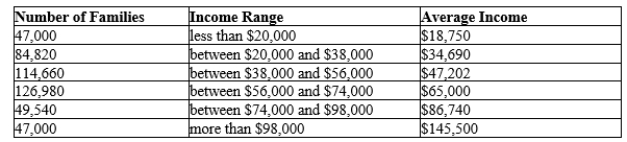 -Refer to Table 20-5. Approximately what percentage of families in Umakastan have income levels below $74,000?
 (Multiple Choice)
4.8/5 (83)
(83) Suppose that Jamal is moving to a state where personal incomes are distributed randomly. If Jamal believes in liberalism, he would prefer
(Multiple Choice)
4.8/5 (70)
(70) The maximin criterion is attributed to which political philosophy?
(Multiple Choice)
4.9/5 (82)
(82) Scenario 20-8
Suppose the government implemented a negative income tax and used the following formula to compute a family's tax liability:
Taxes owed = (1/4 of income) - $14,000
-Refer to Scenario 20-8. A family earning $56,000 before taxes will have $56,000 after tax.
(True/False)
5.0/5 (75)
(75) Figure 20-1
Number of Poor 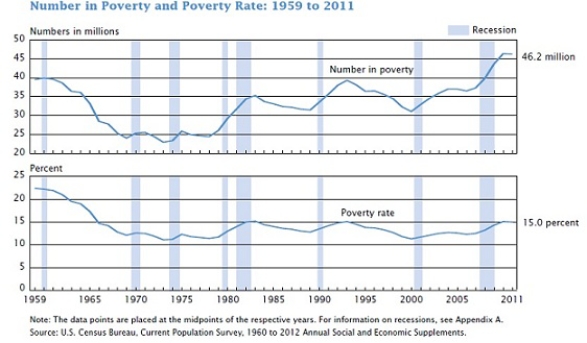 -Refer to Figure 20-1. Between 1965 and 2011, during recessions (the shaded bars) the number of individuals in poverty has
 (Multiple Choice)
4.7/5 (86)
(86) The study by economists Cox and Alm found that the 2006 after-tax income of the richest fifth of U.S. households is
(Multiple Choice)
4.8/5 (84)
(84) The poverty rate is the percentage of the population whose family income falls below the poverty line..
(True/False)
4.8/5 (80)
(80) 
Filters
- Essay(0)
- Multiple Choice(0)
- Short Answer(0)
- True False(0)
- Matching(0)