



 Chat with AI
Exam 20: Income Inequality and Poverty

Exam 1: Ten Principles of Economics455 Questions
Exam 2: Thinking Like an Economist643 Questions
Exam 3: Interdependence and the Gains From Trade547 Questions
Exam 4: The Market Forces of Supply and Demand693 Questions
Exam 5: Elasticity and Its Application626 Questions
Exam 6: Supply, Demand, and Government Policies668 Questions
Exam 7: Consumers, Producers, and the Efficiency of Markets547 Questions
Exam 8: Applications: the Costs of Taxation509 Questions
Exam 9: Application: International Trade521 Questions
Exam 10: Externalities543 Questions
Exam 11: Public Goods and Common Resources452 Questions
Exam 12: The Design of the Tax System664 Questions
Exam 13: The Costs of Production649 Questions
Exam 14: Firms in Competitive Markets604 Questions
Exam 15: Monopoly662 Questions
Exam 16: Monopolistic Competition649 Questions
Exam 17: Oligopoly522 Questions
Exam 18: The Markets for the Factors of Production592 Questions
Exam 19: Earnings and Discrimination511 Questions
Exam 20: Income Inequality and Poverty478 Questions
Exam 21: The Theory of Consumer Choice570 Questions
Exam 22: Frontiers in Microeconomics461 Questions
Exam 23: Measuring a Nation S Income547 Questions
Exam 24: Measuring the Cost of Living565 Questions
Exam 25: Production and Growth527 Questions
Exam 26: Saving, Investment, and the Financial System637 Questions
Exam 27: Tools of Finance534 Questions
Exam 28: Unemployment and Its Natural Rate701 Questions
Exam 29: The Monetary System540 Questions
Exam 30: Money Growth and Inflation504 Questions
Exam 31: Open-Economy Macroeconomics: Basic Concepts540 Questions
Exam 32: A Macroeconomic Theory of the Open Economy511 Questions
Exam 33: Aggregate Demand and Aggregate Supply572 Questions
Exam 34: The Influence of Monetary and Fiscal Policy on Aggregate Demand523 Questions
Exam 35: The Short-Run Tradeoff Between Inflation and Unemployment536 Questions
Exam 36: Six Debates Over Macroeconomic Policy354 Questions
Select questions type


A system in which anyone collecting antipoverty program benefits must accept a government-provided job is called .
(Short Answer)
4.8/5  (81)
(81) Explain what is meant by "in-kind transfer" programs. Briefly outline the advantages and disadvantages of an in-kind transfer program.
(Essay)
4.9/5 (88)
(88) People can borrow and lend money to smooth out short term variations in income known as what kind of changes?
(Short Answer)
4.8/5 (89)
(89) Which political philosophy concludes that equality of opportunities is more important than equality of outcomes?
(Short Answer)
4.9/5 (72)
(72) Table 20-13
The following table shows the distribution of income in Widgetapolis. 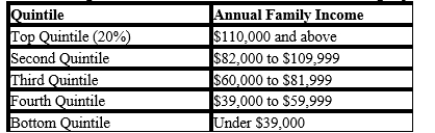
-Refer to Table 20-13. If the poverty rate is 19%, where is the poverty line in Widgetapolis?
-Refer to Table 20-13. If the poverty rate is 19%, where is the poverty line in Widgetapolis? (Multiple Choice)
4.9/5 (79)
(79) The income level below which families are said to be poor is known as the
(Multiple Choice)
4.7/5 (81)
(81) The 2011 U.S. distribution of income shows that the top 20 percent of families have approximately what share of income?
(Multiple Choice)
4.7/5 (81)
(81) In 2011, the top 20% of US families had more than times as much income as the bottom 20%.
(Short Answer)
4.8/5 (81)
(81) In a typical 10-year period, about one in four families falls below the poverty line in at least one year. What percentage of families are poor for eight or more years?
(Short Answer)
4.8/5 (88)
(88) Table 20-3
The Distribution of Income in Edgerton 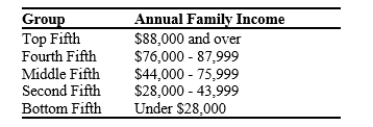 -Refer to Table 20-3. According to the table, what percent of families in Edgerton have income levels below $44,000?
 (Multiple Choice)
4.7/5 (77)
(77) The poverty line in the country of Inequalia is $10,000. The distribution of income for Inequalia is as follows: 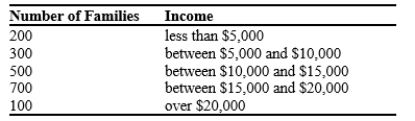 The poverty rate in Inequalia is
 (Multiple Choice)
5.0/5 (71)
(71) Table 20-15
Income Inequality in 2010 in the United States by Race
The values in the table reflect the percentages of pre-tax-and-transfer income.  Source: US Census Bureau
-Refer to Table 20-15. Which race shows the least equal distribution of income?
Source: US Census Bureau
-Refer to Table 20-15. Which race shows the least equal distribution of income? (Short Answer)
4.8/5 (75)
(75) Scenario 20-8
Suppose the government implemented a negative income tax and used the following formula to compute a family's tax liability:
Taxes owed = (1/4 of income) - $14,000
-Refer to Scenario 20-8. The government does not have to pay a subsidy to any family through this negative income tax if the family with the lowest income earns $50,000.
(True/False)
4.9/5 (75)
(75) Which of the following programs would be opposed by philosopher John Rawls?
(Multiple Choice)
4.9/5 (87)
(87) "The government should punish crimes and enforce voluntary agreements but not redistribute income." This statement is most closely associated with which political philosophy?
(Multiple Choice)
4.7/5 (82)
(82) 
Filters
- Essay(0)
- Multiple Choice(0)
- Short Answer(0)
- True False(0)
- Matching(0)