



 Chat with AI
Exam 20: Income Inequality and Poverty

Exam 1: Ten Principles of Economics455 Questions
Exam 2: Thinking Like an Economist643 Questions
Exam 3: Interdependence and the Gains From Trade547 Questions
Exam 4: The Market Forces of Supply and Demand693 Questions
Exam 5: Elasticity and Its Application626 Questions
Exam 6: Supply, Demand, and Government Policies668 Questions
Exam 7: Consumers, Producers, and the Efficiency of Markets547 Questions
Exam 8: Applications: the Costs of Taxation509 Questions
Exam 9: Application: International Trade521 Questions
Exam 10: Externalities543 Questions
Exam 11: Public Goods and Common Resources452 Questions
Exam 12: The Design of the Tax System664 Questions
Exam 13: The Costs of Production649 Questions
Exam 14: Firms in Competitive Markets604 Questions
Exam 15: Monopoly662 Questions
Exam 16: Monopolistic Competition649 Questions
Exam 17: Oligopoly522 Questions
Exam 18: The Markets for the Factors of Production592 Questions
Exam 19: Earnings and Discrimination511 Questions
Exam 20: Income Inequality and Poverty478 Questions
Exam 21: The Theory of Consumer Choice570 Questions
Exam 22: Frontiers in Microeconomics461 Questions
Exam 23: Measuring a Nation S Income547 Questions
Exam 24: Measuring the Cost of Living565 Questions
Exam 25: Production and Growth527 Questions
Exam 26: Saving, Investment, and the Financial System637 Questions
Exam 27: Tools of Finance534 Questions
Exam 28: Unemployment and Its Natural Rate701 Questions
Exam 29: The Monetary System540 Questions
Exam 30: Money Growth and Inflation504 Questions
Exam 31: Open-Economy Macroeconomics: Basic Concepts540 Questions
Exam 32: A Macroeconomic Theory of the Open Economy511 Questions
Exam 33: Aggregate Demand and Aggregate Supply572 Questions
Exam 34: The Influence of Monetary and Fiscal Policy on Aggregate Demand523 Questions
Exam 35: The Short-Run Tradeoff Between Inflation and Unemployment536 Questions
Exam 36: Six Debates Over Macroeconomic Policy354 Questions
Select questions type


Table 20-10 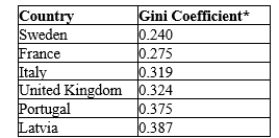 *A Gini coefficient is a commonly used measure of income inequality, with values between 0 and 1 (0 corresponds to perfect equality whereby everyone has exactly the same income, and 1 corresponds to perfect inequality where one person has all the income, while everyone else has zero income).
Source: The World Bank
-Refer to Table 20-10. Which of the following statements is correct?
*A Gini coefficient is a commonly used measure of income inequality, with values between 0 and 1 (0 corresponds to perfect equality whereby everyone has exactly the same income, and 1 corresponds to perfect inequality where one person has all the income, while everyone else has zero income).
Source: The World Bank
-Refer to Table 20-10. Which of the following statements is correct? (Multiple Choice)
4.7/5  (86)
(86) The ancient Greek philosopher, Plato, concluded that in an ideal society the income of the richest person
(Multiple Choice)
4.8/5 (87)
(87) Table 20-3
The Distribution of Income in Edgerton 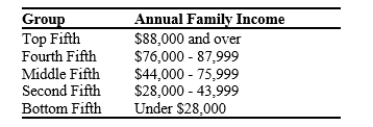 -Refer to Table 20-3. According to the table, what percent of families in Edgerton have income levels at or above $76,000?
 (Multiple Choice)
4.8/5 (75)
(75) When we examine historical data on income inequality in the U.S., we see that the distribution of income gradually became
(Multiple Choice)
4.9/5 (76)
(76) Explain how a "leaky bucket" can be used to illustrate the utilitarian argument that governments should not attempt to completely equalize individual incomes.
(Essay)
4.8/5 (87)
(87) Whether or not policymakers should try to make our society more egalitarian is largely a matter of
(Multiple Choice)
4.8/5 (83)
(83) Table 20-13
Distribution of Income in Imagination  -Refer to Table 20-13. The Human Development Report computes a measure of inequality by dividing the income of the richest 10% of the population by the income of the poorest 10%. If the value for this measure of inequality in the US is 15.9 and the value for India is 8.6, how does Imagination compare to these two nations?
 (Essay)
4.8/5 (76)
(76) Of the following groups, which group is least likely to live in poverty - whites, blacks, Hispanics, Asians?
(Short Answer)
4.7/5 (86)
(86) The poverty rate is a measure of the percentage of people whose incomes fall below
(Multiple Choice)
4.8/5 (73)
(73) According to a study by Michael Cox and Richard Alm, consumption per person in the richest 20% of households was only 2.1 times consumption per person in the poorest 20% of households.
(True/False)
4.9/5 (88)
(88) For which of the following programs can a person qualify solely by having a low income?
(Multiple Choice)
4.9/5 (77)
(77) Scenario 20-7
Zooey is a single mother of two young children whose husband died in a tragic car accident. She earns $20,000 per year working as a cashier at a grocery store. The government uses a negative income tax system in which
Taxes owed = (1/4 of income) - $15,000.
-Refer to Scenario 20-7. Does Zooey owe or receive money from the government? How much?
(Short Answer)
4.9/5 (94)
(94) The distribution of income for Inequalia is as follows: 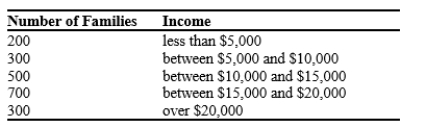 If the poverty rate in Inequalia is 25 percent, what is the poverty line in Inequalia?
 (Multiple Choice)
4.9/5 (69)
(69) The distribution of income for Dismal is as follows: 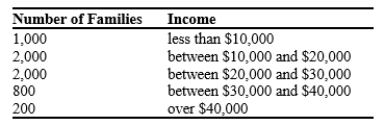 If the poverty rate in Dismal is 50 percent, what is the poverty line in Dismal?
 (Multiple Choice)
4.7/5 (68)
(68) Assume that the government proposes a negative income tax that calculates the taxes owed as follows: Taxes Owed = (1/3  Income) - 10,000. If a family doesn't earn any income, how does the negative income tax affect it?
 (Multiple Choice)
4.9/5 (67)
(67) Table 20-14
Income Inequality in the United States
The values in the table reflect the percentages of pre-tax-and transfer income.  Source: US Census Bureau
-Refer to Table 20-14. In percentage terms, how much less income did the bottom 40% of families have in 2010 than in 1980?
Source: US Census Bureau
-Refer to Table 20-14. In percentage terms, how much less income did the bottom 40% of families have in 2010 than in 1980? (Short Answer)
4.9/5 (69)
(69) What is one argument made by proponents of in-kind transfers over cash payments to the needy?
(Essay)
4.9/5 (76)
(76) The only qualification to receive government assistance under a negative income tax is
(Multiple Choice)
4.7/5 (81)
(81) 
Filters
- Essay(0)
- Multiple Choice(0)
- Short Answer(0)
- True False(0)
- Matching(0)