



 Chat with AI
Exam 20: Income Inequality and Poverty

Exam 1: Ten Principles of Economics455 Questions
Exam 2: Thinking Like an Economist643 Questions
Exam 3: Interdependence and the Gains From Trade547 Questions
Exam 4: The Market Forces of Supply and Demand693 Questions
Exam 5: Elasticity and Its Application626 Questions
Exam 6: Supply, Demand, and Government Policies668 Questions
Exam 7: Consumers, Producers, and the Efficiency of Markets547 Questions
Exam 8: Applications: the Costs of Taxation509 Questions
Exam 9: Application: International Trade521 Questions
Exam 10: Externalities543 Questions
Exam 11: Public Goods and Common Resources452 Questions
Exam 12: The Design of the Tax System664 Questions
Exam 13: The Costs of Production649 Questions
Exam 14: Firms in Competitive Markets604 Questions
Exam 15: Monopoly662 Questions
Exam 16: Monopolistic Competition649 Questions
Exam 17: Oligopoly522 Questions
Exam 18: The Markets for the Factors of Production592 Questions
Exam 19: Earnings and Discrimination511 Questions
Exam 20: Income Inequality and Poverty478 Questions
Exam 21: The Theory of Consumer Choice570 Questions
Exam 22: Frontiers in Microeconomics461 Questions
Exam 23: Measuring a Nation S Income547 Questions
Exam 24: Measuring the Cost of Living565 Questions
Exam 25: Production and Growth527 Questions
Exam 26: Saving, Investment, and the Financial System637 Questions
Exam 27: Tools of Finance534 Questions
Exam 28: Unemployment and Its Natural Rate701 Questions
Exam 29: The Monetary System540 Questions
Exam 30: Money Growth and Inflation504 Questions
Exam 31: Open-Economy Macroeconomics: Basic Concepts540 Questions
Exam 32: A Macroeconomic Theory of the Open Economy511 Questions
Exam 33: Aggregate Demand and Aggregate Supply572 Questions
Exam 34: The Influence of Monetary and Fiscal Policy on Aggregate Demand523 Questions
Exam 35: The Short-Run Tradeoff Between Inflation and Unemployment536 Questions
Exam 36: Six Debates Over Macroeconomic Policy354 Questions
Select questions type


Table 20-7 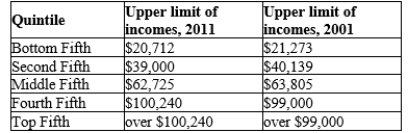 -Refer to Table 20-7. Which of the following is the best overall conclusion to draw from the data?
 (Multiple Choice)
4.8/5  (81)
(81) Which of the following pholitical philosophies would support redistribution of income that makes society fully egalitarian?
(Multiple Choice)
4.8/5 (83)
(83) A disadvantage associated with in-kind transfers to reduce poverty is that they
(Multiple Choice)
4.9/5 (74)
(74) The 2011 U.S. distribution of income shows that the top 5 percent of families have approximately what share of income?
(Multiple Choice)
4.8/5 (78)
(78) The distribution of income for Dismal is as follows: 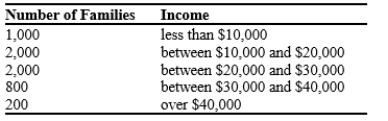 If the poverty rate in Dismal is about 17 percent, what is the poverty line in Dismal?
 (Multiple Choice)
4.7/5 (81)
(81) Suppose that a family saves and borrows to buffer itself against changes in income. These actions relate to which problem in measuring inequality?
(Multiple Choice)
4.9/5 (77)
(77) Temporary Assistance for Needy Families (TANF) and Supplemental Security Income (SSI) are examples of .
(Short Answer)
4.7/5 (85)
(85) Figure 20-2 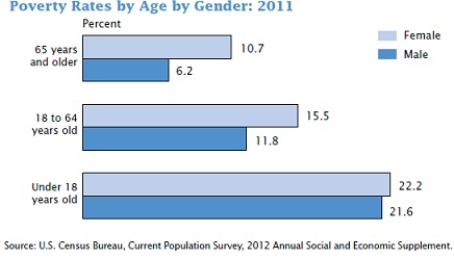 -Refer to Figure 20-2. Which of the following is consistent with the data reported in the figure?
 (Multiple Choice)
4.7/5 (79)
(79) Approximately what fraction of total income in the US economy comes from labor earnings?
(Short Answer)
4.7/5 (89)
(89) If the value of in-kind transfers are taken into account, the number of families living in poverty in the United States would
(Multiple Choice)
4.8/5 (88)
(88) If the U.S. government determines that the cost of feeding an urban family of four is $7,500 per year, then the official poverty line for a family of that type is
(Multiple Choice)
4.9/5 (73)
(73) Scenario 20-5
Suppose the government implemented a negative income tax and used the following formula to compute a family's tax liability:
Taxes owed = (1/4 of income) - $10,000
-Refer to Scenario 20-5. Below what level of income would families start to receive a subsidy from this negative income tax?
(Multiple Choice)
4.9/5 (89)
(89) Scenario 20-4
Suppose the government implemented a negative income tax and used the following formula to compute a family's tax liability:
Taxes owed = (1/5 of income) - $15,000
-Refer to Scenario 20-4. Below what level of income would families start to receive a subsidy from this negative income tax?
(Multiple Choice)
4.9/5 (80)
(80) When the government provides poor families with antipoverty programs such as welfare, Medicaid, food stamps, and the Earned Income Tax Credit which are all tied to income,
(Multiple Choice)
4.9/5 (79)
(79) 
Filters
- Essay(0)
- Multiple Choice(0)
- Short Answer(0)
- True False(0)
- Matching(0)