



 Chat with AI
Exam 20: Income Inequality and Poverty

Exam 1: Ten Principles of Economics455 Questions
Exam 2: Thinking Like an Economist643 Questions
Exam 3: Interdependence and the Gains From Trade547 Questions
Exam 4: The Market Forces of Supply and Demand693 Questions
Exam 5: Elasticity and Its Application626 Questions
Exam 6: Supply, Demand, and Government Policies668 Questions
Exam 7: Consumers, Producers, and the Efficiency of Markets547 Questions
Exam 8: Applications: the Costs of Taxation509 Questions
Exam 9: Application: International Trade521 Questions
Exam 10: Externalities543 Questions
Exam 11: Public Goods and Common Resources452 Questions
Exam 12: The Design of the Tax System664 Questions
Exam 13: The Costs of Production649 Questions
Exam 14: Firms in Competitive Markets604 Questions
Exam 15: Monopoly662 Questions
Exam 16: Monopolistic Competition649 Questions
Exam 17: Oligopoly522 Questions
Exam 18: The Markets for the Factors of Production592 Questions
Exam 19: Earnings and Discrimination511 Questions
Exam 20: Income Inequality and Poverty478 Questions
Exam 21: The Theory of Consumer Choice570 Questions
Exam 22: Frontiers in Microeconomics461 Questions
Exam 23: Measuring a Nation S Income547 Questions
Exam 24: Measuring the Cost of Living565 Questions
Exam 25: Production and Growth527 Questions
Exam 26: Saving, Investment, and the Financial System637 Questions
Exam 27: Tools of Finance534 Questions
Exam 28: Unemployment and Its Natural Rate701 Questions
Exam 29: The Monetary System540 Questions
Exam 30: Money Growth and Inflation504 Questions
Exam 31: Open-Economy Macroeconomics: Basic Concepts540 Questions
Exam 32: A Macroeconomic Theory of the Open Economy511 Questions
Exam 33: Aggregate Demand and Aggregate Supply572 Questions
Exam 34: The Influence of Monetary and Fiscal Policy on Aggregate Demand523 Questions
Exam 35: The Short-Run Tradeoff Between Inflation and Unemployment536 Questions
Exam 36: Six Debates Over Macroeconomic Policy354 Questions
Select questions type


Table 20-11
Poverty Thresholds in 2011, by Size of Family and Number of Related Children Under 18 Years
[Dollars] 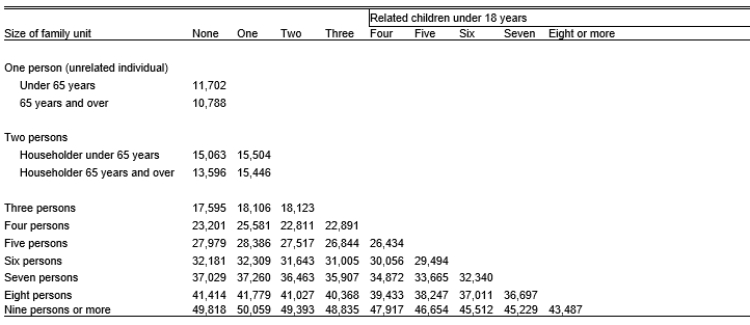 Source: U. S. Bureau of the Census, Current Population Survey.
-Refer to Table 20-11. What is the poverty line for a family of three with one child?
Source: U. S. Bureau of the Census, Current Population Survey.
-Refer to Table 20-11. What is the poverty line for a family of three with one child? (Multiple Choice)
4.9/5  (82)
(82) Table 20-10 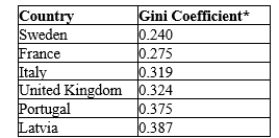 *A Gini coefficient is a commonly used measure of income inequality, with values between 0 and 1 (0 corresponds to perfect equality whereby everyone has exactly the same income, and 1 corresponds to perfect inequality where one person has all the income, while everyone else has zero income).
Source: The World Bank
-Refer to Table 20-10. Which country has the most equal income distribution?
*A Gini coefficient is a commonly used measure of income inequality, with values between 0 and 1 (0 corresponds to perfect equality whereby everyone has exactly the same income, and 1 corresponds to perfect inequality where one person has all the income, while everyone else has zero income).
Source: The World Bank
-Refer to Table 20-10. Which country has the most equal income distribution? (Multiple Choice)
5.0/5 (93)
(93) Table 20-13
The following table shows the distribution of income in Widgetapolis. 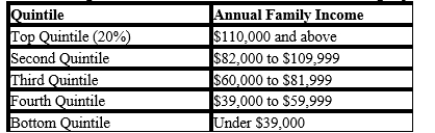
-Refer to Table 20-13. If the poverty rate is 33%, where is the poverty line in Widgetapolis?
-Refer to Table 20-13. If the poverty rate is 33%, where is the poverty line in Widgetapolis? (Multiple Choice)
4.9/5 (76)
(76) The Supplemental Security Income (SSI) program focuses on the poor who are sick or disabled.
(True/False)
4.8/5 (69)
(69) Table 20-14
Income Inequality in the United States
The values in the table reflect the percentages of pre-tax-and transfer income.  Source: US Census Bureau
-Refer to Table 20-14. In 2010, how many more percentage points of total income did the top fifth of the population earn compared to if the income distribution were completely equal?
Source: US Census Bureau
-Refer to Table 20-14. In 2010, how many more percentage points of total income did the top fifth of the population earn compared to if the income distribution were completely equal? (Short Answer)
4.9/5 (87)
(87) Figure 20-3 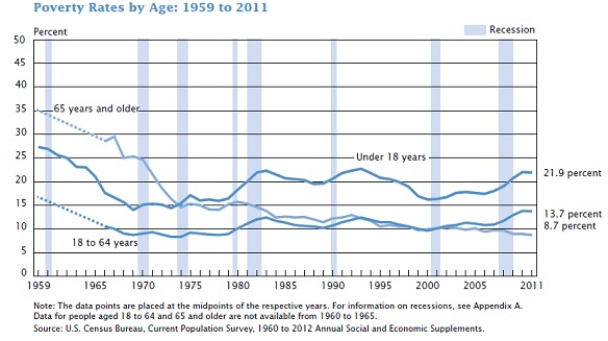 -Refer to Figure 20-3. Which of the following best describes the poverty rates by age from 1965 to 2011?
 (Multiple Choice)
4.9/5 (92)
(92) Based on U.S. data for 2011, the poverty rate is the highest for which group of people?
(Multiple Choice)
4.8/5 (75)
(75) Table 20-13
The following table shows the distribution of income in Widgetapolis.
-Refer to Table 20-13. If the poverty line were $19,915, what would be the poverty rate?
-Refer to Table 20-13. If the poverty line were $19,915, what would be the poverty rate? (Multiple Choice)
4.9/5 (79)
(79) In 2011, what percentage of U.S. families had income levels below $75,000?
(Multiple Choice)
5.0/5 (94)
(94) Table 20-14
James, Luke, Peter, Micah, and Sarah are the only five inhabits of Marketsville. The following table shows their income. 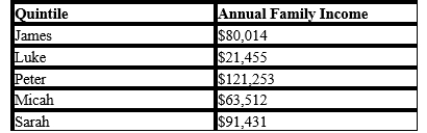
-Refer to Table 20-14. According to the table, what percentage of individuals in Marketsville have an income above $90,000?
-Refer to Table 20-14. According to the table, what percentage of individuals in Marketsville have an income above $90,000? (Multiple Choice)
5.0/5 (78)
(78) Which of the following is most likely to occur when the government enacts policies to make the distribution of income more equal?
(Multiple Choice)
4.7/5 (67)
(67) Which political philosophy believes that the government should equalize the incomes of all members of society?
(Multiple Choice)
4.9/5 (74)
(74) In 2011 the top 5 percent of income earners accounted for over 50% of all income received by United States' families.
(True/False)
4.7/5 (73)
(73) The United States has more income inequality than Japan, Germany, and France.
(True/False)
4.8/5 (87)
(87) A disadvantage of the Earned Income Tax Credit (EITC) program is that it does not help alleviate poverty due to unemployment, sickness, or other inability to work.
(True/False)
4.8/5 (78)
(78) Jermaine believes that it is important to maximize the well-being of the worst-off person in society. He believes in the principle called the .
(Short Answer)
4.8/5 (84)
(84) The poverty rate is the percentage of the population whose family income falls below an absolute level called the .
(Short Answer)
4.8/5 (70)
(70) According to the doctrine of liberalism, principles of justice are the result of
(Multiple Choice)
5.0/5 (64)
(64) Miguel is a 20 year old college student who works part-time and earns an annual income of $12,000. To smooth out his life cycle changes in income, Miguel can
(Multiple Choice)
4.8/5 (78)
(78) 
Filters
- Essay(0)
- Multiple Choice(0)
- Short Answer(0)
- True False(0)
- Matching(0)