



 Chat with AI
Exam 20: Income Inequality and Poverty

Exam 1: Ten Principles of Economics455 Questions
Exam 2: Thinking Like an Economist643 Questions
Exam 3: Interdependence and the Gains From Trade547 Questions
Exam 4: The Market Forces of Supply and Demand693 Questions
Exam 5: Elasticity and Its Application626 Questions
Exam 6: Supply, Demand, and Government Policies668 Questions
Exam 7: Consumers, Producers, and the Efficiency of Markets547 Questions
Exam 8: Applications: the Costs of Taxation509 Questions
Exam 9: Application: International Trade521 Questions
Exam 10: Externalities543 Questions
Exam 11: Public Goods and Common Resources452 Questions
Exam 12: The Design of the Tax System664 Questions
Exam 13: The Costs of Production649 Questions
Exam 14: Firms in Competitive Markets604 Questions
Exam 15: Monopoly662 Questions
Exam 16: Monopolistic Competition649 Questions
Exam 17: Oligopoly522 Questions
Exam 18: The Markets for the Factors of Production592 Questions
Exam 19: Earnings and Discrimination511 Questions
Exam 20: Income Inequality and Poverty478 Questions
Exam 21: The Theory of Consumer Choice570 Questions
Exam 22: Frontiers in Microeconomics461 Questions
Exam 23: Measuring a Nation S Income547 Questions
Exam 24: Measuring the Cost of Living565 Questions
Exam 25: Production and Growth527 Questions
Exam 26: Saving, Investment, and the Financial System637 Questions
Exam 27: Tools of Finance534 Questions
Exam 28: Unemployment and Its Natural Rate701 Questions
Exam 29: The Monetary System540 Questions
Exam 30: Money Growth and Inflation504 Questions
Exam 31: Open-Economy Macroeconomics: Basic Concepts540 Questions
Exam 32: A Macroeconomic Theory of the Open Economy511 Questions
Exam 33: Aggregate Demand and Aggregate Supply572 Questions
Exam 34: The Influence of Monetary and Fiscal Policy on Aggregate Demand523 Questions
Exam 35: The Short-Run Tradeoff Between Inflation and Unemployment536 Questions
Exam 36: Six Debates Over Macroeconomic Policy354 Questions
Select questions type


Goods and services given to the poor such as food stamps, housing vouchers, and medical services are called
(Short Answer)
4.8/5  (69)
(69) Raising total utility is the prime objective of which political philosophy?
(Multiple Choice)
4.8/5 (87)
(87) One existing government program that works much like a negative income tax is the Earned Income Tax Credit.
(True/False)
4.7/5 (80)
(80) Which two of the Ten Principles of Economics are illustrated in this chapter?
(Multiple Choice)
4.9/5 (88)
(88) Scenario 20-5
Suppose the government implemented a negative income tax and used the following formula to compute a family's tax liability:
Taxes owed = (1/4 of income) - $10,000
-Refer to Scenario 20-5. A family earning $110,000 before taxes would have how much after-tax income?
(Multiple Choice)
4.9/5 (77)
(77) Figure 20-3 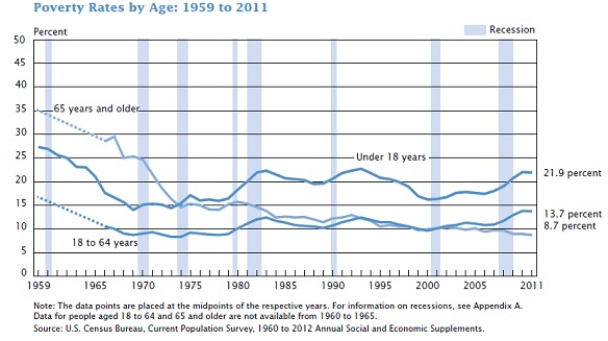 -Refer to Figure 20-3. In 1968, the percent of elderly aged 65 and over in poverty is
 (Multiple Choice)
4.9/5 (83)
(83) Table 20-11
Poverty Thresholds in 2011, by Size of Family and Number of Related Children Under 18 Years
[Dollars] 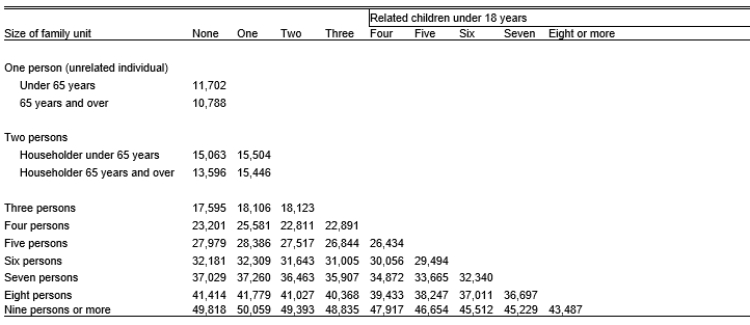 Source: U. S. Bureau of the Census, Current Population Survey.
-Refer to Table 20-11. What is the poverty line for a family of six with three children?
Source: U. S. Bureau of the Census, Current Population Survey.
-Refer to Table 20-11. What is the poverty line for a family of six with three children? (Multiple Choice)
4.8/5 (89)
(89) Robert Nozick criticizes Rawls's concept of justice by using an example of
(Multiple Choice)
4.9/5 (84)
(84) Economists who support minimum-wage legislation are likely to believe that the
(Multiple Choice)
4.9/5 (76)
(76) The table below reflects the levels of total utility received from income for each of four members of a society. 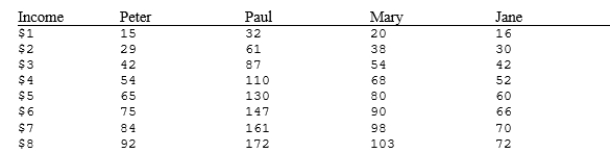 a.Assume that the society has the following income distribution:Peter $3Paul $7Mary $5Jane $3Is it possible for the government to increase total aggregate utility by redistributing income among members of society? Explain your answer.
b.Assume that the government has $19 to allocate among the four members of society. (Assume that no one has any income to start with.) If the government is interested in distributing income in a way that maximizes aggregate total utility, how should it distribute the $19 of income?
c.Does the table above describe a situation characterized by diminishing marginal utility? Explain your answer.
a.Assume that the society has the following income distribution:Peter $3Paul $7Mary $5Jane $3Is it possible for the government to increase total aggregate utility by redistributing income among members of society? Explain your answer.
b.Assume that the government has $19 to allocate among the four members of society. (Assume that no one has any income to start with.) If the government is interested in distributing income in a way that maximizes aggregate total utility, how should it distribute the $19 of income?
c.Does the table above describe a situation characterized by diminishing marginal utility? Explain your answer. (Essay)
4.8/5 (96)
(96) The statement that "measures of the distribution of income are based on money income" relates to which problem in measuring inequality?
(Multiple Choice)
4.8/5 (86)
(86) Scenario 20-7
Suppose the government implemented a negative income tax and used the following formula to compute a family's tax liability:
Taxes owed = (1/6 of income) - $24,000
-Refer to Scenario 20-7. A family earning $120,000 before taxes would have how much after-tax income?
(Multiple Choice)
4.8/5 (84)
(84) Table 20-1
The following table shows the distribution of income in Marysville. 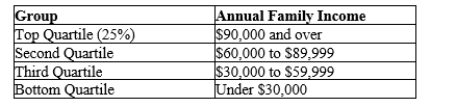 -Refer to Table 20-1. If the poverty line were $23,021, what would be the poverty rate?
 (Multiple Choice)
4.7/5 (74)
(74) The poverty line in the country of Abbyville is $15,000. The distribution of income for Abbyville is as follows: 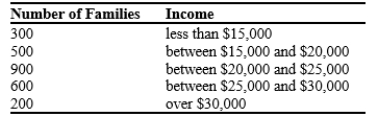 The poverty rate in Abbyville is
 (Multiple Choice)
5.0/5 (86)
(86) Assume that the government proposes a negative income tax that calculates taxes owed by the following formula,
Taxes Owed = (1/3  Income) - $10,000.
Compute the tax that would be owed given each level of income.
a.$120,000
b.$90,000
c.$60,000
d.$30,000
e.
$0
Income) - $10,000.
Compute the tax that would be owed given each level of income.
a.$120,000
b.$90,000
c.$60,000
d.$30,000
e.
$0 (Essay)
4.8/5 (72)
(72) 
Filters
- Essay(0)
- Multiple Choice(0)
- Short Answer(0)
- True False(0)
- Matching(0)